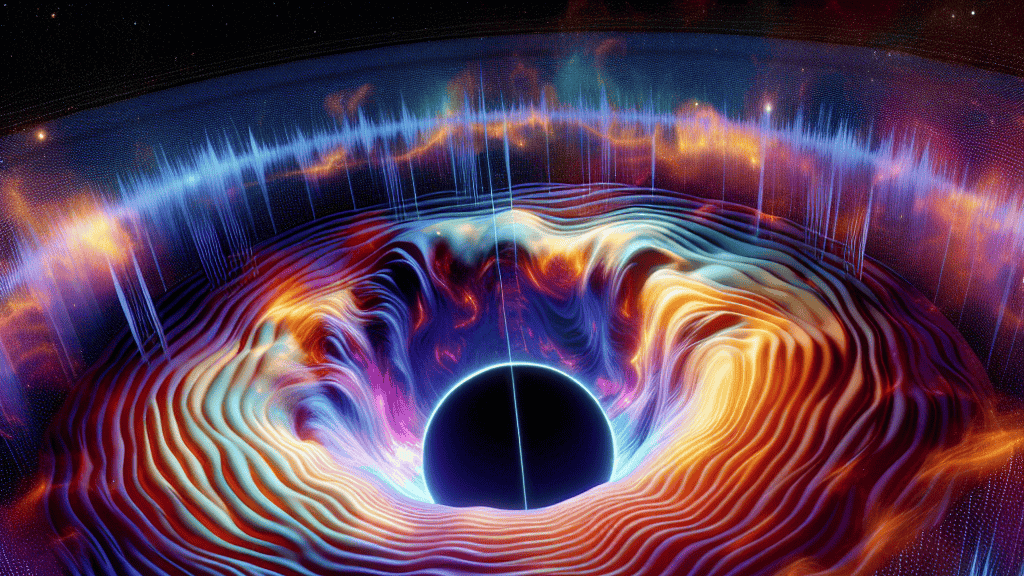
Did you know that black holes might have secrets to share not just through light, but sound? Picture a band playing its mysterious melody not in a concert hall, but in the arena of space. This is what scientists believe happens when black holes interact with the matter spiraling into them. They theorize that as material rushes into black holes, it creates ‘acoustic horizons’ – basically cosmic sound barriers that can tell us more about the universe’s mysteries.
Let’s delve into what these researchers are uncovering. They’ve been looking at how matter, when pulled into the gravitational maw of black holes, behaves and creates sound-like waves. These waves essentially form a kind of sound metric—an acoustic version of the event horizon that keeps anything from escaping a black hole’s pull. By using mathematics and the study of fluid dynamics, scientists construct models to simulate and understand these phenomena, offering a whole new way to look at cosmic events.
How could this possibly affect us here on Earth? Well, imagine if one day we could ‘hear’ the universe in ways we never thought possible before! These studies might enable future technologies to detect cosmic events earlier or even inspire new methods of communication across vast distances. Who knew that black holes could possibly become the instruments that help us tune into the rhythms of the universe?
Black holes don’t just absorb everything; they might also play a cosmic tune through gravitational waves!
FAQs
How do black holes create sound-like waves?
When matter falls into a black hole, the gravitational tension can create waves in the matter similar to sound waves in air. These are studied as ‘acoustic horizons’ in the field of analogue gravity.
What is an acoustic horizon?
Just like light cannot escape a black hole’s event horizon, sound-like waves cannot escape an acoustic horizon—a theoretical boundary within infalling matter in space.
Why is studying analogue gravity important?
It helps scientists understand complex cosmic phenomena without the need to observe direct gravitational events, offering new perspectives on how the universe works.
Can we really hear black holes?
Not in the traditional sense; the ‘sounds’ are theoretical waves that give scientists insights into the behaviors and properties of matter and gravity in space.
Could this research affect future technology?
Yes, understanding these phenomena could eventually lead to new technologies in space exploration and communication, expanding our abilities to monitor the universe.
Background
The study of analogue gravity involves using fluid dynamics and sound wave principles to simulate and understand gravitational phenomena in space. Black holes create intense gravitational fields that influence the behavior of nearby matter, leading to complex interactions whose dynamics can be likened to sound waves. These studies use pseudo-Schwarzschild potentials, which allow scientists to model black holes using simpler mathematics than exact solutions, making it easier to study their effects on infalling matter.
History
The concept of analogue gravity has been around for some time, with early studies drawing parallels between gravitational waves and sound waves in fluids. Over the years, researchers have developed more advanced mathematical models and simulations to understand these analogies. The current study builds on past work by applying multi-species relativistic equations of state to better simulate the behavior of matter around black holes, refining our understanding of these cosmic giants.
Based on “Gravity as emergent phenomena for spherically symmetric black hole accretion of multi-component flow with relativistic equation of state” by Tuhin Paul, Aishee Chakraborty, Souvik Ghose, Tapas K. Das, available on arXiv (arxiv.org/abs/2501.15676), used under CC BY 4.0 (creativecommons.org/licenses/by/4.0/).