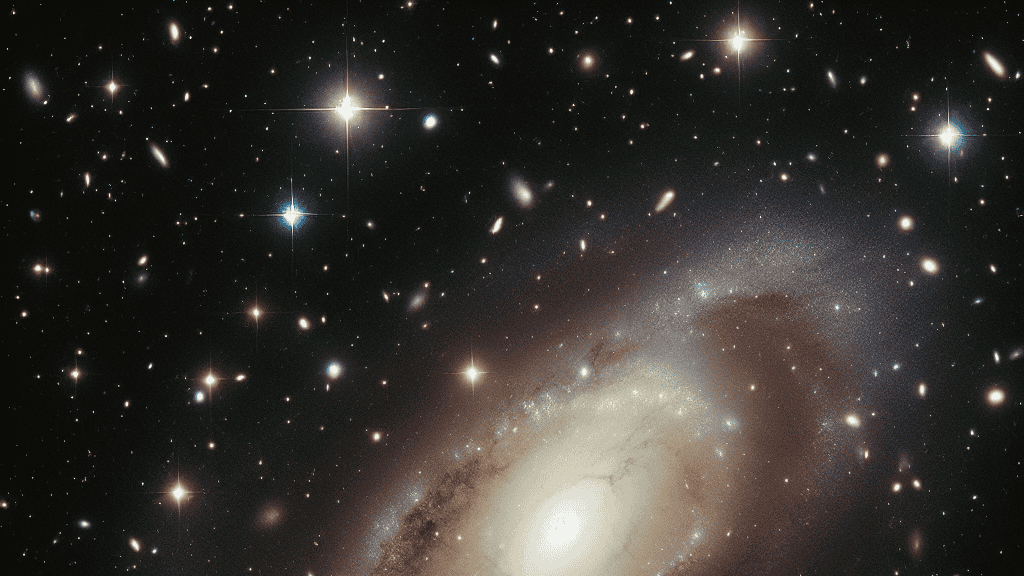
Imagine looking up at the night sky and realizing that somewhere in that vast expanse is a galaxy so faint and distant that it’s almost invisible even to the most powerful telescopes. That’s exactly what happened when scientists discovered a new, ultra-faint galaxy hiding in the constellation of Leo. This little galaxy has a low shine—less light than what the moon reflects off the Earth—making it a tough spot in our celestial neighborhood.
This discovery was made using the Dark Energy Camera, which can spot tiny differences in star density and revealed this hidden gem as a collection of stars packed together in an unexpected way. They confirmed the galaxy’s identity through careful observations and found it’s not only far—about 350,000 light-years away—but also larger than it seems at first glance. It’s classified as an ultra-faint dwarf galaxy, meaning it’s one of the smallest and least luminous members of our Milky Way’s family.
The real-world impact of discovering something so tiny on a cosmic scale might seem distant, but it plays a crucial role in understanding how galaxies form and evolve. It’s like finding a missing piece of a giant jigsaw puzzle that helps astronomers piece together how the Milky Way grew to its current grandeur. In the future, anyone looking up might wonder just what’s out there, waiting to be discovered next.
This galaxy is so faint that it emits less light than what a firefly emits in a dark field.
FAQs
What is an ultra-faint galaxy, and how was it discovered?
Ultra-faint galaxies are very dim and small, often containing few stars compared to larger galaxies. This particular galaxy was found using the Dark Energy Camera, which detected a cluster of stars in the Leo constellation that turned out to be this dim galaxy.
How far is the newly discovered Leo VI satellite galaxy?
The Leo VI galaxy is about 350,000 light-years away from us, making it quite distant, yet still a part of the Milky Way’s satellite galaxy system.
Why does finding a small galaxy matter for astronomy?
Discovering such galaxies helps astronomers understand the structure and formation of the Milky Way and other galaxies. It’s like finding pieces of a cosmic puzzle that reveal how galaxies grow over time.
What makes the Leo VI galaxy unique?
Leo VI is ultra-faint and nearly invisible, making it difficult to spot but crucial for understanding the diversity of galaxies in our universe. Its discovery adds to our knowledge of galactic development.
Background
The key concept here is the ultra-faint dwarf galaxy, a small celestial body with significantly fewer stars and much lower brightness compared to typical galaxies. These galaxies are important for understanding dark matter and galaxy formation, providing clues about the early universe’s conditions. Ultra-faint galaxies are often discovered by observing areas with an unusual concentration of stars, as detected by high-powered telescopes like the Dark Energy Camera.
History
The study of satellite galaxies around the Milky Way has evolved significantly over the past few decades. With technological advancements in telescopes, astronomers have discovered many small galaxies in our immediate cosmic neighborhood. Earlier, ultra-faint dwarf galaxies were nearly impossible to spot because of their low luminosity. The recent discovery of Leo VI builds on previous finds, further expanding our understanding of these enigmatic galaxies and the structure of the Milky Way.
Based on “A Pride of Satellites in the Constellation Leo? Discovery of the Leo VI Milky Way Satellite Galaxy with DELVE Early Data Release 3” by C. Y. Tan, W. Cerny, A. Drlica-Wagner, A. B. Pace, M. Geha, A. P. Ji, T. S. Li, M. Adamów, D. Anbajagane, C. R. Bom, J. A. Carballo-Bello, J. L. Carlin, C. Chang, Y. Choi, M. L. M. Collins, A. Doliva-Dolinsky, P. S. Ferguson, R. A. Gruendl, D. J. James, G. Limberg, M. Navabi, D. Martínez-Delgado, C. E. Martínez-Vázquez, G. E. Medina, B. Mutlu-Pakdil, D. L. Nidever, N. E. D. Noël, A. H. Riley, J. D. Sakowska, D. J. Sand, J. Sharp, G. S. Stringfellow, C. Tolley, D. L. Tucker, A. K. Vivas, available on arXiv (arxiv.org/abs/2408.00865), used under CC BY 4.0 (creativecommons.org/licenses/by/4.0/).