Connect with us

Search by keyword

General Relativity and Quantum Cosmology

Can We Avoid the Universe’s Big Crunch?

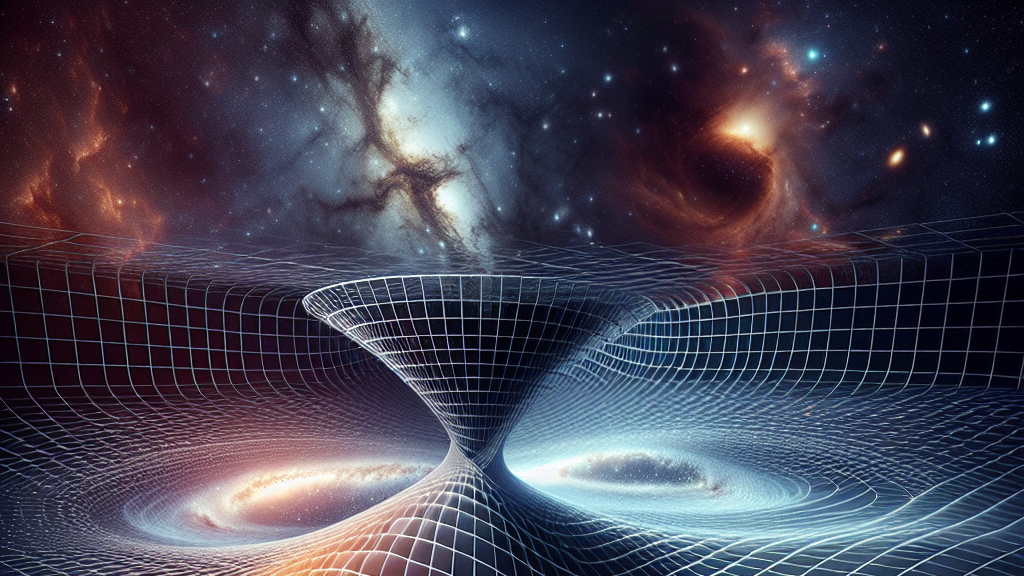
Scientists have found a way that our universe might keep its cool and avoid catastrophic endings, thanks to the mysterious Gauss-Bonnet scalar. This could mean the difference between everything staying ‘just fine’ and a spectacular cosmic crash.

Can We Avoid the Universes Big Crunch
✨Researched by humans. Explained by robots. Learn more.

Imagine if our universe had a self-preservation mode, a way to keep things stable and avoid the kind of cataclysmic ending you’d see in science fiction movies. This research delves into just that, exploring how certain mathematical scalars might save the universe from collapse or shredding apart. We don’t want a universe gone haywire, right?

Scientists considered a curious character called the ‘phantom scalar field’ mingling with the Gauss-Bonnet scalar in a calm, uncurved universe. They ran a bunch of tests with fancy math, using variables to analyze how these elements behave. What they found is pretty amazing—our universe could keep expanding without spiraling into any catastrophic endings. It’s like having a cosmic safety net!

While we might not see the impact of this research today, the idea of a universe that avoids total collapse or ripping apart is comforting. Imagine a future where we’re able to use this understanding to plan galaxies and interstellar travel, knowing the universe won’t suddenly decide to implode or explode. It’s the science fiction reality we might one day live in, and that’s pretty exciting.

The Gauss-Bonnet scalar is a mathematical concept that can help predict the universe’s stability, acting like a safety valve against cosmic disaster.

FAQs

What is a phantom scalar field in cosmology?

A phantom scalar field is a theoretical concept in cosmology that can lead to strange behaviors like negative energy densities, challenging our understanding of the universe’s structure and expansion.

How does the Gauss-Bonnet scalar affect the universe’s stability?

The Gauss-Bonnet scalar, when coupled with other fields, can prevent catastrophic events like the Big Crunch or Big Rip, acting as a stabilizer for the universe’s expansion.

What are Big Rip and Big Crunch singularities?

Big Rip and Big Crunch are theoretical endings of the universe: a Big Rip where everything tears apart, and a Big Crunch where everything collapses back into a singular point.

How could this research impact future space exploration?

Understanding universal stability can have long-term implications for planning future space travel, ensuring the universe remains a safe environment for interstellar exploration and habitation.

Is the concept of the Gauss-Bonnet scalar purely theoretical?

Yes, it is a mathematical concept that helps scientists explore and predict the dynamic behaviors of the universe, although it hasn’t been empirically observed yet.

Background

In the world of cosmology, researchers often use mathematical models to explore how the universe behaves. This study focuses on the FLRW geometry—a model of a universe that’s smooth, homogeneous, and flat. The Gauss-Bonnet scalar is a fascinating tool that can influence the universe’s dynamics. By understanding how this scalar interacts with the phantom scalar field, scientists are trying to predict whether certain catastrophic cosmic events, like the universe collapsing or tearing apart, are avoidable.

History

Cosmological models have long tried to describe the universe’s fate, with theories like the Big Bang leading to potential ends such as the Big Crunch or Big Rip. Previous groundbreaking research in cosmology often revolved around theories of expansion and contraction of the universe. This study builds on those ideas, using advanced mathematical tools to ensure such dire ends are less probable, offering a more stable cosmic narrative.

Based on “Avoiding Big Rip Singularities in Phantom Scalar Field theory with Gauss-Bonnet term” by Giannis Papagiannopoulos, Genly Leon, Andronikos Paliathanasis, available on arXiv (arxiv.org/abs/2501.18392), used under CC BY 4.0 (creativecommons.org/licenses/by/4.0/).

Trending

Latest

Can AI Save Water Discover How

Computers

AI is transforming the tech world, but it uses lots of water! A new tool, SCARF, helps us measure and reduce AI's water footprint,...

Whats a Forbush Decrease and Why Should We Care Whats a Forbush Decrease and Why Should We Care

Space

Scientists just observed the biggest solar storm event in years, revealing unexpected cosmic ray patterns. Understanding these changes could help us protect our technology...

Can Cars Spot Danger Faster Than Humans Can Cars Spot Danger Faster Than Humans

Computers

Think about how quickly you react when something unexpected happens on the road. This research brings us closer to creating self-driving cars that can...

Can Fear of the Other Stop Social Harmony Can Fear of the Other Stop Social Harmony

Physics

Fear of the unknown might make it harder for people to agree and get along. This study shows that when people have strong xenophobic...

Can AI Revolutionize Breast Cancer Diagnosis Can AI Revolutionize Breast Cancer Diagnosis

Electricity

This research introduces a groundbreaking AI model that can accurately assess HER2-positive breast cancer using widely accessible staining methods, potentially revolutionizing how we diagnose...

Can AI Transform Your Singing into a Choir Can AI Transform Your Singing into a Choir

Computers

Imagine singing solo and having AI turn you into a choir. This research unveils a groundbreaking AI tool that transforms your voice into rich...

You May Also Like

Space

This research is changing the game for how we see the universe using radio waves! It enlists the help of regular people and smart...

General Relativity and Quantum Cosmology

This study explores the possible fate of our universe—revealing that under certain conditions, it might one day collapse into a Big Bang-like singularity or...

Physics

Scientists are on a mission to discover if ghost-like particles called neutrinos could reveal astonishing insights about the universe. Using cutting-edge technology, they searched...

Space

Scientists are puzzled by the universe's changing speed, as it seems to be accelerating quickly at some points and slowing down at others. This...

Space

Our understanding of the universe's uniformity faces a serious challenge, as new findings suggest our cosmos might not be as smooth and even as...

Space

Tiny blue galaxies, like the one studied, may hold clues to the early universe, but there's a puzzling twist: their high-energy emissions hint at...

Physics

Scientists explore the fascinating possibility that our entire universe may have originated as a 'baby' universe. This intriguing idea not only aligns with existing...

Space

Some galaxy groups might be cosmic 'thieves,' picking up extra stars as they pass through clusters of galaxies. This discovery could change how we...

Physics

Is our universe truly curved, or could it be flat with a twist? This debate could reshape our understanding of reality, sparking curiosity about...

Copyright © 2024 8ig8rain.

Disclaimer: The content on 8ig8rain.com consists of AI-generated summaries of scientific abstracts from arXiv. Please note that most arXiv abstracts are preprints and may not have undergone formal peer review. While these summaries aim to convey key ideas and potential applications, they are provided for informational purposes only and should not be interpreted as validated scientific findings or professional advice. The summaries are intended to educate, spark curiosity, and inspire further exploration of science.