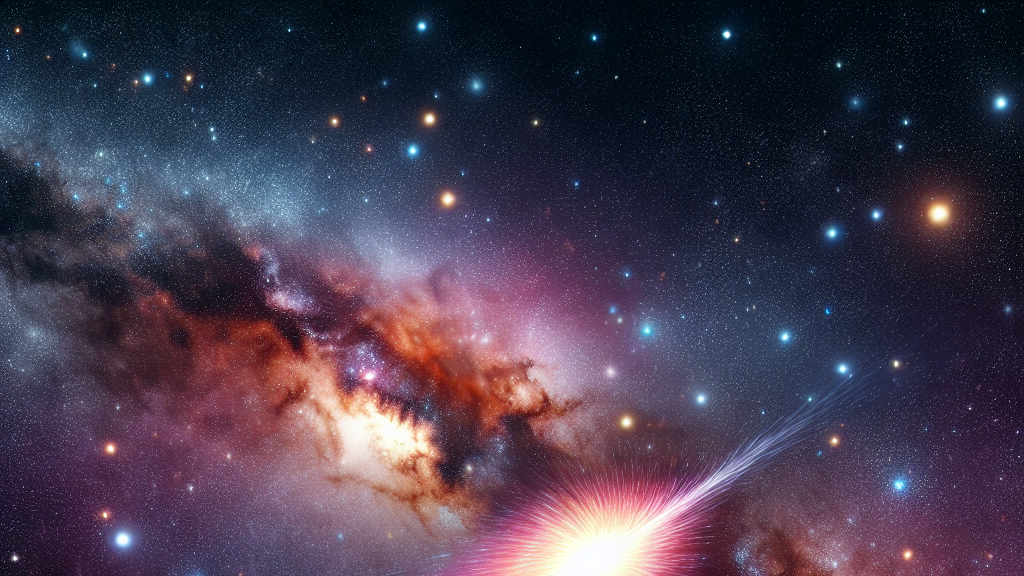
Did you know some stars are moving so fast across the universe that they escape their galaxy? Imagine a spaceship zooming off at incredible speeds due to a powerful push. That’s exactly what’s happening to some stars, thanks to a cosmic slingshot effect caused by supermassive black holes. Just like a bouncy ball sent flying after hitting the ground at high speed, these stars, known as hypervelocity stars, are sent soaring across space.
Scientists have now discovered that many of these fast-moving stars are not just escaping our Milky Way galaxy but also coming from its nearby neighbor, the Large Magellanic Cloud. Thanks to a powerful telescope survey and data from Gaia, researchers have traced back the paths of these stars, finding that half of them seem to have been launched from the Large Magellanic Cloud instead of the center of our galaxy. This discovery adds a new piece to the puzzle of how stars move across the universe.
Imagine if this research means we could eventually track star movements to predict cosmic events or understand galaxy formations better. These hypervelocity stars might even help us gauge how massive and influential hidden black holes are, particularly in galaxies like the Large Magellanic Cloud. Who knows? One day, we might see them as cosmic messengers, whispering the secrets of the universe back to us.
The fastest of these hypervelocity stars can travel at speeds over 300 kilometers per second!
FAQs
What are hypervelocity stars?
Hypervelocity stars are stars that travel at speeds so fast they can escape the gravitational pull of their home galaxy, often caused by interactions with supermassive black holes.
How were these hypervelocity stars discovered in the Large Magellanic Cloud?
Using data from the Gaia telescope and simulations, scientists traced the paths of several fast-moving stars, discovering they originated from the Large Magellanic Cloud rather than our own galaxy’s center.
Why do hypervelocity stars matter?
They help us understand galaxy dynamics, including interactions with supermassive black holes, and can provide clues to cosmic forces we can’t easily observe.
Can hypervelocity stars be seen from Earth?
While not visible to the naked eye, astronomers use powerful telescopes to study them and gather data critical for understanding the universe.
Are there practical applications to understanding hypervelocity stars?
Yes, insights into the paths of these stars could reveal information about galaxy formation, black hole properties, and the history of cosmic events.
Background
Hypervelocity stars are rare, fast-moving stars that can escape the grip of their home galaxy. This phenomenon occurs through the Hills mechanism, named after astronomer Jack G. Hills, which describes how a star can gain extreme speed from the gravitational forces of a supermassive black hole. When a binary star system, which is two stars orbiting each other, gets too close to a supermassive black hole, one star might be captured while the other is flung away at incredible speeds.
History
The study of hypervelocity stars began in earnest in the early 2000s after the first such star was discovered escaping the Milky Way. Since then, astronomers have sought to understand their origins and trajectories. The Gaia satellite, launched by the European Space Agency, has provided precise astrometric data, which has been crucial in mapping these stellar paths. Recent findings indicate a significant number of these stars originate from the Large Magellanic Cloud, a discovery that marks a significant shift in our understanding of galactic dynamics.
Based on “Hypervelocity Stars Trace a Supermassive Black Hole in the Large Magellanic Cloud” by Jiwon Jesse Han, Kareem El-Badry, Scott Lucchini, Lars Hernquist, Warren Brown, Nico Garavito-Camargo, Charlie Conroy, Re’em Sari, available on arXiv (arxiv.org/abs/2502.00102), used under CC BY 4.0 (creativecommons.org/licenses/by/4.0/).