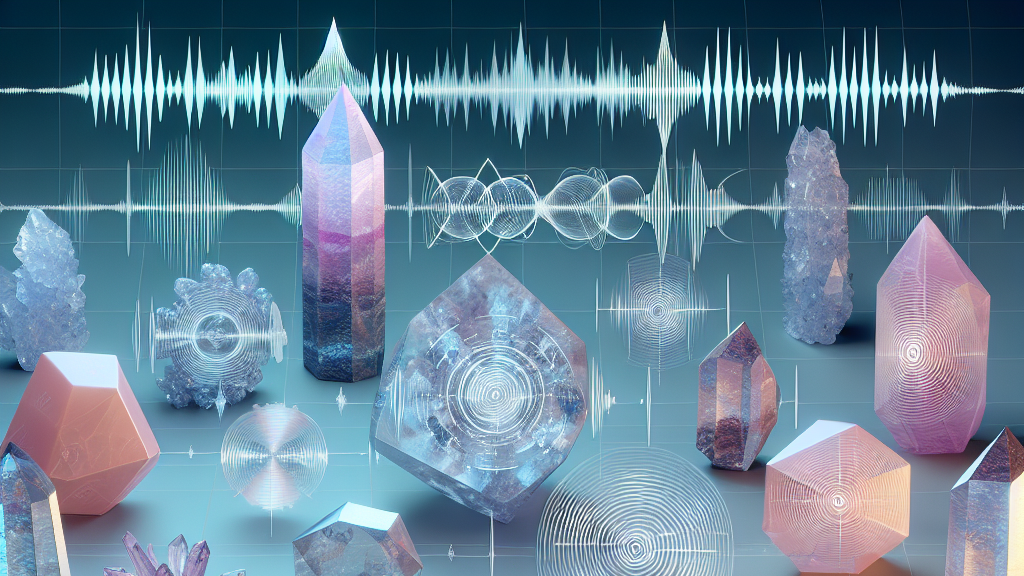
Have you ever wondered if different shaped objects can produce the same sound waves? Imagine this: two drums of different shapes vibrating identically. This mind-bending idea extends into the world of crystals, and scientists are exploring just that! They want to know whether crystals with different shapes can have identical vibrational modes, or in simpler terms, if these crystals can produce the same ‘sound’. This intriguing question taps into a famous puzzle once posed: ‘Can you hear the shape of a drum?’
Researchers are delving deeper into this mystery by looking at the specific arrangements of atoms in crystals, known as lattice structures, across different dimensions. They want to find out the minimum number of atoms needed in these arrangements to see if two seemingly different structures can share the same ‘notes’. They’ve discovered that with just a few particles in one, two, and three-dimensional spaces, crystals can indeed possess these shared characteristics.
Imagine in the future, we could design materials with tailored properties by simply changing how atoms are arranged. This could revolutionize technology, allowing us to craft materials that behave identically even if they look different at a microscopic level. From creating more efficient solar panels to developing stronger building materials, understanding these unique vibrational symmetries could unlock endless possibilities!
Crystals can ‘sing’ the same tune even if they’re shaped differently!
FAQs
What is isospectrality in the context of crystal structures?
Isospectrality refers to different crystal structures having the same set of vibration modes or ‘spectra’. This means that despite their differing shapes, they can essentially produce the same ‘sound’.
How does the research determine minimum particle bases for isospectral crystals?
Researchers use rigorous mathematical approaches and precise numerical algorithms to identify the smallest number of particles in a crystal’s structure that can still share the same vibrational properties as another, different structure.
Why is the study of isospectral crystals significant?
Understanding isospectral crystals can significantly impact material sciences by allowing the development of materials with targeted properties. This can lead to innovative advancements in technology, including improved energy efficiency and stronger construction materials.
Background
The study of isospectrality revolves around understanding how different structures can have identical sets of eigenvalues, or spectra. In simpler terms, it’s like figuring out how different instruments can play the same note. In mathematics and physics, this concept is explored through the Laplacian operator, which essentially analyzes vibrations or modes of a given shape or structure.
History
The concept of isospectrality extends from a historical mathematical puzzle known as ‘Can you hear the shape of a drum?’. This question originated from the study of how different geometric shapes can produce identical acoustic signatures or vibrational sounds. Over time, this inquiry has expanded beyond simple shapes to more complex structures like crystals in multiple dimensions.
Based on “Can one hear the shape of a crystal?” by Haina Wang, Salvatore Torquato, available on arXiv (arxiv.org/abs/2502.02819), used under CC BY 4.0 (creativecommons.org/licenses/by/4.0/).