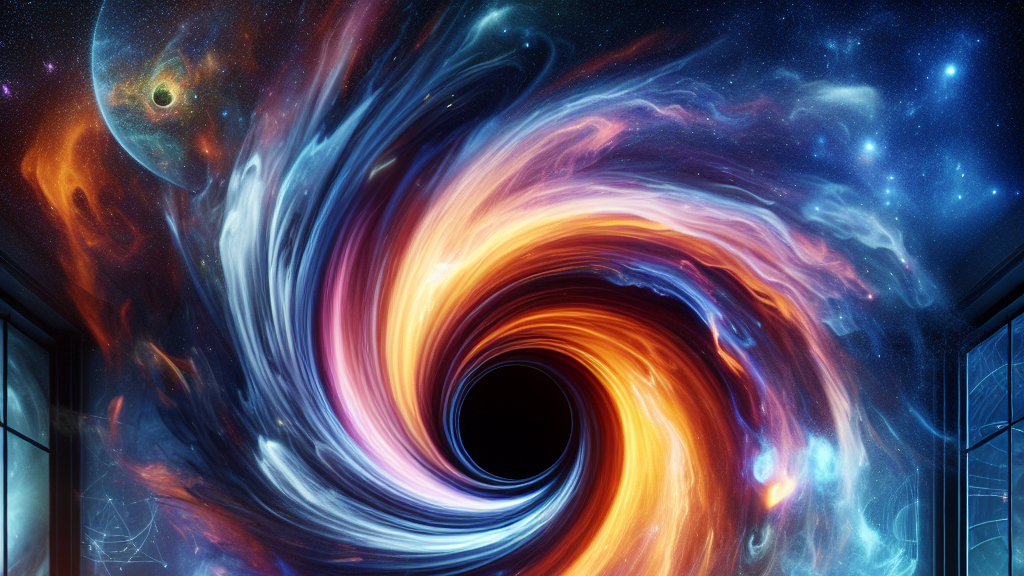
What if everything you thought you knew about black holes was flipped on its head? Traditionally, it’s been believed that once something enters a black hole, any information it carried was lost forever. This puzzling concept, known as the information paradox, has baffled scientists for decades and went against some fundamental aspects of physics.
Recent research suggests a groundbreaking shift in our understanding. By revisiting Hawking’s original work, which indicated that absorbed information was destroyed, researchers found he had overlooked an essential piece. According to Einstein’s theory, the natural process of radiation emission should also include a ‘stimulated’ component, not just the spontaneous radiation that Hawking described. By including this ‘missing’ piece, scientists calculated that black holes are not information blackouts but instead have the capacity to transmit information back out into the universe.
So, why does this matter to you? Imagine the universe like a giant library; black holes were thought to be where some books disappeared forever. But now, it turns out those ‘books’ might just be on a different shelf, still accessible and readable. This insight reshapes our understanding of the universe’s most mysterious objects and opens up new possibilities for future space exploration and technology, possibly affecting everything from cosmic studies to how we approach information theory on Earth.
Did you know that black holes are actually not completely black? Hawking radiation, a faint glow from black holes, holds the key to solving the information paradox.
FAQs
What is the black hole information paradox?
The black hole information paradox is a scientific dilemma suggesting that information that falls into a black hole is lost forever, contradicting the laws of physics that state information must be conserved.
How does stimulated emission change our understanding of black holes?
Incorporating stimulated emission into black hole theory shows that information absorbed by a black hole can actually be recovered, challenging the idea that black holes are information erasers.
What role did Einstein’s theory play in this research?
Einstein’s theory of blackbody radiation indicates that radiation should include both spontaneous and stimulated emissions. The new research highlights how considering both changes our understanding of black holes and information transmission.
Why is this discovery about black holes important?
This discovery could transform our understanding of the universe, affecting how black holes are perceived and potentially leading to new advancements in space exploration and information technology.
How could this research impact everyday life?
This research could redefine our approach to information technology and data storage, with practical applications in developing more efficient technologies and systems.
Background
Black holes are dense celestial objects with gravitational pulls so strong that not even light can escape. Traditionally, it has been debated whether information that falls into black holes is permanently lost, known as the information paradox. Hawking radiation, proposed by Stephen Hawking, is the theoretical emission of radiation from black holes, suggesting they aren’t entirely ‘black.’ This study revisits those notions by adding a layer of ‘stimulated’ emissions, which are natural according to Einstein’s theory of blackbody radiation, but were initially overlooked.
History
In the 1970s, Stephen Hawking introduced the theory that black holes emit radiation (Hawking radiation), suggesting they could eventually evaporate and disappear, taking any captured information with them. This posed a challenge to the principle that physical information should never be lost. Einstein’s earlier work on stimulated emission laid the groundwork for understanding how radiation might behave, but it wasn’t until now that researchers reconsidered this part of the theory to address the paradox.
Based on “Paradox No More: How Stimulated Emission of Radiation Preserves Information Absorbed by Black Holes” by Christoph Adami, available on arXiv (arxiv.org/abs/2502.05642), used under CC BY 4.0 (creativecommons.org/licenses/by/4.0/).