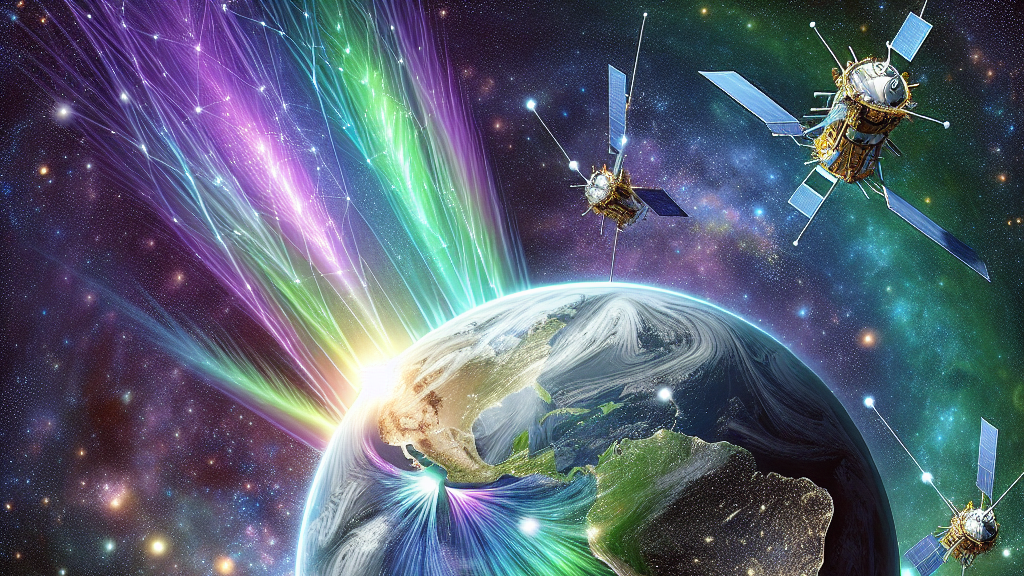
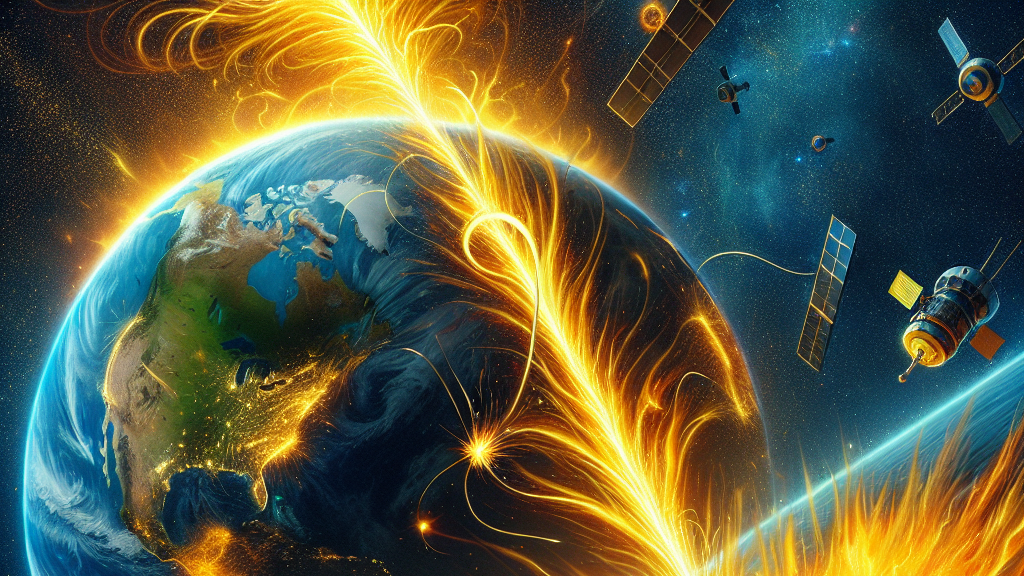
Imagine if we could predict powerful solar storms that can disrupt our technology on Earth. Scientists are getting closer to cracking that code! These solar storms are caused by massive eruptions from the Sun called coronal mass ejections (CMEs), which can send shockwaves through space and affect us here on Earth.
Researchers have been tracking these CMEs and their effects on the interplanetary magnetic field—think of it like the invisible blanket of magnetism around our planet. By using data from spacecraft positioned just in the right spot, like STEREO-A and ACE, scientists were able to catch a CME shockwave almost three hours before it hit Earth. This early detection is crucial because it could buy us precious time to protect our satellites and power grids from the storm’s impact.
If we can fine-tune this prediction method, it would transform how we prepare for solar storms. Imagine getting an early warning that one of these storms is coming, allowing governments and businesses to safeguard our technology. It could mean fewer power outages, safer air travels, and even protection for astronauts in space. This research is like having a solar weather forecast—and the possibilities for using it in daily life are electrifying!
Did you know that solar storms can cause colorful auroras and also knock out power grids on Earth?
FAQs
How do solar storms affect Earth?
Solar storms, like those caused by coronal mass ejections, can disrupt Earth’s magnetic field, leading to power grid failures, communication issues, and even beautiful auroras.
What are coronal mass ejections (CMEs)?
CMEs are massive bursts of solar wind and magnetic fields rising above the solar corona or released into space. They are a major cause of solar storms.
How do spacecraft help in predicting solar storms?
Spacecraft like STEREO-A and ACE provide valuable data on the solar wind’s magnetic field, allowing scientists to predict the timing and impact of solar storms on Earth.
How quickly can solar storms reach Earth?
Solar storms can travel at speeds up to 710 kilometers per second, potentially reaching Earth within one to three days after leaving the Sun.
Why is predicting solar storms important?
Accurate predictions allow us to take preventive measures to protect sensitive technology and infrastructure from being damaged by intense solar activity.
Background
Solar storms are caused by coronal mass ejections (CMEs), which are explosive bursts of solar wind and magnetic fields that can interact with Earth’s magnetosphere. The interplanetary magnetic field is a key factor in how these storms impact us. Scientists use spacecraft data to measure the strength and direction of these magnetic fields to predict geomagnetic activity on Earth.
History
The study of solar storms began with the observation of auroras and magnetic disturbances on Earth. With the advent of space exploration, spacecraft like ACE and STEREO have provided direct measurements of the solar wind, allowing scientists to better understand and predict solar activity. This research builds on decades of studies that focus on improving space weather forecasting using upstream monitors.
Based on “First observations of a geomagnetic superstorm with a sub-L1 monitor” by Eva Weiler (Austrian Space Weather Office, GeoSphere Austria, Graz, Austria), Christian Möstl (Austrian Space Weather Office, GeoSphere Austria, Graz, Austria), Emma E. Davies (Institute of Physics, University of Graz, Graz, Austria), Astrid Veronig (Institute of Physics, University of Graz, Graz, Austria), Ute V. Amerstorfer (Austrian Space Weather Office, GeoSphere Austria, Graz, Austria), Tanja Amerstorfer (Austrian Space Weather Office, GeoSphere Austria, Graz, Austria), Justin Le Louédec (Austrian Space Weather Office, GeoSphere Austria, Graz, Austria), Maike Bauer (Austrian Space Weather Office, GeoSphere Austria, Graz, Austria), Noé Lugaz (Space Science Center and Department of Physics and Astronomy, University of New Hampshire, Durham, NH, USA), Veronika Haberle (Conrad Observatory, GeoSphere Austria, Vienna, Austria), Hannah T. Rüdisser (Austrian Space Weather Office, GeoSphere Austria, Graz, Austria), Satabdwa Majumdar (Austrian Space Weather Office, GeoSphere Austria, Graz, Austria), Martin Reiss (Community Coordinated Modeling Center, NASA Goddard Space Flight Center, Greenbelt, MD, USA), available on arXiv (arxiv.org/abs/2411.12490), used under CC BY 4.0 (creativecommons.org/licenses/by/4.0/).