Connect with us

Search by keyword

Physics

Could Space Weather Crash Satellites?

This research reveals how wild changes in space weather can make satellites fall faster to Earth, impacting how our tech works up in space.

Could Space Weather Crash Satellites
✨Researched by humans. Explained by robots. Learn more.

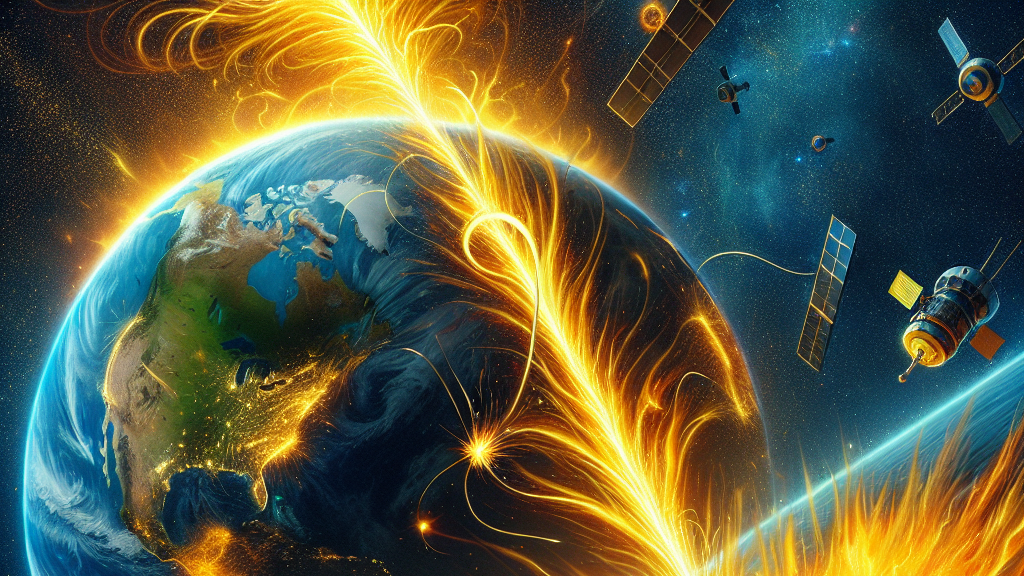
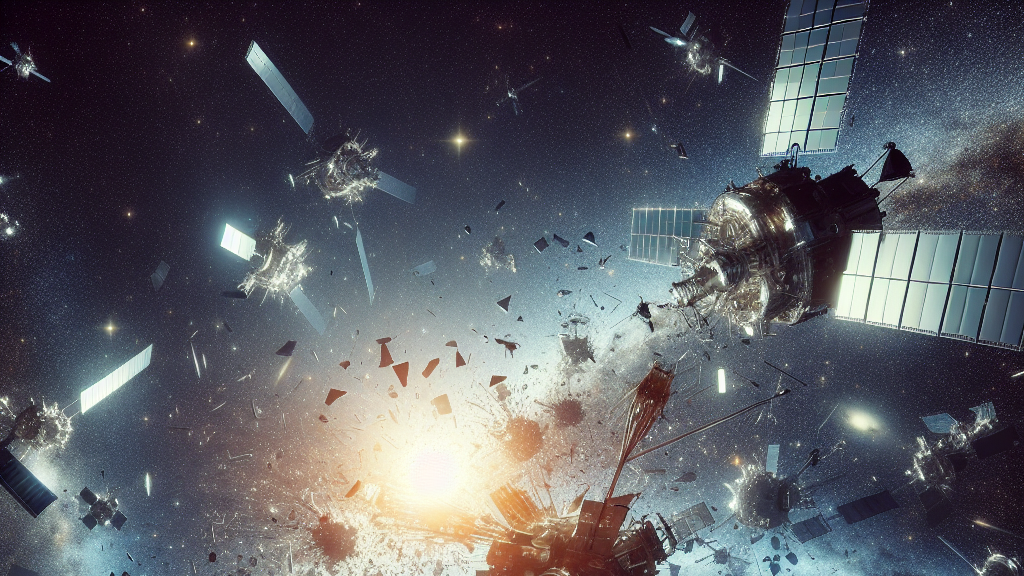
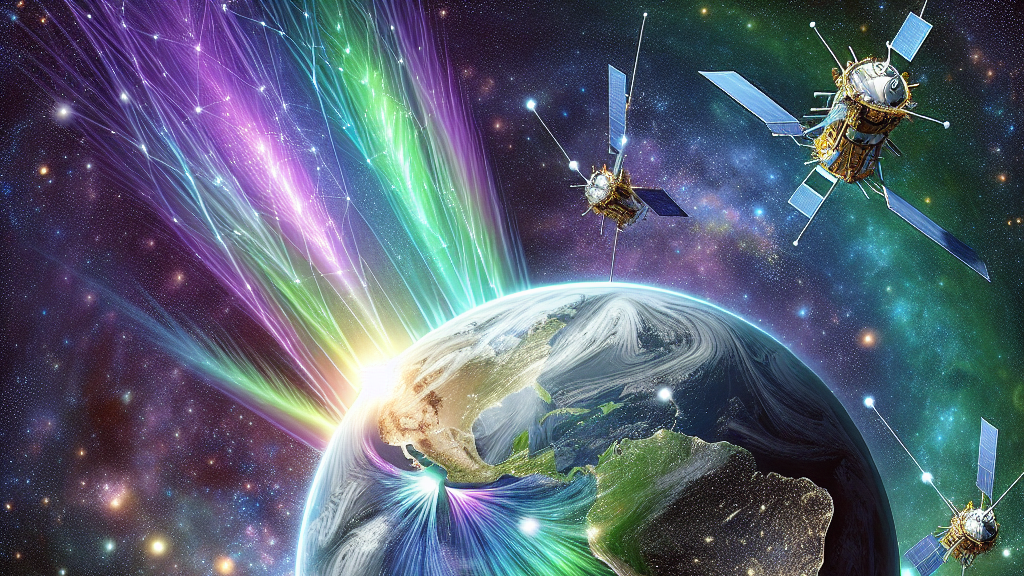
Imagine if our technology in space, like the Starlink satellites, could suddenly fall out of the sky. Sounds crazy, right? Yet, this could happen because of wild space weather. Recently, scientists found that a significant storm in space led to some Starlink satellites experiencing faster orbital decay, meaning they are dropping closer to Earth than expected.

During a stormy period in early May 2024, scientists observed 10 Starlink satellites behaving unusually, with their orbits shrinking faster than anticipated. By studying these changes, they found a connection to an increase in the density of the atmosphere due to geomagnetic storms and extreme conditions, like more strong ultraviolet light from the Sun. Surprisingly, two satellites that were hanging out at lower altitudes didn’t seem bothered by these big changes.

In practical terms, this research might help us design better satellite technologies that could withstand these extreme weather conditions. It also suggests the need for more precise tracking and prediction methods, which would be crucial for ensuring the continued operation and safety of our space technologies. Just as we plan for storms on Earth, this is about forecasting storms in space.

Did you know that storms in space can cause satellites to plummet closer to Earth?

FAQs

How does space weather impact satellites?

Space weather, such as geomagnetic storms, increases the density of the thermosphere, causing satellites to plummet closer to Earth.

Why was the decay rate of Starlink satellites unusual during April and May 2024?

The decay rate of Starlink satellites was unusual due to a spike in the O/N2 ratio and an increase in Extreme Ultra Violet (EUV) flux, as well as geomagnetic storms influencing their orbits.

Why were some Starlink satellites unaffected by space weather?

Two lower-altitude Starlink satellites were unaffected because their orbits did not experience the same environmental conditions that increased decay rates for higher-altitude satellites.

What is the O/N2 ratio and why does it matter?

The O/N2 ratio refers to the ratio of atomic oxygen to nitrogen molecules. Changes in this ratio can affect atmospheric density and thus influence satellite orbits.

Can this research help improve satellite technology?

Yes, by understanding how space weather affects satellites, scientists can design better technology to withstand these conditions, improving satellite longevity and performance.

Background

This research dives into how the atmosphere around Earth, including its density, can change when affected by space weather like geomagnetic storms. These storms occur when energy from the Sun interacts with Earth’s magnetic field, sometimes causing the thermosphere to become denser, which can drag satellites downwards, causing them to lose altitude more quickly.

History

Space weather research has evolved significantly over the years, with earlier studies focusing on understanding the sun’s cycles and their effects on Earth. As satellite technology advanced, scientists began investigating how these space weather events could impact satellite operations. This study builds on past work by examining the nuances of how different atmospheric factors, like EUV flux, specifically affect satellite decay.

Based on “Loss of 12 Starlink Satellites Due to Pre-conditioning of Intense Space Weather Activity Surrounding the Extreme Geomagnetic Storm of 10 May 2024” by Ayisha M Ashruf, Ankush Bhaskar, C Vineeth, Tarun Kumar Pant, Ashna V M, available on arXiv (arxiv.org/abs/2410.16254), used under CC BY 4.0 (creativecommons.org/licenses/by/4.0/).

Trending

Latest

Can AI Save Water Discover How

Computers

AI is transforming the tech world, but it uses lots of water! A new tool, SCARF, helps us measure and reduce AI's water footprint,...

Whats a Forbush Decrease and Why Should We Care Whats a Forbush Decrease and Why Should We Care

Space

Scientists just observed the biggest solar storm event in years, revealing unexpected cosmic ray patterns. Understanding these changes could help us protect our technology...

Can Cars Spot Danger Faster Than Humans Can Cars Spot Danger Faster Than Humans

Computers

Think about how quickly you react when something unexpected happens on the road. This research brings us closer to creating self-driving cars that can...

Can Fear of the Other Stop Social Harmony Can Fear of the Other Stop Social Harmony

Physics

Fear of the unknown might make it harder for people to agree and get along. This study shows that when people have strong xenophobic...

Can AI Revolutionize Breast Cancer Diagnosis Can AI Revolutionize Breast Cancer Diagnosis

Electricity

This research introduces a groundbreaking AI model that can accurately assess HER2-positive breast cancer using widely accessible staining methods, potentially revolutionizing how we diagnose...

Can AI Transform Your Singing into a Choir Can AI Transform Your Singing into a Choir

Computers

Imagine singing solo and having AI turn you into a choir. This research unveils a groundbreaking AI tool that transforms your voice into rich...

You May Also Like

Space

Scientists have uncovered why some small galaxies are born without stars. It turns out, they lack the dense gas needed for star formation, thanks...

Space

This research unveils how solar storms and space weather can influence satellite orbits, leading to a shorter life for these crucial technologies. It highlights...

Space

Researchers discovered that Starlink satellites are causing unexpected radio wave emissions that could interfere with vital communication and astronomy tools. This matters because uninterrupted...

Physics

Quantum networks promise ultra-secure internet by using drones and satellites to form connections previously confined to the ground, potentially revolutionizing the way we communicate.

Electricity

Did you know that satellites, which help keep your world connected, could potentially be used to disrupt those very connections? This study explores how...

Space

Discover how clouds on distant planets might change daily, much like Earth's weather, revealing new insights into their atmospheres.

Space

Imagine giant alien-built satellite swarms collecting energy from stars—sounds amazing, right? But these space wonders need constant fixing to last, just like your smartphone...

Space

TRAPPIST-1e, a planet much like Earth, could potentially support life if its magnetic field is strong enough to handle space weather. If we learn...

Space

TRAPPIST-1e, an Earth-like planet in the nearby TRAPPIST-1 system, may support life thanks to its magnetic field. Scientists are exploring how this magnetic shield...

Copyright © 2024 8ig8rain.

Disclaimer: The content on 8ig8rain.com consists of AI-generated summaries of scientific abstracts from arXiv. Please note that most arXiv abstracts are preprints and may not have undergone formal peer review. While these summaries aim to convey key ideas and potential applications, they are provided for informational purposes only and should not be interpreted as validated scientific findings or professional advice. The summaries are intended to educate, spark curiosity, and inspire further exploration of science.