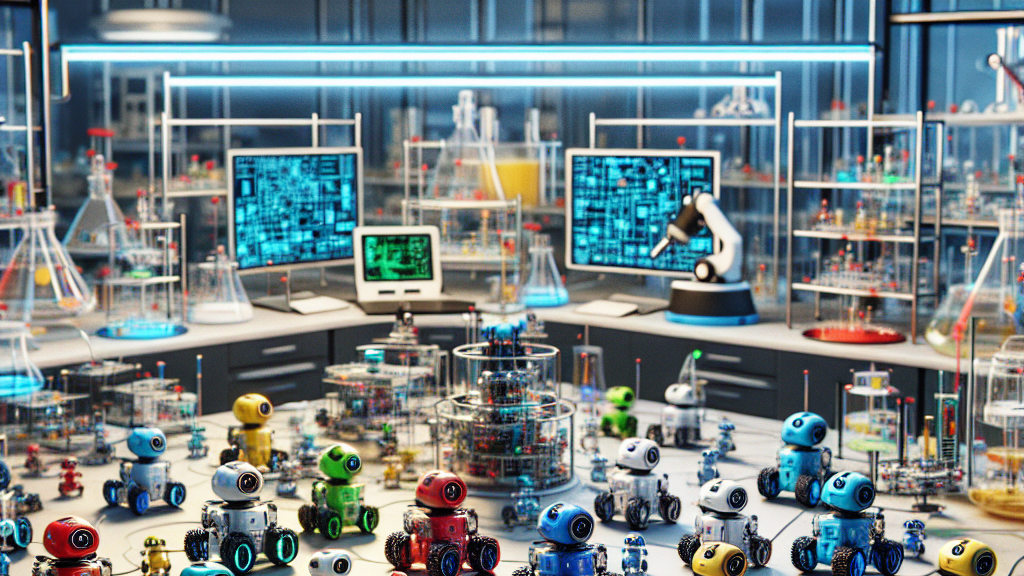
Imagine a future where tiny robots can think together like a hive of bees, coordinating without human instructions to tackle challenges in real life. That future might be closer than you think! In a recent study, researchers have developed a method that allows swarms of robots to discover and develop new behaviors by themselves. This is achieved through a clever blend of artificial intelligence and simulation, where the robots learn and practice these behaviors in a virtual world before trying them in the real world.
The magic behind this discovery is a process called ‘Real2Sim2Real Behavior Discovery.’ It’s like teaching a robot to learn a dance in a virtual school before it performs on a real stage. The researchers used an innovative technique called self-supervised representation learning combined with novelty search. This allows the robots to explore different ways of acting, without needing humans to guide them. What’s truly fascinating is that once these behaviors are discovered in simulation, they can be smoothly transferred to actual robots. This was tested on a low-cost, open-source robotic platform to ensure that it’s accessible and practical for real-world use.
Think about the potential applications! Imagine deploying a swarm of robots to a disaster site, where they can figure out how to navigate through rubble to find survivors on their own. Or picture them working together on a vast farm, efficiently planting crops without needing constant human oversight. These robots could tackle complex, large-scale problems that would be too difficult for humans alone. This kind of autonomous problem-solving can revolutionize industries and improve safety and efficiency in many areas of life.
Did you know? The idea of robots learning from each other is inspired by how ants or bees communicate and solve tasks, turning simple individual actions into complex group behaviors!
FAQs
How do robot swarms discover new behaviors?
In this research, robot swarms discover new behaviors by using Real2Sim2Real Behavior Discovery. This innovative approach combines simulation, representation learning, and novelty search to allow robots to explore and learn new behaviors automatically without constant human guidance.
What makes Real2Sim2Real different from previous methods?
Real2Sim2Real is unique because it successfully transfers learned behaviors from simulation to real robots, something previous methods struggled to achieve. It uses self-supervised representation learning to more accurately represent the space of possible behaviors, enabling practical deployment on real-world platforms.
What are the potential real-world applications of robot swarm behavior discovery?
Robot swarm behavior discovery can be applied in various fields, such as search-and-rescue missions, agriculture, environmental monitoring, and even urban planning. By automating complex tasks, these robots can increase efficiency and safety in operations that are challenging or hazardous for humans.
Why is it important for robots to discover behaviors independently?
Allowing robots to discover behaviors independently increases their adaptability and efficiency. It reduces the need for constant human oversight and programming, allowing robots to better respond to unforeseen challenges or dynamic environments in real-time.
How do robots perform these behavior discoveries in practice?
In practice, robots discover behaviors by first using simulation to explore various possible actions. With self-supervised learning, robots identify novel behaviors, which are then tested in a lightweight simulator to address the reality gap before being transferred to actual robots for real-world deployment.
Background
Swarm robotics focuses on creating groups of simple robots that can work together to perform tasks without centralized control, much like ants working together in a colony. The idea is that individually simple robots can achieve complex objectives by leveraging their numbers and coordination. Representation learning is an AI technique that helps robots understand and interpret data about their environment, while novelty search encourages exploring new solutions instead of optimizing known ones.
History
Early work in swarm intelligence took inspiration from biological systems, such as the collective behavior of ants or bees. Previous studies primarily focused on simulation, where behaviors were manually designed or required significant human intervention to evolve. The novelty of this study lies in its blend of representation learning and simulation, enabling a direct transition of learned behaviors from virtual environments to tangible, real-world applications.
Based on “Discovery and Deployment of Emergent Robot Swarm Behaviors via Representation Learning and Real2Sim2Real Transfer” by Connor Mattson, Varun Raveendra, Ricardo Vega, Cameron Nowzari, Daniel S. Drew, Daniel S. Brown, available on arXiv (arxiv.org/abs/2502.15937), used under CC BY 4.0 (creativecommons.org/licenses/by/4.0/).