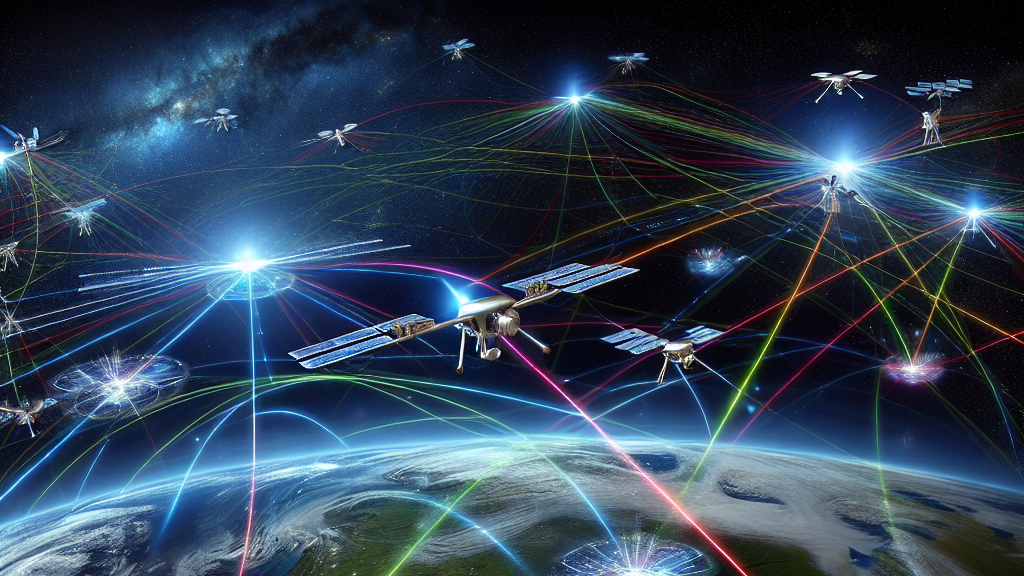
Imagine a world where drones can instantly become expert navigators, weaving through complex environments without needing to practice first. Sounds like science fiction, right? Well, researchers have developed a new way for drones to learn navigation using a simulator so advanced that the drones can transfer their ‘skills’ directly to real life with zero practice. This means faster, more efficient, and safer drones that can work right out of the box.
The breakthrough comes from a simulator called FiGS, which uses a simple model for drone movements combined with super-realistic scene reconstructions. It allows the collection of thousands of image-action pairs in a controlled environment. The drones use this data to train a lightweight neural network (or brain), which processes visual data and adjusts its flying patterns in real-time. As a result, these drones have shown they can handle unexpected challenges like wind gusts, changes in lighting conditions, and moving obstacles in their path.
Such drones could revolutionize delivery services, search and rescue missions, or even entertainment by navigating tricky terrains without needing to be pre-trained for each unique scenario. Imagine a drone delivering your package, effortlessly dodging trees and adapting to sudden downpours or gusty winds, all while saving time and resources by not requiring a human operator. The possibilities for practical applications are endless, making this research not only fascinating but also incredibly useful in our everyday lives.
Drones trained with this method adapted to 40 m/s wind gusts without prior experience!
FAQs
How does this research improve drone navigation?
This study introduces a new training method that allows drones to navigate expertly in real-world conditions without needing practice, making them highly adaptable to unexpected challenges.
What is zero-shot sim-to-real transfer for drones?
Zero-shot sim-to-real transfer means the drones can apply their simulated learning directly to real-world navigation, without any real-world training, significantly enhancing efficiency and adaptability.
Why is the simulator FiGS important?
FiGS combines simple drone movement models with realistic visual scenes to create a training environment that prepares drones for real-life navigation through complex and dynamic scenarios.
What are the potential applications of this new drone navigation technology?
This technology could improve services like delivery, search and rescue, and even entertainment by allowing drones to adapt quickly to different environments without pre-training.
How can the drones handle changes in real-world conditions?
The drones use a specially designed neural network that processes visual and motion data to adjust its control commands in response to changing conditions, such as wind or lighting variances.
Background
This research is based on creating a training environment that mimics real-world conditions as closely as possible. The simulator called FiGS uses a simple model to simulate drone flight dynamics but pairs it with extremely realistic visuals. The idea is to train a neural network that can interpret these visuals and adapt to changes in the environment in real-time, allowing the drone to fly safely and effectively without pre-programming for specific conditions.
History
The journey to autonomous drone navigation has seen various approaches, mostly focusing on pre-programmed instructions or limited real-world training. However, the recent shift towards using simulators to create data-rich environments has been a game-changer, allowing for the capture of vast amounts of data without the risks associated with real-world testing. This study builds on that foundation by enhancing the simulator’s realism and effectiveness, leading to better real-world performance.
Based on “SOUS VIDE: Cooking Visual Drone Navigation Policies in a Gaussian Splatting Vacuum” by JunEn Low, Maximilian Adang, Javier Yu, Keiko Nagami, Mac Schwager, available on arXiv (arxiv.org/abs/2412.16346), used under CC BY 4.0 (creativecommons.org/licenses/by/4.0/).