Imagine if our world had crystals that didn’t just sit still, but actually ‘danced’ to a rhythm all their own, independent of anything around them. Sounds like science fiction, right? Well, it’s closer to reality than you might think! Researchers have discovered that certain ultracold atomic clouds can do just this—forming what’s known as a ‘time crystal.’ These crystals break the conventional rules of time, evolving with a unique rhythm, all thanks to a magical-sounding setup involving atomic mirrors and invisible forces that pull and push like the ultimate dance partners.
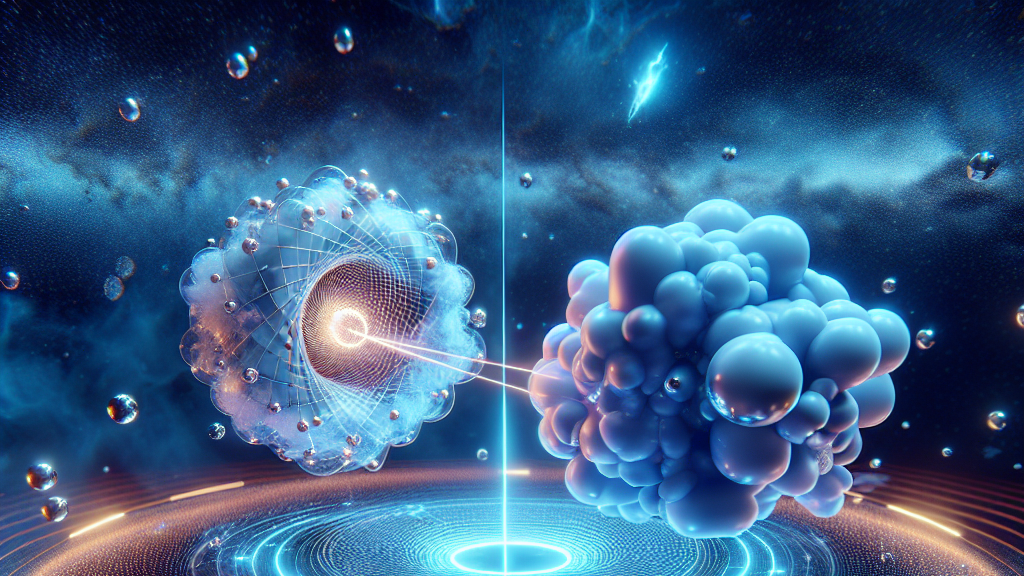
Here’s how it works: Picture two super-cold clouds of atoms, stacked atop each other. They don’t mingle or blend, thanks to an intense invisible force keeping them apart. The bottom cloud bounces on a sort of quantum trampoline—a special oscillating atomic mirror—providing a mysterious push to the upper cloud. This causes the two clouds to enter a time-travel-like dance, creating what’s known as a ‘cascade of spontaneous symmetry breaking’. It’s like each cloud is setting its own metronome tick that defies the traditional clock’s rhythm.
What’s exciting is how this could be a peek into the future of quantum tech. Imagine devices running on this unique time, unlocking new capabilities we can barely imagine today. From cutting-edge computers to novel ways of measuring time itself, these time crystals hint at a future where the limits of physics are stretched, opening doors to uncharted scientific territories, and maybe even helping us understand the mysteries of time travel itself!
Did you know that a ‘time crystal’ isn’t a crystal in the usual sense? Instead of being defined by space, it’s all about time—it repeats its structure in time rather than in space!
FAQs
What is a discrete time crystal in quantum physics?
A discrete time crystal is a phase of matter that repeats its structure over time rather than over space. It doesn’t stay static but evolves in a periodic manner, breaking the typical time translation symmetry, meaning it operates on a unique rhythm independent of the surrounding environment.
How do ultracold atomic clouds form a time crystal?
In this study, two ultracold atomic clouds stack on top of each other in a gravitational field, with the bottom one bouncing on an oscillating mirror. The strong repulsive force between them and the weak attractive force within each cloud cause them to spontaneously break time translation symmetry, forming a structure that repeats at a different time interval than the driving force.
Why is time crystal research important?
Time crystal research is fascinating because it challenges our understanding of time and symmetry in physics. It could lead to new technologies in quantum computing, where time crystals may serve as clocks operating on novel principles, potentially revolutionizing how we process information and understand time itself.
Has this been observed in the real world?
Yes, scientists have observed time crystals in laboratory settings using ultracold atoms and other quantum systems. These experiments provide insight into the possibility of exotic phases of matter, expanding our understanding of physics.
Could time crystals be used in future technologies?
Absolutely! The unique properties of time crystals could inspire innovations in quantum computing, timekeeping, and materials science, offering revolutionary ways to manipulate time and energy in technology.
Background
The concept of a time crystal stems from breaking of time translation symmetry, which traditionally means everything in a system repeats at consistent intervals, just like the ticking of a clock. In the quantum world, this can get strange. Researchers use ultracold atoms because they’re so still and controlled, they reveal these quantum phenomena beautifully. The forces between atoms—both attractive within them and repulsive between them—are key to driving these unusual time-dancing behaviors.
History
The idea of time crystals was first proposed in 2012 by physicist Frank Wilczek, who wondered whether systems could have a structure that repeats over time. Since then, experimental and theoretical research has explored how such systems could exist, especially in quantum environments. This study expands on past efforts by creating a time crystal using ultracold atoms, providing new insights into how these exotic structures can form and evolve.
Based on “Formation of Complex Discrete Time Crystals with Ultracold Atoms” by Weronika Golletz, Krzysztof Sacha, available on arXiv (arxiv.org/abs/2502.18613), used under CC BY 4.0 (creativecommons.org/licenses/by/4.0/).