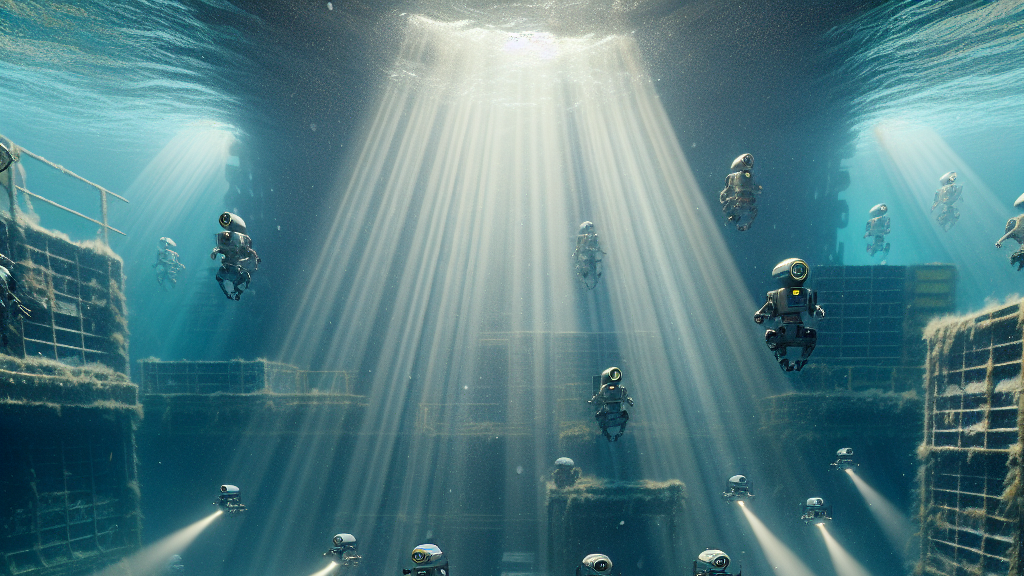
Exploring the deep sea or any underwater storage facility is not just a thrilling adventure but a risky and expensive task. Imagine having tiny robots diving deep into the ocean, inspecting every corner of these mysterious places, while keeping humans out of harm’s way. Sounds like a sci-fi movie? Well, this is the future of underwater exploration as we know it. These tiny robots can roam the underwater world, saving time and reducing the risk of human intervention in dangerous conditions.
The research introduces an innovative method to transform how we explore underwater environments. These robots work together, capturing images from varied angles, and then combining these to build a 3D map of the space. They use advanced deep learning to correct for any disturbances that might drift or tilt them off course. By processing images and data together, these robots can paint a perfect picture of what lies beneath the waves, even in noisy and unpredictable conditions.
In real life, imagine a scenario where these robots are unleashed in the depths of the ocean to monitor underwater oil rigs—detecting leaks or structural weaknesses early. They can operate continuously, sending back crucial data that helps in swift decision-making, ensuring safety and efficiency. The dream of automated underwater inspections is becoming a reality, and it could mean fewer accidents, better resource management, and a peek into the previously unseen marine world.
Did you know? These underwater robots can still capture accurate data even if they are disturbed by strong ocean currents or rotations!
FAQs
How do these underwater robots improve safety during exploration?
These robots reduce the need for humans to be present in hazardous underwater environments, allowing for safe, remote monitoring and inspections that significantly reduce the risk of accidents.
What makes these robots’ technology so effective underwater?
By using a combination of deep learning for precise position prediction and the ability to reassemble images despite disturbances, these robots can accurately map environments, ensuring effective monitoring even in challenging conditions.
What kind of data do these robots capture during exploration?
The robots capture visual snapshots, global positional context, and adjust for any noisy coordinates, creating a comprehensive and coherent view of the underwater setting for analysis.
How might this technology lower the cost of underwater facility monitoring?
Automated robots can operate continuously without human intervention, saving labor costs and reducing the expensive equipment traditionally needed for underwater monitoring tasks.
What is the potential real-world impact of this robotic research?
This technology can vastly improve underwater facility inspections, detecting problems early to prevent larger accidents, thereby improving operational efficiency and environmental safety.
Background
The research is based on automating exploration and monitoring processes using tiny robots underwater. These robots capture images and data, which are then processed through a multi-modal deep learning network. This technology helps in predicting precise locations and creating coherent images, even when the robots face disruptions like position drift or rotation due to environmental factors.
History
Previous attempts to monitor underwater environments relied heavily on human divers and expensive technologies, which were risky and limited in scope. With advancements in robotics and deep learning, the current study offers a more efficient way to explore these hazardous environments while reducing human involvement and enhancing safety.
Based on “Deep Learning-Enhanced Visual Monitoring in Hazardous Underwater Environments with a Swarm of Micro-Robots” by Shuang Chen, Yifeng He, Barry Lennox, Farshad Arvin, Amir Atapour-Abarghouei, available on arXiv (arxiv.org/abs/2503.02752), used under CC BY 4.0 (creativecommons.org/licenses/by/4.0/).