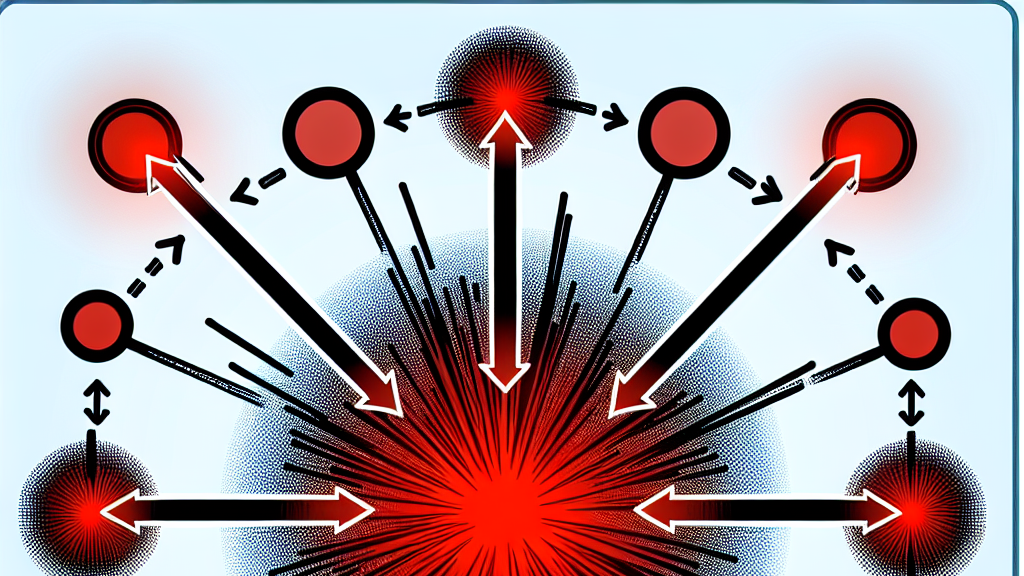
Imagine a world where less is actually more. In the arena of public health, researchers have unearthed a peculiar phenomenon: sometimes, fewer warnings can more effectively halt an epidemic in its tracks. This seemingly counterintuitive idea mirrors a concept known as Braess’s paradox, where the addition of resources can actually slow things down. Here, fewer people becoming aware of an epidemic can lead to better control of its spread. But how does that make any sense?
The study looks at how diseases spread through networks – think of these as webs of people connected by interaction. In these networks, some individuals become ‘aware’ of the disease and adjust their behavior to prevent it. Fascinatingly, when only those infected or certain key individuals get the warning instead of everyone, the epidemic spread is reduced. This is especially true in scale-free networks, where a small number of very well-connected people (think influencers) hold more sway. By focusing on strategic points in the network, awareness is raised more effectively than when everyone gets the same message.
This might just change how we deal with outbreaks in the future. Picture a school during flu season. Instead of sending alerts to everyone, the focus could be on students who interact with the most classmates. By strategically choosing who to inform, the chances of stopping the spread improve dramatically. Such targeted awareness could revolutionize how we tackle contagious diseases, making it both a health breakthrough and a fascinating twist on human behavior.
Did you know that in certain cases, telling fewer people about an outbreak can actually contain it more effectively?
FAQs
What is the core finding of this epidemic awareness research?
The study discovered that alerting fewer, strategically chosen individuals in a network can more effectively curb the spread of an epidemic, compared to spreading awareness to everyone.
How does this research relate to Braess’s paradox?
The research illustrates a scenario similar to Braess’s paradox, where fewer aware nodes can lead to a more effective reduction in epidemic size, akin to the paradoxical concept where adding a road can lead to more traffic congestion.
Why focus on scale-free networks in this study?
Scale-free networks are a type of network commonly used to model social connections, where a few nodes are highly connected and play a critical role in information dissemination, making them ideal for studying epidemic spread and awareness tactics.
What are scale-free networks, and why do they matter in this study?
Scale-free networks are networks in which a few nodes are very highly connected, while most others have few connections. This structure is common in social networks and plays a key role in how diseases or information spread, making it critical to this study.
What practical application does this research suggest for epidemic control?
The research suggests that by identifying and raising awareness among key influencers in a network, rather than everyone, we can more effectively reduce the spread of diseases, optimizing health communication strategies.
Background
Scale-free networks are fascinating because they reflect real-world social connections, with a few ‘hubs’ holding most connections. In an epidemic, these hubs are particularly important as they can rapidly spread or mitigate disease. In this study, the focus on strategic use of awareness shows how different alert strategies can significantly change an outbreak’s outcome.
History
This study builds on previous research around epidemic modeling and social network theory. While traditional approaches often focus on general awareness campaigns, this work looks at how network dynamics and targeted awareness can lead to unexpected, yet effective outcomes, specifically drawing on earlier work around Braess’s paradox, which challenges our intuitive understanding of systems and optimization.
Based on “Epidemic paradox induced by awareness driven network dynamics” by Csegő Balázs Kolok, Gergely Ódor, Dániel Keliger, Márton Karsai, available on arXiv (arxiv.org/abs/2409.01384), used under CC BY 4.0 (creativecommons.org/licenses/by/4.0/).