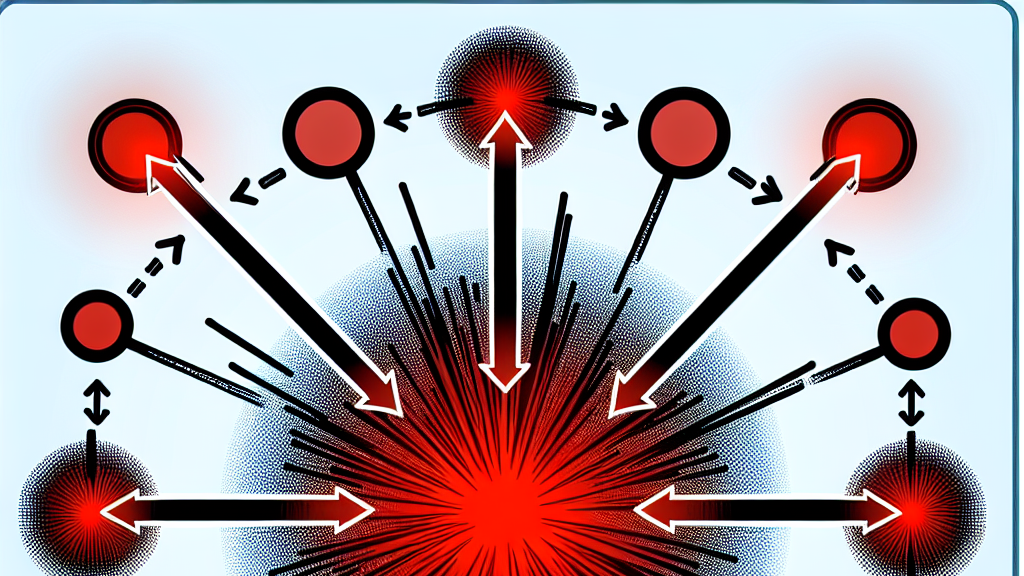
Imagine a gigantic spiderweb of interconnected systems—from the power grid that lights our homes to the internet of things that connects our gadgets. These networks are marvels of modern engineering, capable of running smoothly and silently in the background. But what if I told you that a single, seemingly insignificant component could cause this entire web of systems to wobble and shake, potentially leading to catastrophic failure?
Recent research has uncovered that when it comes to destabilizing a network, it’s not the big, obvious targets you should worry about. The real threat lies with smaller, low-indegree nodes—those lesser-known cogs in the machine. By focusing an attack on just one of these, an intruder can efficiently disrupt the network’s balance. Think of it like a tiny pebble causing ripples across a vast lake, challenging the common belief that network hubs, or main nodes, are the most critical.
So, why should you care? Well, this insight can revolutionize how we protect essential networks. For instance, by identifying and strengthening these vulnerable low-indegree nodes, we can make technological systems—from our smart cities to our online communities—more resilient. This means fewer unexpected outages and a safer, more reliable digital and physical world for all of us.
Surprisingly, attacking a low-indegree node can destabilize a network more effectively than targeting a major hub!
FAQs
How can one weak link destabilize an entire network?
By concentrating an attack on a single low-indegree node, the network becomes unstable, challenging traditional views that major hubs are the most vulnerable. This fragile point can cause a ripple effect, disrupting the entire system.
Why are low-indegree nodes more vulnerable than hubs?
Low-indegree nodes, often overlooked, may lack the robustness of hubs. Attacking these can cause significant disruptions, unlike hubs that generally have more reinforcement and resilience.
Do these findings apply to real-world networks?
Yes, these insights apply across various real-world networks, like power grids and social networks. Recognizing and protecting these vulnerable nodes could enhance overall network stability.
How does this research impact technological systems?
By understanding network vulnerabilities, including in low-indegree nodes, we can design stronger, more resilient networks, improving the reliability of key technologies and infrastructures.
Background
Networks are interconnected systems, such as power grids or social networks, where various nodes (or points) are linked together to function as a whole. The stability of these networks depends on the synchronized activity of their nodes. The concern addressed in this study is how such a stable state can be compromised when a ‘bad actor’ or intruder node affects its dynamics. Prior assumptions focused on targeting major hubs in a network, but the study reveals that even minor nodes can have a major impact if destabilized.
History
Research on networks initially emphasized the importance of major hubs due to their high-degree of connectivity and seeming criticality. However, this study builds on and challenges such traditional views by showing that lesser-connected nodes can be significant vulnerabilities. This is a shift from past conclusions that mainly underscored the need to protect the bigger and more connected nodes (hubs).
Based on “Extreme vulnerability to intruder attacks destabilizes network dynamics” by Amirhossein Nazerian, Sahand Tangerami, Malbor Asllani, David Phillips, Hernán Makse, Francesco Sorrentino, available on arXiv (arxiv.org/abs/2502.08552), used under CC BY 4.0 (creativecommons.org/licenses/by/4.0/).