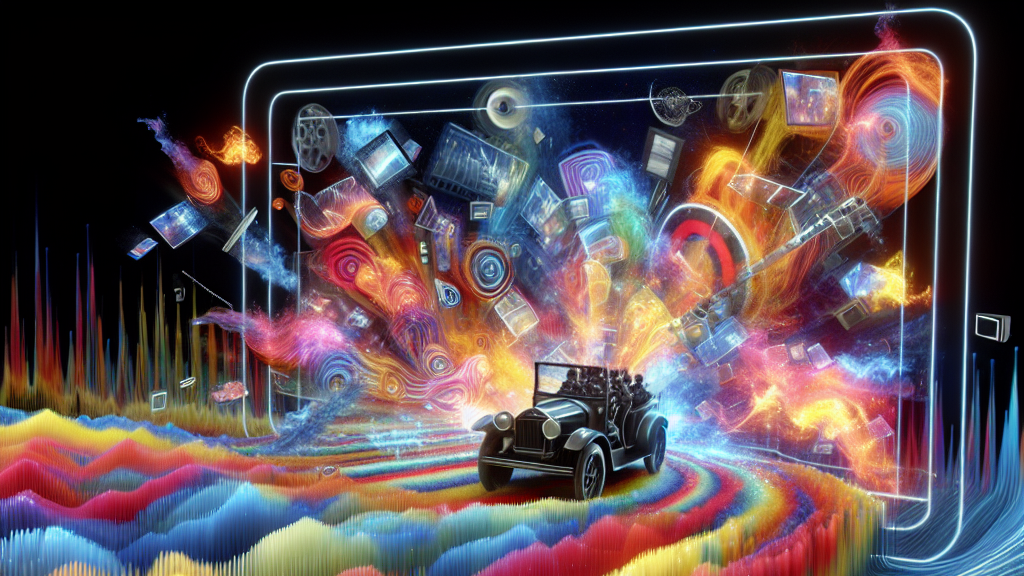
Ever wondered if a video could create its own soundtrack? Well, the latest research is delving into the exciting world of video-to-audio generation, potentially transforming how we experience visual content. Imagine watching a video of a bustling city and hearing the authentic sounds of traffic and people, perfectly in sync with what you see. This is not science fiction; it’s a revolution in audio-visual technology waiting to happen.
Researchers have focused on understanding how to automatically generate audio that aligns both semantically and temporally with video input. They studied different methods, using vision encoders to interpret video content, auxiliary embeddings to enhance understanding, and data augmentation techniques to improve model performance. The result? A system that can produce incredibly lifelike audio from just video data!
This research could have groundbreaking applications in creating immersive worlds for virtual reality or enhancing the viewing experience in movies and gaming without the need for extensive audio production teams. Imagine a future where a simple home video of your pet could automatically generate its soundtrack, capturing every bark or purr without any audio being recorded at the time. It’s a whole new dimension to storytelling and content creation, making everyday moments even more memorable.
Did you know? This technology could one day allow cameras to ‘hear’ just by watching!
FAQs
What is video-to-audio generation?
Video-to-audio generation is a technology that allows a video to automatically produce audio that aligns with its visual content, creating a synchronized and immersive experience.
How does video-to-audio generation technology work?
This technology uses vision encoders to interpret the video content, auxiliary embeddings to understand context, and data augmentation to enhance the model’s ability to generate realistic audio.
Why is video-to-audio generation important for the future of media?
Video-to-audio generation could revolutionize media by allowing for the automatic creation of realistic soundtracks, enhancing experiences in film, virtual reality, and gaming without the need for manual audio production.
Can video-to-audio generation be used in everyday life?
Yes! Imagine your smartphone videos generating their own soundtrack, making home videos more engaging and lifelike with automatically synchronized audio.
What was a surprising finding in this research?
Researchers found that certain data augmentation methods significantly enhanced the ability of models to produce more realistic and synchronized audio from videos.
Background
Video-to-audio generation is all about creating sound that matches the movements and scenes of a video. This involves using advanced technologies like vision encoders, which help computers interpret what is happening in the video. Auxiliary embeddings are used to give more context for the sound, and data augmentation techniques enhance the model’s performance. These methods aim to make the audio output as realistic and synchronized as possible, aligning perfectly with the video footage.
History
In the world of artificial intelligence and machine learning, the text-to-video generation was considered a major breakthrough. This laid the groundwork for exploring video-to-audio generation. Early research focused on separating audio from video, but the latest studies have shifted toward integrating them seamlessly. This aligns with a broader trend in technology seeking to create multi-sensory and immersive experiences by synchronizing different media forms.
Based on “Video-to-Audio Generation with Hidden Alignment” by Manjie Xu, Chenxing Li, Xinyi Tu, Yong Ren, Rilin Chen, Yu Gu, Wei Liang, Dong Yu, available on arXiv (arxiv.org/abs/2407.07464), used under CC BY 4.0 (creativecommons.org/licenses/by/4.0/).