Connect with us

Search by keyword

Computers

Can Galloping Save Robot Energy?

This research explores how different galloping styles can make robots move more efficiently, potentially saving energy and influencing future robot designs.

Can Galloping Save Robot Energy
✨Researched by humans. Explained by robots. Learn more.

Imagine a world where robots are not just cool gadgets but also energy savers, galloping like horses to conserve power! That’s what this study dives into, exploring how different galloping techniques can decrease energy consumption in quadrupedal robots, just like the ones you see in sci-fi movies.

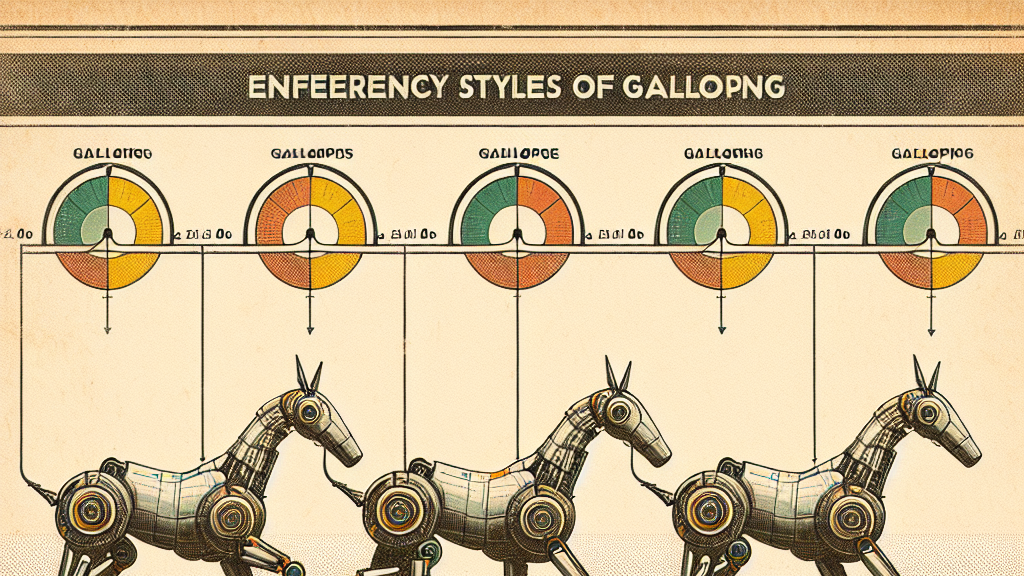
The research focuses on galloping styles by looking at different footfall patterns, like when and how each foot hits the ground. Scientists used a fancy robot named A1 to test these gallops at various speeds, and they found something interesting: galloping with no flight time, meaning all feet are on the ground at some point, is best for lower speeds. But when the robot takes two flight phases (where it is completely off the ground), it saves more energy at high speeds.

Imagine if your robot vacuum could gallop around your house without gulping electricity or if a delivery robot could zip down the street without needing constant recharges. This galloping research might make that possible one day, showing the path to more efficient, adaptable robots that hop around like kangaroos or gallop like cheetahs, saving energy as they go!

Did you know? Galloping robots can save more energy than those that don’t fly off the ground!

FAQs

How does galloping improve the energy efficiency of quadrupedal robots?

Galloping allows robots to transition between different footfall patterns, optimizing energy use. At lower speeds, keeping all feet on the ground is efficient, while at higher speeds, having two flight phases where the robot is airborne reduces energy consumption.

What are flight phases in galloping robots?

Flight phases occur when a galloping robot is airborne, with no feet touching the ground. These phases can make robots more energy-efficient by minimizing ground contact during high-speed motion.

How could this research affect everyday technology?

This study on galloping robots could lead to more energy-efficient designs for domestic and industrial robots, making them more practical for everyday use by reducing power consumption and increasing battery life.

Are there practical applications for this research on quadrupedal robots in the real world?

Yes! Future robots, like delivery bots or robotic pets, could use galloping gaits to move between tasks more efficiently, minimizing energy use and maximizing their work duration between charges.

Does this research change our understanding of animal locomotion?

While focused on robots, this study deepens our understanding of energy-efficient locomotion in animals, showing the underlying principles that could apply both in nature and technology.

Background

Galloping, a fast movement style in animals like horses, involves precise timing and sequencing of footfalls. In robotics, scientists replicate this to create efficient movement using a combination of flight and contact phases. The dynamics of these movements are analyzed through trajectory optimization and hybrid dynamical systems—methods that help model and predict the best patterns for reduced energy use.

History

Galloping in animals has been studied for its efficiency and speed. Recently, this knowledge has inspired advancements in robotic locomotion. Previous studies have explored basic walking and trotting, but this research breaks new ground by systematically examining the energy costs of different galloping styles, offering insights into optimizing robotic gait transitions.

Based on “16 Ways to Gallop: Energetics and Body Dynamics of High-Speed Quadrupedal Gaits” by Yasser G. Alqaham, Jing Cheng, Zhenyu Gan, available on arXiv (arxiv.org/abs/2503.13716), used under CC BY 4.0 (creativecommons.org/licenses/by/4.0/).


Trending

Latest

Can AI Save Water Discover How

Computers

AI is transforming the tech world, but it uses lots of water! A new tool, SCARF, helps us measure and reduce AI's water footprint,...

Whats a Forbush Decrease and Why Should We Care Whats a Forbush Decrease and Why Should We Care

Space

Scientists just observed the biggest solar storm event in years, revealing unexpected cosmic ray patterns. Understanding these changes could help us protect our technology...

Can Cars Spot Danger Faster Than Humans Can Cars Spot Danger Faster Than Humans

Computers

Think about how quickly you react when something unexpected happens on the road. This research brings us closer to creating self-driving cars that can...

Can Fear of the Other Stop Social Harmony Can Fear of the Other Stop Social Harmony

Physics

Fear of the unknown might make it harder for people to agree and get along. This study shows that when people have strong xenophobic...

Can AI Revolutionize Breast Cancer Diagnosis Can AI Revolutionize Breast Cancer Diagnosis

Electricity

This research introduces a groundbreaking AI model that can accurately assess HER2-positive breast cancer using widely accessible staining methods, potentially revolutionizing how we diagnose...

Can AI Transform Your Singing into a Choir Can AI Transform Your Singing into a Choir

Computers

Imagine singing solo and having AI turn you into a choir. This research unveils a groundbreaking AI tool that transforms your voice into rich...

You May Also Like

Materials

This research reveals that traditional basket weaving techniques can be a breakthrough in creating modern, super-resilient materials for tech and robotics, potentially leading to...

Computers

Discover how setting a simple power cap on processors can lead to 25% more energy efficiency compared to traditional methods, all while maintaining good...

Computers

Imagine saving electricity without sacrificing your computer’s performance. This study shows that a simple power cap can make your server more energy-efficient by up...

Materials

Researchers have discovered that plasma-powered engines can achieve the highest efficiency possible by using a unique caloric equation of state. This breakthrough could open...

Computers

Imagine moving things without touching them, just like magic! This cutting-edge research uses sound waves and robots to transport objects through the air, revolutionizing...

Physics

Switching to electricity-based technology like heat pumps and electric cars makes our energy use much more efficient and sustainable. By doing this, we can...

Computers

Imagine robots that can think creatively like humans! By teaching robots metacognitive skills, this research shows they can solve complex tasks with fewer instructions,...

Computers

AI-driven robots could transform ocean exploration by enabling the creation of highly efficient underwater gliders with unique shapes, increasing the reach and effectiveness of...

Computers

AI can create amazing 3D models in seconds, but turning them into real things isn't as easy. This research explores how to actually build...

Copyright © 2024 8ig8rain.

Disclaimer: The content on 8ig8rain.com consists of AI-generated summaries of scientific abstracts from arXiv. Please note that most arXiv abstracts are preprints and may not have undergone formal peer review. While these summaries aim to convey key ideas and potential applications, they are provided for informational purposes only and should not be interpreted as validated scientific findings or professional advice. The summaries are intended to educate, spark curiosity, and inspire further exploration of science.