Imagine a world where the flutter of a butterfly’s wings could predict the synchronized dance of forests and streams. Recent research is unraveling the tangled web of species interactions and introducing us to how time-delayed reactions in ecosystems might lead to unexpected patterns. This insight into the ‘memory’ of ecosystems could change everything we know about predicting ecological dynamics.
The study explores how time delays, or ‘memory effects,’ naturally occur among species. Researchers used a model (similar to the famous predator-prey cycle) that showed how these delays lead to fascinating patterns where species seemed to sync up in their population changes. Forget complexity; this study suggests that just the inherent ‘memory’ of an ecosystem can give rise to these synchronized patterns—like birds suddenly flocking or fish swimming in perfect tandem.
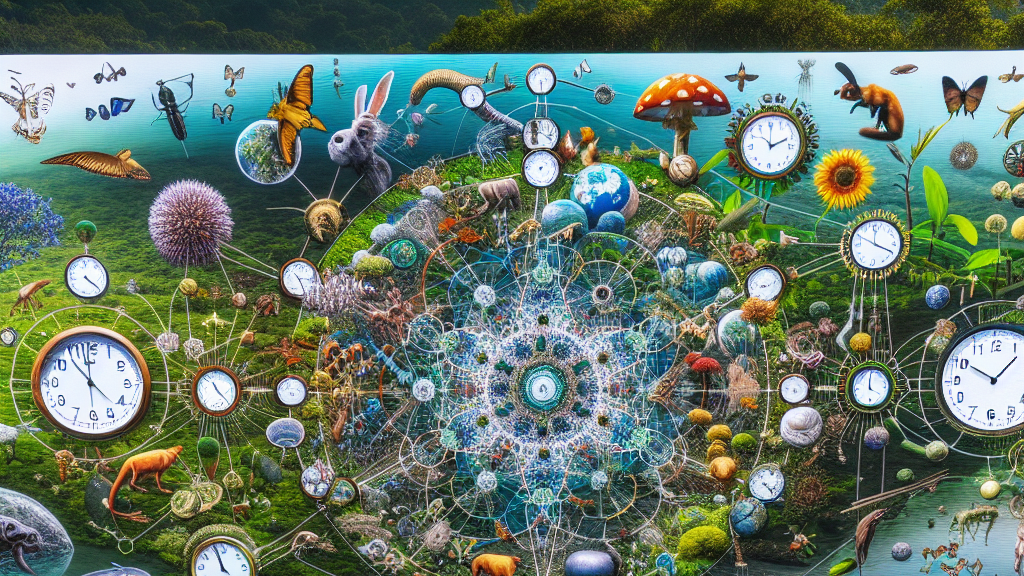
Think of this research like creating a new ecological clock that doesn’t just tick predictably but sometimes skips, rewinds, or speeds up without warning. Imagine using this understanding to predict and perhaps control how ecosystems might react to changes, such as climate change, by ‘listening’ to these natural time delays. This could be the key to sustainable ecosystems, predicting chaos, and finding synchronization in a world full of surprises.
Did you know? Ecological time delays are like natural ‘jet lags’ that can cause chaotic or synchronized patterns in ecosystems!
FAQs
What are time delays in species interactions?
Time delays refer to the periods between interactions among species, caused by factors like growth rates or reaction times, affecting how their populations change over time.
How do memory effects impact ecosystems?
Memory effects, or the ‘echoes’ of past interactions, lead to synchronized or chaotic population patterns, shaping the dynamics within an ecosystem.
What is the broader impact of understanding ecological time delays?
By grasping how time delays shape ecosystems, we can better predict and manage environmental changes, potentially mitigating impacts like climate change.
Are complex ecosystems always unpredictable?
No, this research shows that even with inherent memories, ecosystems can become predictable, helping us foresee and address environmental shifts.
What practical applications could arise from this study?
The study could help design sustainable practices by predicting ecosystem responses, benefiting conservation efforts, and ecosystem management worldwide.
Background
In ecological communities, multiple species and their interactions need to be understood to predict changes in the environment. ‘Memory effects’ in this context refer to the influences of past interactions on current dynamics, which can create patterns in how species populations fluctuate over time. The generalized Lotka-Volterra equations are mathematical models that help us understand such interactions, particularly when considering time delays.
History
The concept of predator-prey cycles has long been a classic example of ecological dynamics, where populations of predators and their prey naturally cycle over time due to direct interactions. This study expands on that understanding by incorporating the effects of time delays and random interactions, providing a novel perspective on how ecosystems might operate in a less predictable world.
Based on “Synchronization and chaos in complex ecological communities with delayed interactions” by Francesco Ferraro, Christian Grilletta, Emanuele Pigani, Samir Suweis, Sandro Azaele, Amos Maritan, available on arXiv (arxiv.org/abs/2503.21551), used under CC BY 4.0 (creativecommons.org/licenses/by/4.0/).