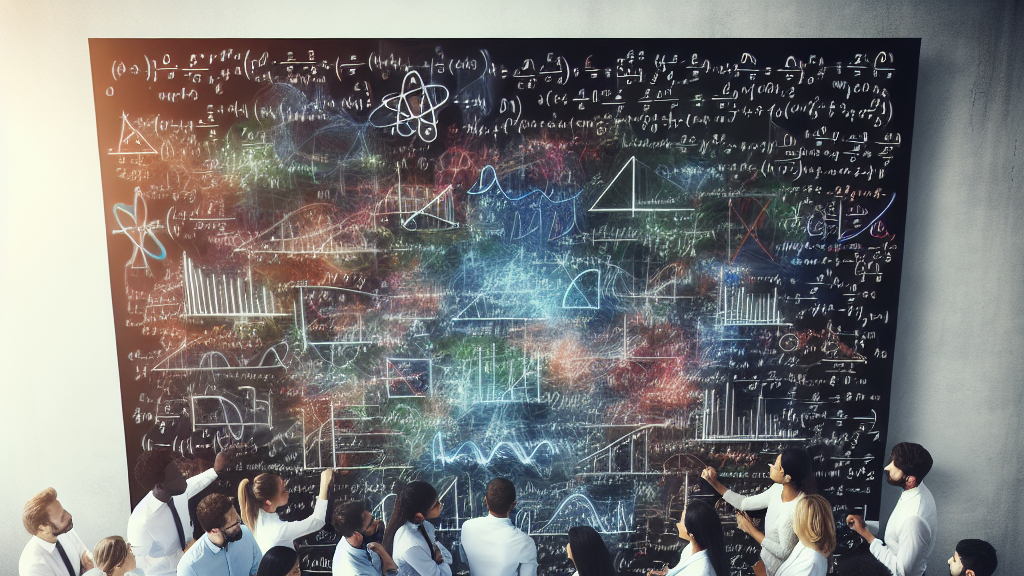
Chaos sounds like the ultimate unpredictability, doesn’t it? Well, recent research flips that idea on its head. Imagine if those chaotic systems actually held the keys to precise predictions. This new approach called ‘chaotic learning’ does precisely that, turning the random into the predictable. It’s kind of like finding hidden order in what seems like pure madness. This means that the chaos in weather patterns, financial markets, or even your brain waves could be the gateway to more accurate forecasts than ever before. Intriguing, right?
The core idea here is about using something called multiscale topological Laplacians. These are like complex maps of chaotic systems, helping us chart out a wild, unpredictable terrain with precision. The researchers applied this technique to a diverse range of real-world data sets—like brain wave recordings and protein data—and even classic chaotic systems like the Lorenz and Rossler attractors. The results were nothing short of revolutionary. Chaos, once the foe of predictability, suddenly became its ally.
Why does this matter to you? Think of your everyday life mixed with a spoonful of chaos—weather forecasts that never seem right, the unpredictable stock markets, or perhaps the mystery of human biology with its countless variables. Now imagine if we could take the ‘chaos’ out and replace it with clarity. Accurate predictions powered by this new chaotic learning method might improve everything from how we plan our days to medical breakthroughs. It’s opening a door to a world where the chaotic noise is finally tuned into a harmonious signal.
Did you know that chaotic systems, which seem random, actually have patterns called ‘strange attractors’ that can help predict future outcomes?
FAQs
What is chaotic learning?
Chaotic learning is a new method for making precise predictions in systems that appear unpredictable. It uses multiscale topological Laplacians to turn chaos into clarity.
How does chaotic learning impact real-world issues?
Chaotic learning has the potential to improve predictions in fields like weather forecasting, stock market analysis, and even understanding brainwaves and RNA sequencing, leading to more informed decisions and breakthroughs.
Can chaotic learning be applied to any chaotic system?
While chaotic learning holds promise for many types of data, it is particularly effective with systems that have complex behaviors, like brainwaves and RNA sequencing, where traditional methods struggle to provide accurate predictions.
What makes chaos predictable with chaotic learning?
By using multiscale topological Laplacians, chaotic learning maps out chaotic systems with high precision, revealing patterns that were previously obscured, ultimately enabling accurate predictions.
How does chaotic learning differ from traditional prediction methods?
Traditional prediction methods often struggle with chaotic systems due to their complexity and apparent randomness. Chaotic learning, however, embraces chaos, using its inherent patterns to achieve more reliable predictions.
Background
Chaos theory describes systems that are highly sensitive to initial conditions, leading to behavior that appears random but is not. This complexity has made chaotic systems difficult to predict until now. Key concepts include strange attractors, which are patterns that chaotic systems tend to follow, and fractals, which are intricate, repeating patterns that occur at every scale.
History
Chaos theory emerged from earlier studies of dynamic systems where small differences in initial conditions could lead to vastly different outcomes. The famous ‘butterfly effect’ is an example of this. Over time, researchers have developed mathematical tools to explore and describe these systems, but predictability remained a challenge until this new approach, chaotic learning, was pioneered. It builds on, refines, and fuses methods from topology, chaos theory, and machine learning.
Based on “Machine learning predictions from unpredictable chaos” by Jian Jiang, Long Chen, Lu ke, Bozheng Dou, Yueying Zhu, Yazhou Shi, Huahai Qiu, Bengong Zhang, Tianshou Zhou, Guo-Wei Wei, available on arXiv (arxiv.org/abs/2503.14956), used under CC BY 4.0 (creativecommons.org/licenses/by/4.0/).