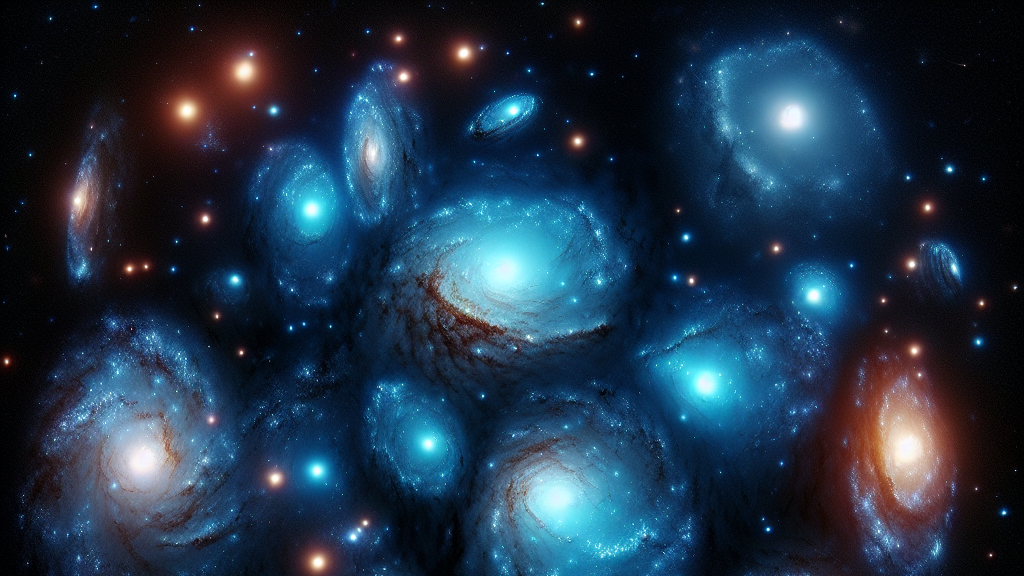
Did you know that the tiny, often overlooked dwarf galaxies might hold secrets to understanding the cosmos? Recent research has shown that these little galaxies are clustering in space much more strongly than expected. This is unexpected because they’re behaving more like massive galaxy groups! What could this intriguing behavior mean for our understanding of the universe?
A new study explores this mystery by analyzing the large-scale clustering of isolated, diffuse, and blue dwarf galaxies. Typically, we expect larger, redder, more compact galaxies to have strong clustering in space due to their formation in cold dark matter (CDM) halos. However, the surprising strong clustering of these dwarf galaxies suggests something is amiss in current galaxy formation models. One hypothesis is that diffuse dwarfs are forming in older, low-mass halos, and this might align them with a phenomenon known as halo assembly bias.
So, what does this mean for us on Earth? Well, if self-interacting dark matter is influencing their distribution, it might mean rethinking our galaxy evolution models and could provide clues on the behavior of dark matter itself. This could revolutionize the way we understand the fundamental forces that shape our universe, leading to a deeper understanding of both our cosmic past and future. Imagine the vast mysteries these tiny galaxies could unlock!
Dwarf galaxies, despite their small size, can have as much mysterious influence on space clustering as their much larger counterparts.
FAQs
Why are dwarf galaxies clustering like massive galaxies?
This curious behavior in dwarf galaxies’ clustering challenges the current models of galaxy formation which tie clustering to the mass of dark matter halos. Their strong clustering might be explained by their formation in older, low-mass halos.
How does this research impact our understanding of dark matter?
By showing that dwarf galaxies cluster more than expected, this research suggests that self-interacting dark matter could be at play, offering a new perspective on dark matter’s role in the universe.
What is the significance of halo assembly bias in this study?
Halo assembly bias suggests that galaxies’ clustering can depend on the age of the halo rather than just its mass. This plays a crucial role in explaining why diffuse dwarf galaxies show unexpectedly strong clustering.
How might this research affect future models of galaxy evolution?
Current models may need revision as this study highlights the need to consider different factors, such as self-interacting dark matter, to explain galaxy formation and clustering accurately.
Could these findings lead to a major scientific breakthrough?
This discovery not only challenges existing models but could open new avenues in the study of dark matter and galaxy formation, leading to significant breakthroughs in understanding the universe.
Background
Galaxy clustering is often measured through the galaxy correlation function, a tool that helps cosmologists understand the arrangement and distribution of galaxies in the universe. Typically, galaxies form in dark matter halos, with more massive halos generally forming more clustered galaxies. This is well understood in the context of the Cold Dark Matter (CDM) model. However, isolated dwarf galaxies showing strong clustering poses a challenge to existing theories because their clustering strength is not adequately explained by their expected halo mass.
History
The concept of galaxy clustering has been central to cosmology for decades, with the Cold Dark Matter model serving as a cornerstone for understanding galaxy formation. Previous studies have shown that larger galaxies tend to cluster more. However, recent advancements in simulations and observational techniques have highlighted anomalies, such as the clustering of dwarf galaxies, prompting a reevaluation of longstanding models.
Based on “Unexpected clustering pattern in dwarf galaxies challenges formation models” by Ziwen Zhang, Yangyao Chen, Yu Rong, Huiyuan Wang, Houjun Mo, Xiong Luo, Hao Li, available on arXiv (arxiv.org/abs/2504.03305), used under CC BY 4.0 (creativecommons.org/licenses/by/4.0/).