Imagine if tiny geometric rules could create entirely new ‘worlds’ in the quantum universe! That’s what scientists are doing by using something called algebraic geometry. It’s allowing them to come up with new ways to mess around with quantum bits, which might change the way we build future technology, like super-fast quantum computers.
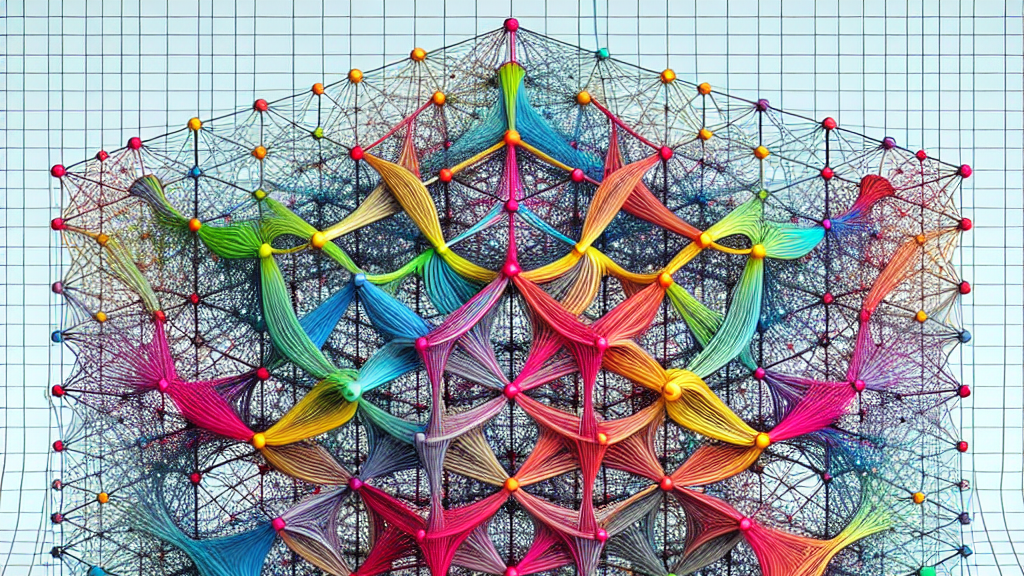
In simpler terms, researchers are using a special kind of mathematical ‘scaffold’ to build structures inside something called a Hilbert space, where quantum bits live. By tweaking this scaffold, they’re creating new dimensions of space that help them understand and manipulate entanglement—when quantum bits are mysteriously connected over distances. This process reveals new possibilities for creating and managing complex quantum systems, which could revolutionize our understanding and use of quantum technology.
Imagine using this quantum magic in real life: it could lead to breakthroughs in quantum computing, making our computers faster and more efficient than ever before. In the future, such advanced quantum systems might solve impossible problems in seconds, revolutionizing industries like medicine, finance, and artificial intelligence.
Did you know? Quantum entanglement can connect particles over distances, even across galaxies!
FAQs
What is the significance of geometry in quantum physics?
In quantum physics, geometry helps create layouts in the Hilbert space where quantum bits exist, allowing scientists to explore new ways to manipulate entangled states for advanced technologies.
How does altering the Hilbert space affect quantum technology?
By modifying the Hilbert space, scientists can enhance or control quantum entanglement, potentially leading to breakthroughs in quantum computing and faster data processing capabilities.
What is quantum entanglement, and why is it important?
Quantum entanglement is a phenomenon where particles become interconnected, regardless of distance. It’s crucial for developing future technologies like quantum computers, providing faster and more secure data processing.
Background
Hilbert space is a fundamental concept in quantum mechanics, representing the ‘space’ where quantum states live. Algebraic geometry, on the other hand, is a branch of mathematics dealing with understanding geometric structures using algebra. By employing concepts from algebraic geometry, researchers can create new structures within the Hilbert space that allow for innovative manipulation of quantum states.
History
In the past, algebraic geometry has been used in theoretical physics to solve complex mathematical problems. This particular research leverages these techniques to craft new quantum structures, building upon decades of exploration in quantum theory and geometry. It’s a continuation of the quest to understand and manipulate quantum systems more effectively.
Based on “Entangled Subspaces through Algebraic Geometry” by Masoud Gharahi, Stefano Mancini, available on arXiv (arxiv.org/abs/2504.11525), used under CC BY 4.0 (creativecommons.org/licenses/by/4.0/).