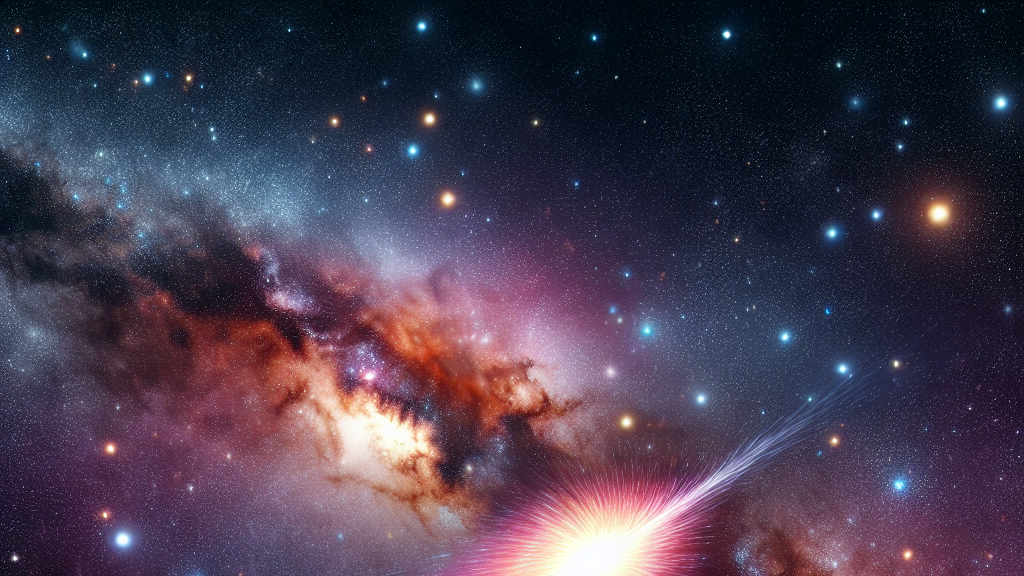
Imagine stars as brave adventurers in space, sometimes getting too close to the fearsome supermassive black holes lurking at galaxy centers. These stars face dramatic ends, with some being ripped apart in astonishing flashes of cosmic energy, known as tidal disruption events. Space doesn’t get more extreme than this!
Researchers are fascinated by these rare events, which happen once in 10,000 to 100,000 years. When tides from a supermassive black hole disrupt a star, what’s left is unique. Scientists simulate these disruptions using models to understand the star remnants’ behavior over thousands to billions of years. Initially, these leftovers shine brightly but gradually settle down, still carrying the telltale signs of their dramatic history. Some of the mysterious objects in our galaxy might be these very survivors!
So what could this mean for us Earthlings? Spotting these stellar misfits, with their enriched outer layers, might shed light on the universe’s most powerful forces. They hold clues about how stars evolve after such close calls, helping scientists understand more about space, gravity, and possibly even our galactic neighborhood’s past. As science unlocks these mysteries, who knows what other secrets we’ll reveal about our universe?
Did you know that a star’s close encounter with a supermassive black hole only happens once in 10,000 to 100,000 years?
FAQs
What are tidal disruption events involving supermassive black holes?
Tidal disruption events occur when a star gets too close to a supermassive black hole, causing the star to be torn apart by the intense gravitational forces. This leads to a bright, dramatic flash of energy as parts of the star are hurled into space.
How can tidal disruption events explain mysterious galactic center objects?
The remnants of stars disrupted by tidal forces may linger as unusual objects in our galaxy. These remnants, with unique features, could match some unexplained objects observed near our galaxy’s center, termed ‘G objects.’
Why are tidal disruption event remnants important for scientists?
Studying these remnants helps scientists understand the extreme gravitational forces in space and the behavior of stars after such dramatic encounters. They offer valuable insights into black hole dynamics and stellar evolution.
How do scientists study the aftermath of tidal disruption events?
Scientists use computer simulations of tidal disruption and map these into stellar evolution codes to predict how the remnants evolve over time, revealing their unique properties and potential indicators of past disruptions.
How often do tidal disruption events happen?
Tidal disruption events are rare, occurring approximately once every 10,000 to 100,000 years. This rarity makes the study of these events and their remnants particularly exciting and valuable to astronomy.
Background
Tidal disruption events happen when a star passes too close to a supermassive black hole, resulting in intense gravitational forces that tear the star apart. These events produce bright energy flashes visible across the universe and leave behind remnants that go through a complex evolution process. Scientists use hydrodynamic models to simulate these events and predict how the remnants change over time, helping understand the unique conditions and forces at play.
History
The study of tidal disruption events has evolved with astronomy’s advancement, from initial observations of unexplained bright flares to current detailed simulations of star-black hole interactions. As telescopes became more powerful, these rare events provided a glimpse into the universe’s most extreme gravitational environments. Today’s research builds on past observations, using technology to simulate and predict the evolution of star remnants, offering new insights into cosmic phenomena.
Based on “Black Hole Survival Guide: Searching for Stars in the Galactic Center That Endure Partial Tidal Disruption” by Rewa Clark Bush, Samantha C. Wu, Rosa Wallace Everson, Ricardo Yarza, Ariadna Murguia-Berthier, Enrico Ramirez-Ruiz, available on arXiv (arxiv.org/abs/2504.14705), used under CC BY 4.0 (creativecommons.org/licenses/by/4.0/).