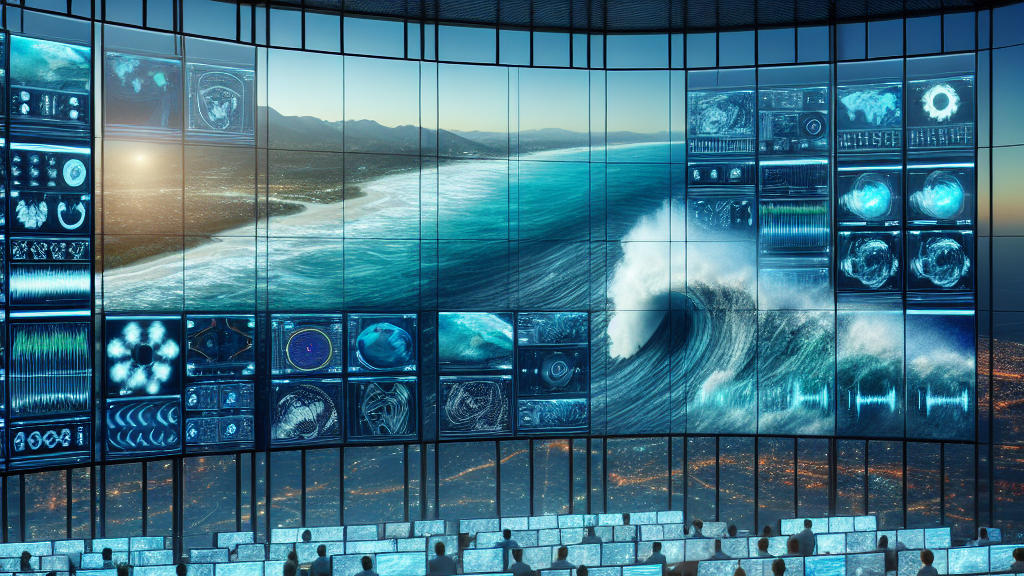
Imagine being able to predict a tsunami in the blink of an eye—well, this research has found a way to make tsunami warnings nearly instantaneous. By using data from seafloor sensors and super-fast computers, scientists are figuring out how to predict when and where these massive waves will strike, potentially saving countless lives by providing quick and reliable warnings.
The secret lies in an advanced digital system that uses real-time data collected from the ocean floor when an earthquake occurs. This system, like a virtual twin of the ocean world, processes enormous amounts of information in seconds, forecasting the path of the tsunami. Essentially, it crunches numbers and patterns at incredible speeds, using what’s called Bayesian inversion—a smart way of making predictions based on probabilities, much like how weather forecasts work but even quicker.
Let’s say you’re on vacation by the ocean, and an earthquake shakes the sea floor miles away. Thanks to this technology, within 0.2 seconds, authorities could issue a tsunami alert, giving you and others ample time to reach safety. This research not only makes a thrilling promise for future safety but also showcases the power of combining cutting-edge technology with data to tackle some of nature’s fiercest challenges.
The new method speeds up tsunami prediction by a factor of ten billion, reducing a process that used to take decades down to just 0.2 seconds!
FAQs
How does this research help in predicting tsunamis more quickly?
This research helps predict tsunamis by using seafloor sensor data and advanced algorithms to quickly analyze and forecast tsunami paths in real-time, reducing the prediction time to just 0.2 seconds.
What is the significance of the Cascadia subduction zone in this research?
The Cascadia subduction zone is a key focus because it is a highly active seismic area. Understanding seismic activity here helps improve early warning systems for potential tsunamis.
How do seafloor sensors contribute to tsunami warnings?
Seafloor sensors collect crucial data on underwater seismic activity, which is then processed using algorithms to predict the movement and potential impact of tsunamis, enabling quicker warnings.
What role do computers play in tsunami forecasting?
Computers process massive amounts of real-time data quickly, using advanced algorithms to model tsunami movement and provide rapid forecasts, crucial for early warning systems.
Why is real-time prediction important for tsunami warnings?
Real-time prediction is vital for tsunami warnings as it allows authorities to issue alerts much faster, providing essential time for evacuation and potentially saving lives.
Background
A digital twin is essentially a virtual version of a physical object or process—like a digital replica of the ocean’s movements. Bayesian inversion is a mathematical approach that uses probabilities to make predictions based on available data, gathering insights from real-world sensors on the seafloor. This process involves intricate algorithms solving complex equations that connect earthquake activity to potential tsunami paths, providing fast, reliable forecasts.
History
In past decades, tsunami predictions were based on historical data and simple models, often taking significant time to compute. As computational capabilities grew, so did the ability to use real-time data for faster calculations. Recent advances in seafloor sensor technology and GPU computing power have paved the way for monumental improvements, allowing predictions to shift from hours to mere seconds, marking a major leap forward in disaster preparedness.
Based on “Real-time Bayesian inference at extreme scale: A digital twin for tsunami early warning applied to the Cascadia subduction zone” by Stefan Henneking, Sreeram Venkat, Veselin Dobrev, John Camier, Tzanio Kolev, Milinda Fernando, Alice-Agnes Gabriel, Omar Ghattas, available on arXiv (arxiv.org/abs/2504.16344), used under CC BY 4.0 (creativecommons.org/licenses/by/4.0/).