Connect with us

Search by keyword

Physics

Could the Universe Be Older Than We Think?

New research suggests our universe might be older than previously thought, reshaping how we understand its formation and early galaxies.

Could the Universe Be Older Than We Think
✨Researched by humans. Explained by robots. Learn more.

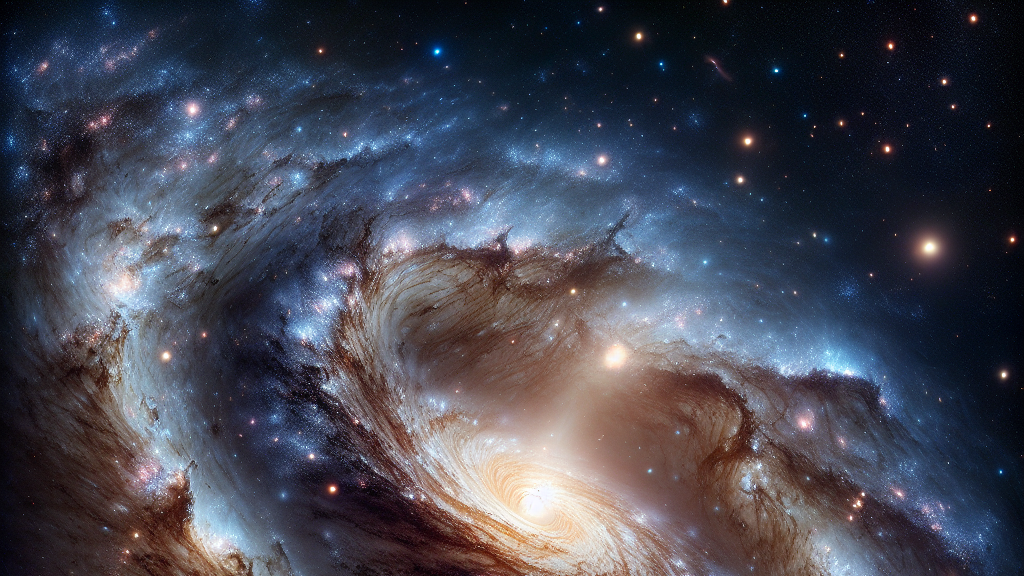
What if I told you the universe might be a bit older than we thought? Exciting new research hints that our cosmic home could have been around even longer than the commonly accepted age, revealing secrets that could change how we see the early universe and its earliest galaxies.

This research comes from the DESI Collaboration, which studied the universe’s expansion history using measurements of something known as redshift and Lyman-alpha. They propose that dark energy, which is this mysterious force pushing the universe apart, might have behaved differently in the past. This could mean the universe is around 15.5 billion years old, slightly older than what we thought. It also makes it fit better with the observations made by the JWST, a powerful space telescope that spotted very bright and developed galaxies much earlier in the universe’s history than expected.

If true, this could change our understanding of the universe’s timeline. Imagine if this older universe means galaxies formed stars differently, or that cosmic events happened in a different order than we thought. Such insights could help scientists as they study everything from star formation to the distribution of galaxies across the sky, potentially explaining some of those mysterious cosmic puzzles.

Did you know that the universe might be 15.5 billion years old, not just 13.8 billion?

FAQs

What does the DESI Collaboration’s research propose about dark energy?

The DESI Collaboration suggests that dark energy, which drives the universe’s expansion, might change with time, impacting how we calculate the universe’s age.

Why is the age of the universe important in science?

Understanding the universe’s age helps scientists piece together the timeline of cosmic events, like galaxy formation and the development of cosmic structures.

How does this research connect to the JWST observations?

The research aligns better with JWST’s discoveries of well-formed galaxies in the early universe by suggesting the universe might be older, allowing more time for such structures to form.

How might an older universe affect our understanding of cosmos?

An older universe could imply differences in star formation and galaxy evolution, affecting our models and predictions of cosmic history.

What is the significance of redshift and Lyman-alpha measurements?

Redshift and Lyman-alpha measurements are crucial for tracking the universe’s expansion and gathering data on cosmic objects over different periods.

Background

The concept of redshift relates to how the light from galaxies shifts towards the red part of the spectrum as they move away from us, helping measure how fast the universe is expanding. Lyman-alpha is a specific kind of spectral line useful in studying the early universe’s hydrogen clouds. Together, these measurements provide insights into the universe’s expansion and age, particularly in understanding mysterious dark energy.

History

For decades, scientists believed the universe was around 13.8 billion years old, a conclusion drawn from the study of cosmic microwave background radiation and galaxy movements. However, as our tools and methods improve, particularly with telescopes like the JWST and collaborations such as DESI, new data provides fresh insights. This study builds on previous work about cosmic expansion, fine-tuning our understanding of how dark energy might have worked across time.

Based on “Is the universe 15.5 Gyr old with time-dependent dark energy and galaxy formation at redshift 14?” by Kevin Cahill, available on arXiv (arxiv.org/abs/2504.06290), used under CC BY 4.0 (creativecommons.org/licenses/by/4.0/).

Trending

Latest

Can AI Save Water Discover How

Computers

AI is transforming the tech world, but it uses lots of water! A new tool, SCARF, helps us measure and reduce AI's water footprint,...

Whats a Forbush Decrease and Why Should We Care Whats a Forbush Decrease and Why Should We Care

Space

Scientists just observed the biggest solar storm event in years, revealing unexpected cosmic ray patterns. Understanding these changes could help us protect our technology...

Can Cars Spot Danger Faster Than Humans Can Cars Spot Danger Faster Than Humans

Computers

Think about how quickly you react when something unexpected happens on the road. This research brings us closer to creating self-driving cars that can...

Can Fear of the Other Stop Social Harmony Can Fear of the Other Stop Social Harmony

Physics

Fear of the unknown might make it harder for people to agree and get along. This study shows that when people have strong xenophobic...

Can AI Revolutionize Breast Cancer Diagnosis Can AI Revolutionize Breast Cancer Diagnosis

Electricity

This research introduces a groundbreaking AI model that can accurately assess HER2-positive breast cancer using widely accessible staining methods, potentially revolutionizing how we diagnose...

Can AI Transform Your Singing into a Choir Can AI Transform Your Singing into a Choir

Computers

Imagine singing solo and having AI turn you into a choir. This research unveils a groundbreaking AI tool that transforms your voice into rich...

You May Also Like

Space

Scientists have discovered a new way that tiny early-universe structures might grow into massive black holes, potentially changing our understanding of cosmic evolution! This...

Space

This research uncovers how setting a visibility limit on starlight reveals more realistic details about galaxies, helping us understand their size and mass better—crucial...

Space

This study explores how tiny space dust grains might escape a planet's grip and travel through the cosmos, potentially carrying life to other star...

Space

Scientists have found a novel way to measure dark matter around black holes using light echoes from space. This could change how we understand...

Space

Scientists have uncovered why some small galaxies are born without stars. It turns out, they lack the dense gas needed for star formation, thanks...

Space

Scientists are puzzled by the universe's changing speed, as it seems to be accelerating quickly at some points and slowing down at others. This...

Space

Scientists are exploring whether dark matter could be a cloud of super tiny particles, which may reshape our understanding of galaxies and the universe.

Space

Tiny blue galaxies, like the one studied, may hold clues to the early universe, but there's a puzzling twist: their high-energy emissions hint at...

Space

AI is now being used to unearth the secrets of outer space, tapping into the ultra-high energies of cosmic rays and galaxy formations to...

Copyright © 2024 8ig8rain.

Disclaimer: The content on 8ig8rain.com consists of AI-generated summaries of scientific abstracts from arXiv. Please note that most arXiv abstracts are preprints and may not have undergone formal peer review. While these summaries aim to convey key ideas and potential applications, they are provided for informational purposes only and should not be interpreted as validated scientific findings or professional advice. The summaries are intended to educate, spark curiosity, and inspire further exploration of science.