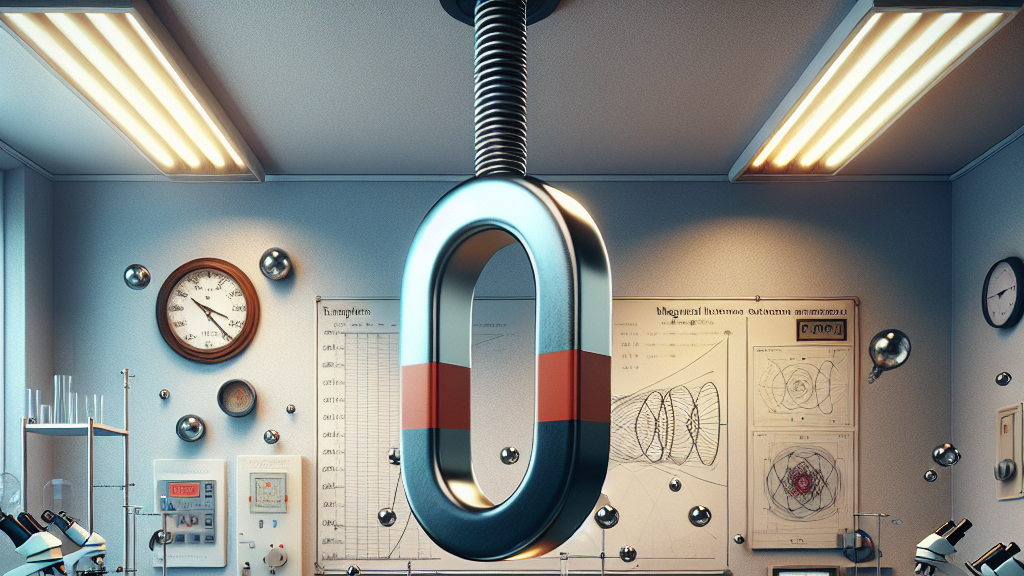
Imagine a tiny magnet just floating in the air, able to sense the faintest of magnetic fields around it. Sounds like sci-fi, right? But it’s real and happening now! Scientists have figured out how to levitate magnets without any mechanical contact, meaning there’s no noise messing things up. This is a huge deal because it allows us to sense things with unbelievable precision.
The secret lies in a system called diamagnetically stabilized magnetically levitated magnet magnetometer, or LeMaMa for short. Unlike typical methods that either need very cold temperatures or rely on tricky effects like the Meissner effect, this new approach works at everyday room temperature. By making the magnet float in mid-air, researchers can measure its motion with lasers, making it super sensitive to even the tiniest changes in the magnetic field. This beats traditional methods like SQUIDs that need freezing temperatures to work.
So, how does this matter in real life? Well, with this technology, doctors could develop better diagnostic tools, making it easier to detect diseases in the human body. Biologists could study the tiniest life forms that still give off a magnetic signature, and chemists could discover new reactions that rely on magnetic changes. Essentially, this could bring a whole new level of sensitivity to many fields that we touch every day.
Did you know? This levitated magnet system works at room temperature, unlike many other high-tech sensors that need freezing conditions.
FAQs
How does the levitated magnet system detect magnetic fields?
The levitated magnet system uses lasers to detect the tiny movements of a floating magnet, which change in response to the magnetic fields around it. This method is highly sensitive and works well at room temperature.
What advantages does the levitated magnet system have over traditional sensors?
This system doesn’t require freezing temperatures or mechanical contact, making it more practical and less noisy. It matches the precision of top technologies like SQUIDs and atomic magnetometers but operates in everyday conditions.
Could the levitated magnet system be used in healthcare?
Yes! Its sensitivity could lead to advancements in diagnostic tools, allowing for earlier detection of diseases by sensing subtle biological magnetism.
How does the levitated magnet system work at room temperature?
It uses strong spin-lattice coupling in a magnet to stabilize it and minimize noise, making it sensitive enough to operate effectively without needing cold or exotic conditions.
What fields could benefit from the levitated magnet system?
This technology can be applied in biology, chemistry, and fundamental physics—basically, any field needing precise measurement of magnetic changes, from medical diagnostics to environmental monitoring.
Background
Levitation technology, especially in the context of magnets, works by using magnetic fields to counteract gravity, allowing objects to float suspended in space. This eliminates mechanical contact that often introduces noisy disturbances. Spin-lattice coupling is a phenomenon where the magnetic properties of a material are strongly linked to its structural lattice, reducing noise in the system. Combining these allows for a highly sensitive detection method akin to traditional sensors like SQUIDs but operational at regular room temperatures.
History
Magnetic sensing has historically relied on techniques like SQUIDs (Superconducting Quantum Interference Devices), which necessitate low temperatures to limit interference. Developments in atomic magnetometers brought room-temperature operations but still shared limitations in range and practicality. This study leverages diamagnetic stabilization in levitation, minimizing energy loss and maximizing sensitivity without the need for cooler environments, marking an evolution towards more accessible and versatile sensing methods.
Based on “Levitated Sensor for Magnetometry in Ambient Environment” by Wei Ji, Changhao Xu, Guofeng Qu, Dmitry Budker, available on arXiv (arxiv.org/abs/2504.21524), used under CC BY 4.0 (creativecommons.org/licenses/by/4.0/).