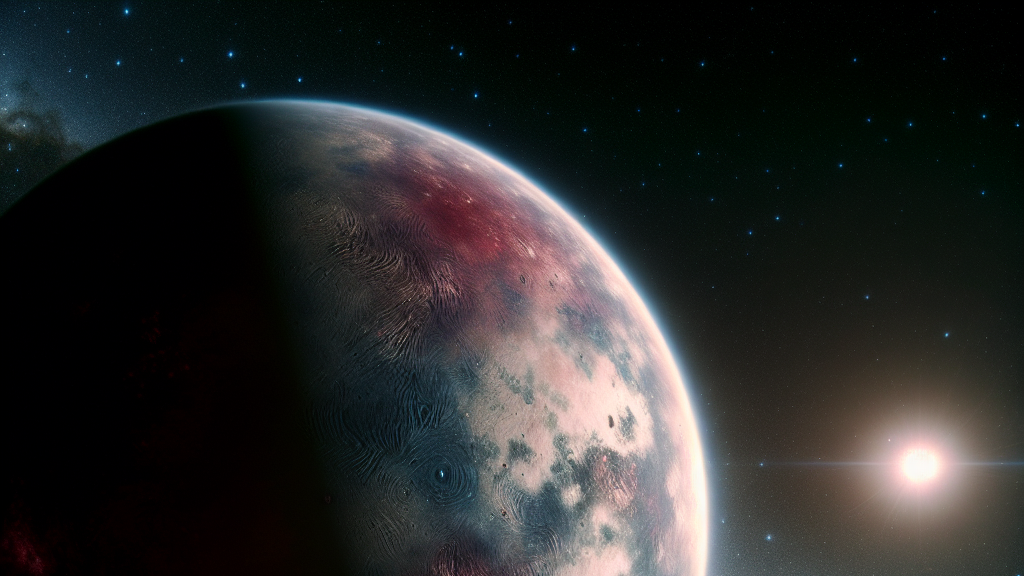
Have you ever imagined living on a planet where it’s always dark but somehow there’s ice and possibly even life? Scientists are exploring this fascinating possibility, especially on planets that orbit small stars known as M dwarfs. These planets could have something called a ‘runaway greenhouse effect’ on the side always facing the star, but the opposite side might just be cold enough to keep ice caps, offering a hidden spot for life to thrive.
This research focuses on understanding how water, a crucial ingredient for life, might behave on these alien worlds. By using computer models, researchers found two completely different climate states—one where the planet is warm and unstable and one where it is cold and stable. This means that even though the sun-facing side of these planets might be too hot, their dark sides could still sustain ice, potentially creating a habitable environment despite the extreme conditions.
So why should we care if there’s ice on the dark side of a planet millions of miles away? Well, if these ice caps can exist, it suggests there might be more places in the universe capable of supporting life than we ever thought possible. Imagine future missions discovering thriving ecosystems in the most unexpected places, reshaping our understanding of where life can exist!
Did you know? On tidally locked planets, the same side always faces their star, just like the Moon always shows the same face to Earth!
FAQs
What are tidally locked planets?
Tidally locked planets are worlds where one side always faces their star, resulting in a permanent day on one side and a perpetual night on the other.
How could ice caps exist on the dark side of these planets?
Despite the extreme heat on the star-facing side, if the movement of heat through the atmosphere is inefficient, the dark side could stay cold enough to sustain ice caps, potentially creating a habitable environment.
What is the runaway greenhouse state mentioned in the research?
The runaway greenhouse state is a condition where a planet’s atmosphere traps so much heat that it leads to extreme temperatures, preventing water from condensing into ice or liquid form.
Why is this research about planets around M dwarf stars important?
M dwarf stars are the most common type of star in our galaxy, which means many planets orbit these stars. Understanding their climate better helps us assess their potential for habitability.
What is unique about the two equilibrium states found in the research?
The two equilibrium states show that these planets can be both warm and unstable or cold and stable, which is crucial for understanding how they may support ice and potentially life.
Background
The study delves into the climate behaviors of planets that orbit M dwarf stars, which are cooler and smaller than our Sun. These planets could have ‘runaway greenhouse’ conditions, where heat is trapped on the daylight side. However, atmospheric dynamics might prevent heat from reaching the dark side, allowing for ice caps—regions that might support life. The research uses models simulating this heat transfer and water behavior to predict conditions on these planets, which are often tidally locked, meaning one side constantly faces their star.
History
The concept of tidally locked planets isn’t new; our Moon is an example close to home, always showing Earth the same face. Previous studies on planets around M dwarf stars, like those by Leconte in 2013, suggested that inefficient heat transport in such environments could allow ice caps to form on the dark sides. This research refines those theories by examining how water transitions from vapor back to ice, offering insights into the potential habitability of these unique worlds.
Based on “Retention of surface water on tidally locked rocky planets in the Venus zone around M dwarfs” by Yueyun Ouyang, Feng Ding, Jun Yang, available on arXiv (arxiv.org/abs/2505.13066), used under CC BY 4.0 (creativecommons.org/licenses/by/4.0/).