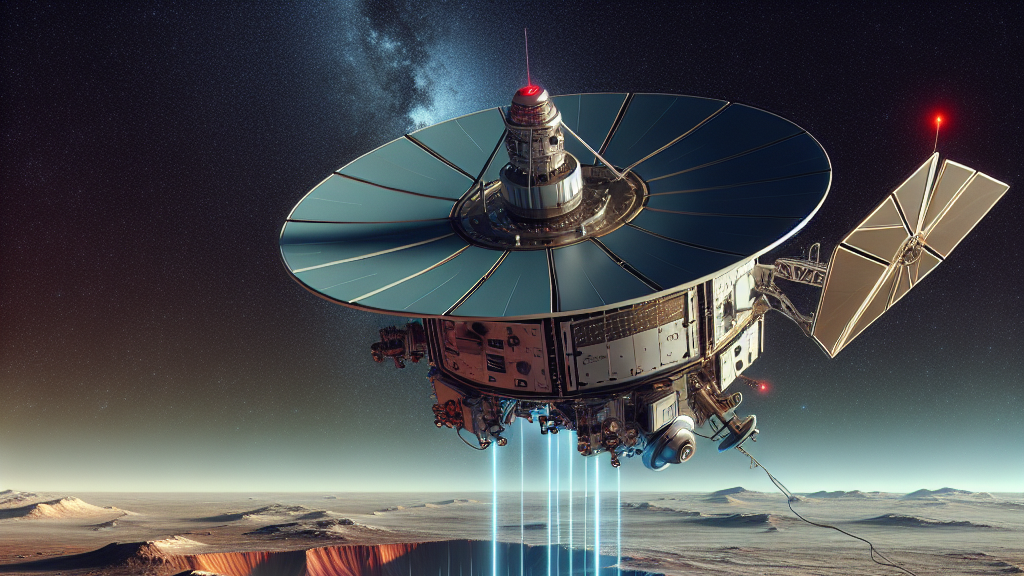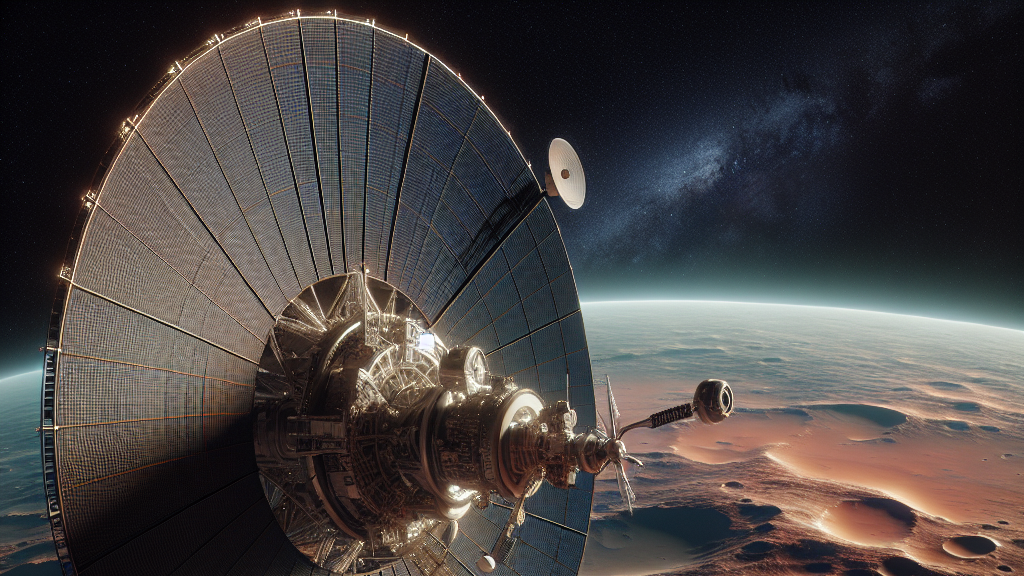
Unveiling the mysteries of Mars has just become a lot more exciting! Scientists have found a way to make our Mars Reconnaissance Orbiter (MRO) even more powerful by daringly rolling it at extreme angles. This bold maneuver dramatically enhances the radar’s ability to peek beneath Mars’ surface, revealing secrets we never thought we’d see.
So, what’s the big deal about rolling a spacecraft like a daredevil? Well, the MRO’s radar, called SHARAD, wasn’t in the best spot to get the clearest signals. So scientists figured out that by rolling the spacecraft to 120 degrees, they could massively boost the clarity of the radar signals. And the results? Astounding images showing incredible detail and depth that was once out of reach, unearthing Mars’ hidden layers like never before.
Imagine discovering ancient ice layers or unseen valleys deep under Mars’ crust just by adjusting an angle in space. The implications are huge — not only for understanding Mars better but also for future missions. Who knows what hidden secrets these new perspectives might reveal? The next step: exploring polar terrains and even more mysterious midlatitude locations on Mars. The sky’s no longer the limit; it’s just the starting point!
The Mars Reconnaissance Orbiter can roll a massive 120 degrees to get a better look beneath the Martian surface.
FAQs
How did the Mars Reconnaissance Orbiter improve radar signal clarity?
By rolling the spacecraft at extreme angles, scientists improved the positioning of its radar, resulting in clearer and more detailed signals.
What did the radar’s enhanced signal reveal on Mars?
The improved radar signals unveiled deeper layers beneath the Martian surface, including ice and terrain details that were previously hidden.
Why is the Mars Reconnaissance Orbiter’s radar position important?
The radar’s position is crucial for obtaining clear signals; by strategically rolling the orbiter, scientists enhanced the radar’s effectiveness in exploring Mars.
What terrain benefits the most from this maneuver?
Low dielectric terrains, like Medusae Fossae, showed significant discoveries, with radar detecting deep layers previously unreachable.
What are the future plans for these Mars Reconnaissance Orbiter maneuvers?
Scientists plan to conduct more observations over polar terrains and explore more mysterious areas to uncover Mars’ secrets.
Background
The Mars Reconnaissance Orbiter is equipped with a radar called SHARAD, which helps scientists study the planet’s surface and subsurface. By analyzing returned radar signals, they can infer the composition and structure of Martian terrain. Signal clarity is crucial for these analyses, which is improved by the strategic rolling of the spacecraft.
History
Mars exploration has seen numerous advancements, with major missions orbiting and landing on the planet. The MRO has been a pivotal player, and its radar studies have evolved over time. Previous observations were limited by signal clarity, but recent maneuvers have drastically enhanced the radar’s potential, building on decades of Martian research.
Based on “SHARAD Illuminates Deeper Martian Subsurface Structures with a Boost from Very Large Rolls of the MRO Spacecraft” by Nathaniel E. Putzig, Gareth A. Morgan, Matthew R. Perry, Bruce A. Campbell, Jennifer L. Whitten, Fabrizio Bernardini, Alessandro DiCarlofelice, Piero Tognolatti, Pierfrancesco Lombardo, available on arXiv (arxiv.org/abs/2505.21810), used under CC BY 4.0 (creativecommons.org/licenses/by/4.0/).