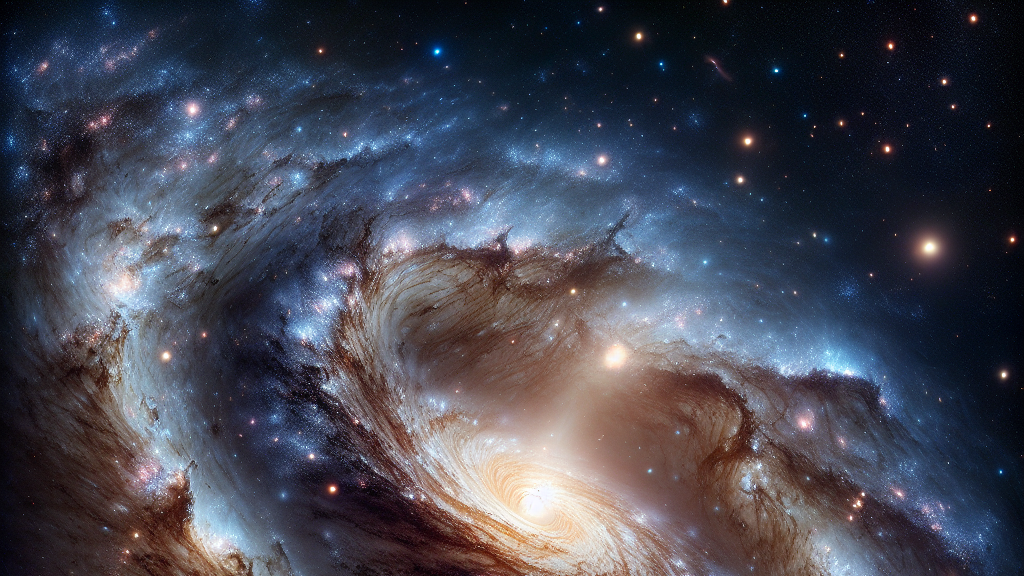
**What if I told you that the universe might be filled with ghostly clouds made of ultra-light particles, shaping galaxies like a cosmic artist?** Scientists think that dark matter, a mysterious and invisible substance that makes up most of the universe, could be made up of particles so light and cool they form a unique shape called a soliton. Imagine a cloud that changes its form depending on the amount of dark matter in a galaxy—it’s like the universe is sculpting itself from the inside out.
Researchers are diving into the intriguing math behind these particles to predict how this ‘dark’ cloud behaves. By solving complex equations, they found that if a galaxy has less dark matter, the soliton shape becomes more pointed, almost like the shape of a hydrogen atom. They used a special method to connect these soliton shapes with how fast stars move around galaxies, which helps us understand the relationship between these mysterious particles and the visible universe.
The idea doesn’t just stop at understanding shapes; it might change how we think about the universe’s evolution. If dark matter is like a ghostly cloud of light particles, it could even suggest that these particles are photons with a tiny mass. This could affect everything from how galaxies form to the behavior of light, providing new angles on age-old cosmic puzzles. Who knows? One day, we might be able to see these dark matter particles evaporate and reshape our universe in real-time!
Dark matter is believed to make up about 27% of the universe, but it doesn’t emit or interact with light, making it almost completely invisible to us!
FAQs
What is dark matter and why is it important?
Dark matter is a mysterious, invisible substance that makes up most of the universe. Its gravitational effects shape galaxies and its study could answer fundamental questions about the universe’s structure and evolution.
How do scientists propose dark matter could be ultra-light particles?
Scientists suggest that dark matter could consist of Bose-Einstein-Condensates, collections of ultra-light particles that behave in a unified way, potentially forming a soliton shape and impacting galaxy formation.
What is a soliton and how does it relate to dark matter?
A soliton is a self-reinforcing wave that maintains its shape. In the context of dark matter, scientists propose soliton shapes represent how these particles might arrange themselves within galaxies.
How could this research change our understanding of galaxies?
If dark matter is made of tiny light particles, it could explain how galaxies form and evolve, offering new insights into their structure and behavior over time.
Are there real-world implications of viewing dark matter as photon condensates?
If dark matter particles are photon condensates, it could potentially affect the fundamental understanding of light and its interactions, leading to innovations in optical technologies.
Background
The research delves into the theory that dark matter might consist of extremely light particles forming a Bose-Einstein-Condensate, a state of matter where particles behave collectively. The focus is on soliton shapes, unique formations that occur in this state, and how they vary with the mass of dark matter in galaxies. This involves complex mathematical models, specifically the Schrödinger-Poisson equation, and how these shapes correlate with observable star behaviors.
History
The idea of dark matter dates back to the early 20th century when astronomers observed that galaxies rotated in ways that visible matter alone couldn’t explain. Over the decades, various theories about dark matter’s composition emerged, including the possibility of ultra-light particles. The study builds on both numerical simulations and earlier analytical models to refine our understanding of dark matter’s potential structure and interaction with galaxies.
Based on “Shape Shifting Light Dark Matter Solitons” by Dor Ben-Amotz, available on arXiv (arxiv.org/abs/2506.01282), used under CC BY 4.0 (creativecommons.org/licenses/by/4.0/).