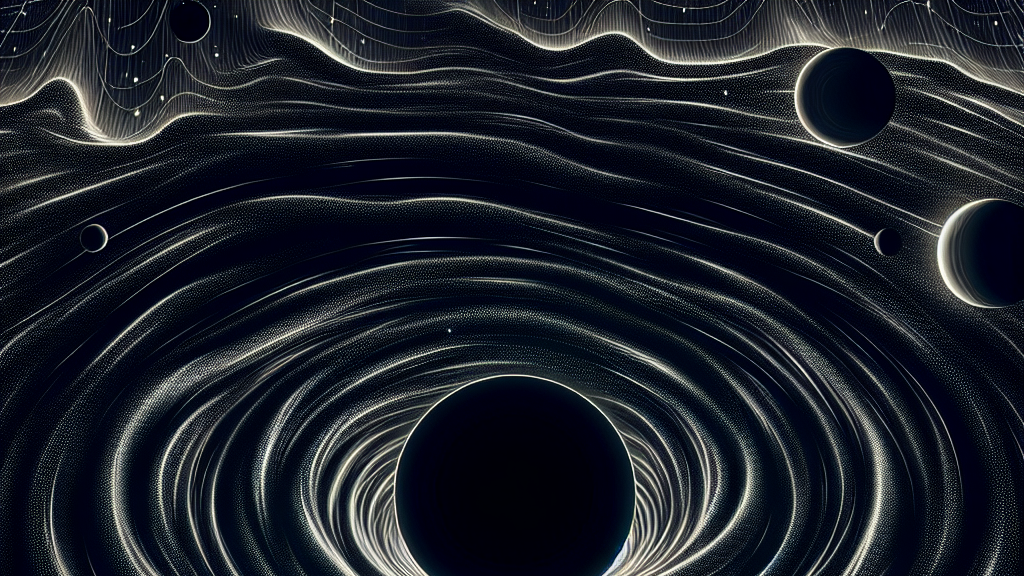
Imagine a cosmic dance happening right over our heads, where dark matter and black holes could be revealing the hidden secrets of our universe. These dark, dense clouds form around supermassive black holes, creating the perfect stage for extreme mass-ratio inspirals. These are events where smaller stars spiral into these hungry giants, sending out ripples of gravitational waves that we can now catch in action.
With cutting-edge technology from space observatories like LISA and Taiji, we can ‘hear’ these gravitational waves and decipher what they tell us about the dark matter around these black holes. Our study dives deep into how dark matter affects these cosmic spirals in the center of our Milky Way. We found that dark matter changes the paths of these stellar objects and tweaks the gravitational waves they emit, creating telltale signs we might soon detect.
The implications are cosmic! Imagine being able to map dark matter by listening to the tunes of the universe. This could revolutionize our understanding of space. The next time a gravitational wave whispers by, it could be one more clue in the puzzle of dark matter, unlocking the secrets of galaxies far, far away. We could one day predict cosmic events or even unlock new sources of futuristic energy just by understanding these mysterious processes in space!
Did you know that gravitational waves are like the universe’s own sound? We can’t hear them with our ears, but scientists can ‘see’ them with special detectors like LISA and Taiji.
FAQs
How does dark matter affect gravitational waves?
Dark matter can influence the path of stellar objects spiraling into supermassive black holes, altering the gravitational waves they emit. This creates detectable changes in the waves’ spectrum.
What is an extreme mass-ratio inspiral?
An extreme mass-ratio inspiral is a cosmic event where a smaller star or black hole spirals into a larger supermassive black hole, emitting gravitational waves as it goes.
Why are space observatories like LISA and Taiji important?
These observatories are crucial because they detect gravitational waves emitted by cosmic events, helping us understand phenomena like dark matter’s influence on such waves.
How might this research advance our understanding of the universe?
This research helps us map dark matter, providing insights into the universe’s structure and evolution. It could lead to breakthroughs in cosmology and astrophysics.
Could this research impact future technology?
By understanding gravitational waves better, we might develop technologies to harness these cosmic signals, potentially leading to new advancements in energy or communications.
Background
Imagine a giant, invisible spiderweb spun around the universe. That’s dark matter for you. It’s something we cannot see but know exists because of its gravitational pull on cosmic objects. Gravitational waves, on the other hand, are ripples in space-time itself, generated by massive objects moving in space, like black holes and neutron stars spiraling together. Scientists measure these ripples to understand more about the universe’s structure, including its hidden dark matter.
History
The concept of dark matter has been around for nearly a century, with astronomers initially observing its effects on galaxy rotations. Later, Einstein’s theory of general relativity predicted gravitational waves, but it wasn’t until 2015 that they were directly observed. This new research builds on both concepts, combining them to explore how dark matter might affect these cosmic ripples and what that can reveal about our universe.
Based on “Probing Dark Matter Spike with Gravitational Waves from Early EMRIs in the Milky Way Center” by Chen Feng, Yong Tang, Yue-Liang Wu, available on arXiv (arxiv.org/abs/2506.02937), used under CC BY 4.0 (creativecommons.org/licenses/by/4.0/).