Connect with us

Search by keyword

Space

What’s Special About Jellyfish Galaxies?

Jellyfish galaxies are cosmic wonders where dramatic transformations happen because of their harsh surroundings. This study reveals how their unique ‘tails’ hint at active, supermassive black holes at their hearts, making these galaxies a fascinating focus for understanding the universe’s dynamic processes.

Whats Special About Jellyfish Galaxies
✨Researched by humans. Explained by robots. Learn more.

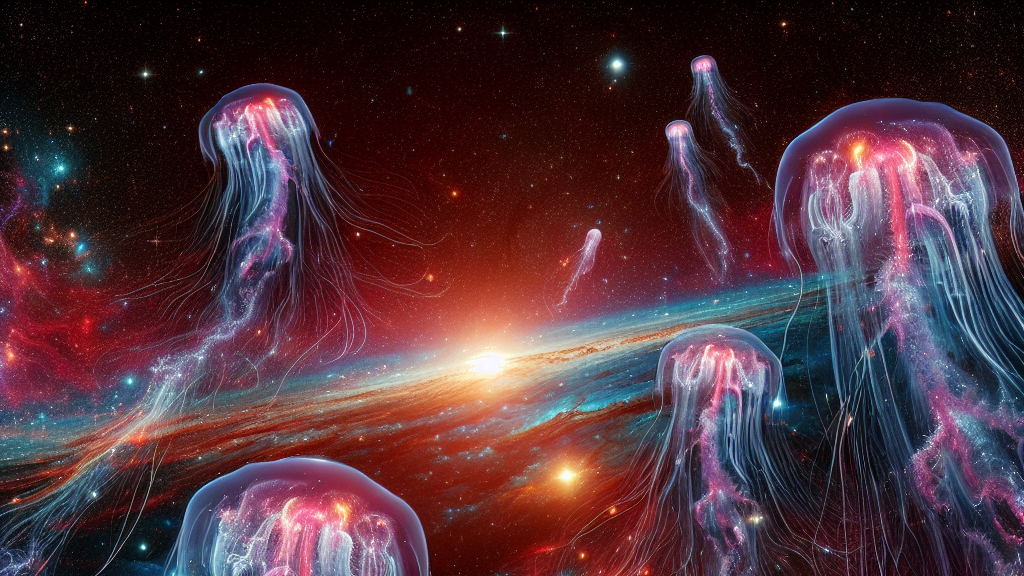
Imagine galaxies that look like jellyfish, floating through the ocean of space with long, trailing tails. These aren’t just pretty sights; they’re cosmic mysteries that tell us about the wild transformations happening in the universe. Such galaxies are ripped and shaped by the fierce forces in space, leading them to form stunning tails made of gas.

This research dives into the intriguing world of these jellyfish galaxies and their hotshot centers, known as active galactic nuclei, or AGN. Scientists used super-smart simulations called IllustrisTNG to bring these galaxies to life. They found that jellyfish galaxies are much more likely to host these supermassive black holes at their cores compared to their calmer counterparts. What’s causing this? The intense pressure from their surroundings strips away their gas, fueling the black holes and kick-starting wild activity within the galaxies.

Why should we care about these space oddities? Well, discovering why jellyfish galaxies are so active could unlock new secrets about how galaxies form and evolve over time. This knowledge could even help us understand what’s happening in our own galaxy. Imagine, one day, using what we’ve learned to fuel new technologies inspired by the universe’s hidden mechanics. It’s like having a sneak peek into the thrilling drama of the cosmos!

Jellyfish galaxies can glow bright with activity, thanks to their central black holes devouring gas like a cosmic buffet.

FAQs

What makes jellyfish galaxies unique in space?

Jellyfish galaxies are fascinating because they have long, trailing gas tails caused by intense pressure exerted by their environment. This makes them look like cosmic jellyfish floating through space!

How do jellyfish galaxies help us understand black holes?

These galaxies often have active supermassive black holes at their centers, which scientists think are fed by gases stripped from the galaxy. Studying them helps us learn more about how black holes grow and influence their surroundings.

Why do scientists use simulations to study jellyfish galaxies?

Simulations allow scientists to recreate the complex environment where jellyfish galaxies exist, helping them analyze how different factors contribute to galaxy transformations and black hole activity.

Are jellyfish galaxies more common than other galaxies?

No, they are not as common as other types of galaxies. Their unique and dramatic changes happen primarily because of the extreme environments they inhabit.

Could studying jellyfish galaxies lead to new technological advancements?

Understanding the processes within jellyfish galaxies could inspire new technologies by revealing the principles of energy transfer and transformation in extreme environments.

Background

When galaxies wander into dense galactic clusters, the pressure from the surrounding gas can strip them of their own gas. This phenomenon, called ram-pressure stripping, is what gives jellyfish galaxies their unique gas tails. The pressure pushes gas out, but it can also compress it at the galaxy’s core, potentially triggering activity in the central black hole, known as an active galactic nucleus.

History

The concept of ram-pressure stripping has been around for decades, explaining how galaxies can lose gas when they move through dense clusters. Over time, this understanding has evolved, linking these transformations to the presence and activity level of black holes at the centers of galaxies. This study builds upon this knowledge by using advanced simulations to explore these phenomena in even greater detail.

Based on “Jellyfish galaxies with the IllustrisTNG simulations — Supermassive black hole activity in dense environments with ram-pressure stripped satellites” by Shalini Kurinchi-Vendhan, Eric Rohr, Annalisa Pillepich, Elad Zinger, Mohammadreza Ayromlou, Gandhali D. Joshi, available on arXiv (arxiv.org/abs/2506.05474), used under CC BY 4.0 (creativecommons.org/licenses/by/4.0/).

Trending

Latest

Can AI Save Water Discover How

Computers

AI is transforming the tech world, but it uses lots of water! A new tool, SCARF, helps us measure and reduce AI's water footprint,...

Whats a Forbush Decrease and Why Should We Care Whats a Forbush Decrease and Why Should We Care

Space

Scientists just observed the biggest solar storm event in years, revealing unexpected cosmic ray patterns. Understanding these changes could help us protect our technology...

Can Cars Spot Danger Faster Than Humans Can Cars Spot Danger Faster Than Humans

Computers

Think about how quickly you react when something unexpected happens on the road. This research brings us closer to creating self-driving cars that can...

Can Fear of the Other Stop Social Harmony Can Fear of the Other Stop Social Harmony

Physics

Fear of the unknown might make it harder for people to agree and get along. This study shows that when people have strong xenophobic...

Can AI Revolutionize Breast Cancer Diagnosis Can AI Revolutionize Breast Cancer Diagnosis

Electricity

This research introduces a groundbreaking AI model that can accurately assess HER2-positive breast cancer using widely accessible staining methods, potentially revolutionizing how we diagnose...

Can AI Transform Your Singing into a Choir Can AI Transform Your Singing into a Choir

Computers

Imagine singing solo and having AI turn you into a choir. This research unveils a groundbreaking AI tool that transforms your voice into rich...

You May Also Like

Space

Scientists have discovered a new way that tiny early-universe structures might grow into massive black holes, potentially changing our understanding of cosmic evolution! This...

Space

Scientists have discovered a stunning jellyfish galaxy far away in space, where intense cosmic forces are stripping away its layers like peeling an onion....

General Relativity and Quantum Cosmology

Researchers have uncovered a potential connection between the behavior of black holes and elusive dark matter particles. This exciting discovery may change how we...

General Relativity and Quantum Cosmology

Imagine using a tabletop setup to mimic the intense gravitational effects of a black hole! These 'gravity simulators' are pushing the boundaries of what...

General Relativity and Quantum Cosmology

Scientists are finding that black holes might not be the simple, spherical giants we once thought—they could have fractal edges, with surprising effects on...

General Relativity and Quantum Cosmology

Ever wondered if black holes could be studied right here on Earth? Scientists are using creative lab setups to mimic the strange physics around...

General Relativity and Quantum Cosmology

Scientists are bringing the mysteries of black holes into the lab by creating small-scale experiments that simulate their incredible gravitational forces. This means we...

Space

Dark matter around black holes might help us detect subtle cosmic signals, leading to new discoveries about the universe with advanced space technology.

Math

Scientists have harnessed AI to model shockwaves around black holes, which could revolutionize our understanding of extreme space environments, potentially impacting future space exploration...

Copyright © 2024 8ig8rain.

Disclaimer: The content on 8ig8rain.com consists of AI-generated summaries of scientific abstracts from arXiv. Please note that most arXiv abstracts are preprints and may not have undergone formal peer review. While these summaries aim to convey key ideas and potential applications, they are provided for informational purposes only and should not be interpreted as validated scientific findings or professional advice. The summaries are intended to educate, spark curiosity, and inspire further exploration of science.