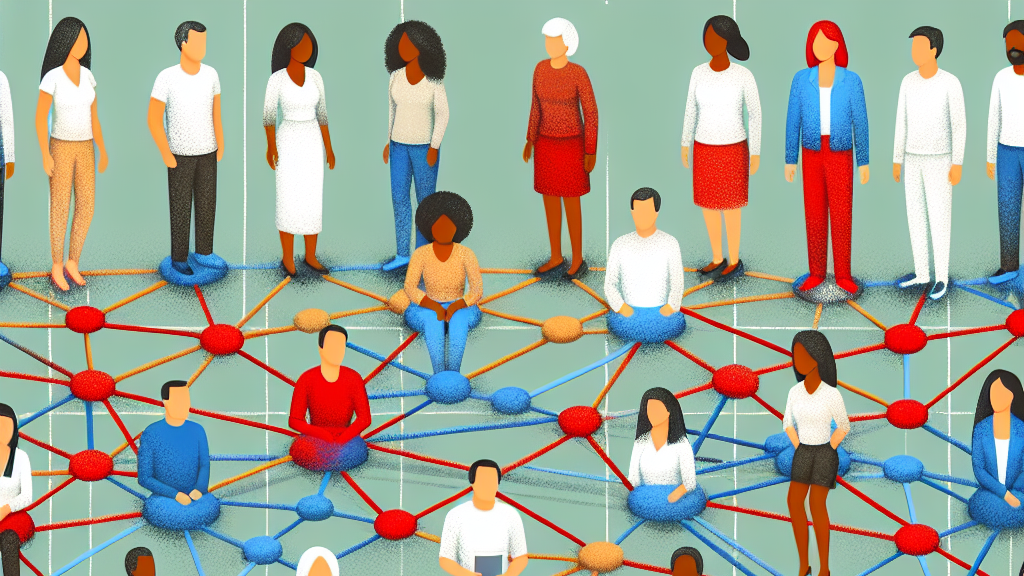
**Did you know that giving someone a health tip could change who they trust?** That’s the intriguing finding from a study in 110 remote Honduran villages. By delivering a public health intervention to select villagers, researchers observed shifts in social networks, uncovering how information can influence social ties and community dynamics. It’s fascinating to see that spreading health advice isn’t just about improving individual health; it can actually alter the whole social fabric of a community, affecting friendships and financial ties as well!
In this remarkable study, villages were divided into different groups based on how many people received health information—some got a little, others got a lot. In places where only a few received the tips, people tended to drift away from those not involved, breaking ties with past advisors. But in villages where many participated, everyone seemed to connect more, broadening their social circles. This shows the power of information—not just to educate, but to transform relationships among people who might otherwise not interact.
Think about it like this: say you’re in a small town where few people have ever talked about health regularly. Suddenly, some start sharing new advice they’ve learned. If only a handful of people are involved, they might shy away from those out of the loop. But when everyone’s in on it, there’s a buzz—more conversations, more connections, and perhaps even new friendships. In the future, such interventions could be used not just to spread valuable health information but also to stitch a community closer together, proving that health advice could be the key to stronger, more connected societies.
A simple health information campaign in a village can either break or strengthen social ties, depending on its reach.
FAQs
How did health information change social networks in Honduran villages?
Health information altered social networks by influencing whom individuals in remote Honduran villages trusted and interacted with, either breaking ties with uninformed peers in low-dosage villages or strengthening connections in high-dosage villages.
What was the purpose of providing health information to villagers?
The purpose was to improve public health while examining how such information affects existing social networks, potentially leading to changes in whom villagers trust and maintain connections with.
Why are social connections important in a community?
Social connections in a community are vital because they facilitate the exchange of information, ideas, and support, strengthening community bonds and collective action, affecting the overall well-being and resilience of the community.
Can changes in networks affect areas beyond health?
Yes, changes in networks can extend beyond health, impacting broader social, economic, and friendship ties in a community, as new connections foster diverse forms of collaboration and support.
What is a real-world implication of modifying social networks through interventions?
One implication is the potential to use network-based interventions for other societal issues like spreading educational resources or addressing misinformation, leveraging the power of connections to foster positive community changes.
Background
Social networks are intricate webs of relationships between individuals through which information, trust, and support flow. They’re influential in shaping behaviors and outcomes within communities, making them critical in designing interventions that can improve community well-being. The concept of network statistics like degree distribution helps in understanding the structure of these networks, indicating who is more or less connected.
History
The study of social networks in the context of interventions has evolved from merely observing relationships to actively understanding how interventions like information dissemination can alter these networks. Previous research highlighted how networks influence behavior, but recent studies focus on how networks themselves can change as a result of deliberate actions like health interventions, indicating a shift towards using networks as tools for social change.
Based on “Educational Intervention Re-Wires Social Interactions in Isolated Village Networks” by Marios Papamichalis, Laura Forastiere, Edoardo M. Airoldi, Nicholas A. Christakis, available on arXiv (arxiv.org/abs/2506.10496), used under CC BY 4.0 (creativecommons.org/licenses/by/4.0/).