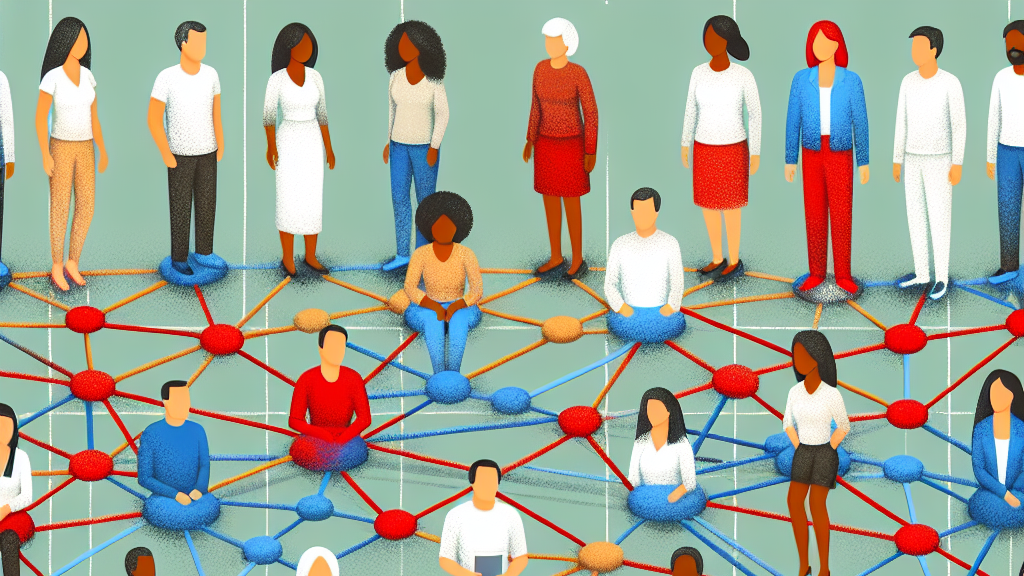
Ever wondered how the cost of keeping up friendships influences your willingness to cooperate? It’s a bit like playing a game where sometimes you win and sometimes you lose, but the stakes are all about kindness and teamwork. This study dives into the mysterious world of social networks and how they affect our behavior in fascinating ways. By analyzing the costs of maintaining our social links, researchers discovered that there’s a tipping point where our cooperation levels dramatically change. Imagine being super cooperative with your friends until suddenly, keeping in touch requires too much from you, and your teamwork takes a hit. That’s exactly what they found! Our cooperative spirit can shift dramatically based on how much energy and resources we need to invest in our social ties. Interestingly, as more people join the network, these shifts become quicker and more evident, but the time spent in each cooperative or non-cooperative state remains consistent.
The research uses a classic scenario known as the Prisoner’s Dilemma, a game theory model that helps explain cooperation and competition, to test these social dynamics. This is played out on a special kind of social network where some links cost more to keep alive than others. Researchers used advanced computer simulations to mimic interactions and saw how different ‘maintenance costs’ for friendships swung our tendency to cooperate. It’s like having a meter that measures how much you value different friendships and adjusting your behavior accordingly!
Imagine a world where we can predict and enhance cooperation in our communities simply by adjusting social network designs! Knowing that the cost of maintaining friendships affects how cooperative we are could lead to changes in how online networks are built and managed. It might mean creating better algorithms that focus on meaningful connections rather than sheer numbers, making our online experiences more fulfilling and harmonious.
Did you know? In the study, social networks with more fluctuating friendship costs led to unpredictable cooperation levels!
FAQs
How does the cost of maintaining social links influence behavior in the Prisoner’s Dilemma?
The research shows that as the cost to maintain social links increases, cooperation can drop dramatically. It’s like having to spend more effort and resources on keeping friendships alive, which makes people less inclined to cooperate.
What happens to cooperation levels as more people join the network?
While the critical region where cooperation changes shrinks with a bigger population, the time people spend being cooperative or not remains the same. More members make cooperation shifts faster, but the pattern of switching between states stays unchanged.
Why is the Prisoner’s Dilemma used in this study?
The Prisoner’s Dilemma is a well-known model to study cooperation and competition. It’s useful for understanding how individuals decide to cooperate or compete, especially when considering social connections and costs.
What could this research mean for social media platforms?
This study suggests that by understanding the cost of social links, platforms could be designed to enhance meaningful interactions. It could lead to better algorithms that focus on quality over quantity, fostering more cooperative and positive online environments.
How might this research apply to real-world communities?
By applying these findings, communities might improve cooperation among members by managing social connection costs. This could lead to stronger, more supportive social structures both online and offline.
Background
The Prisoner’s Dilemma is a popular model in game theory used to study cooperation and competition. It involves two players who can choose to cooperate or betray the other, with outcomes dependent on the combination of their choices. The Barabási-Albert model, used here, is a method to generate scale-free networks, where some nodes (or people, in this context) are more connected than others, mimicking real-world social networks.
History
This study builds on foundational game theory, particularly the Prisoner’s Dilemma, which has been used since the 1950s to explore strategic decision-making. Over the years, researchers have used various models to understand cooperation in different contexts, with scale-free networks becoming a focus in more recent years due to their realistic representation of social connections. This research adds a new layer by considering the cost of maintaining social links.
Based on “Phase transitions in the Prisoner’s Dilemma game on the Barabási-Albert graph with participation cost” by Jacek Miękisz, Javad Mohamadichamgavi, available on arXiv (arxiv.org/abs/2505.23370), used under CC BY 4.0 (creativecommons.org/licenses/by/4.0/).