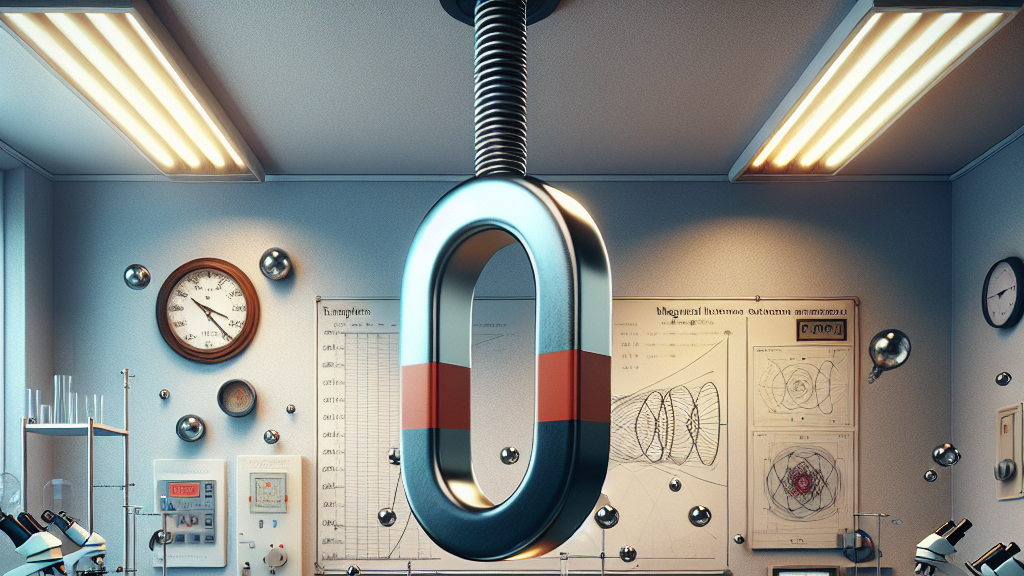
Imagine a tiny magnet floating in mid-air, unlocking mysteries about the very fabric of our universe. That’s exactly what scientists are doing with their latest intriguing experiment, using a magnetically levitated particle to search for forces that challenge our understanding of gravity as described by Newton. It’s like having a portal open in your living room, peeking into the mysteries of physics!
This groundbreaking research, named MORRIS, involves a small magnet suspended in a superconducting trap, wiggling like a pendulum as scientists look for something extraordinary—new types of forces that could exist alongside gravity, acting differently at small scales. By measuring slight movements and interactions, they hope to spot a new ‘fifth force’ that could revolutionize our future understanding of physics, much like how discovering atoms transformed chemistry.
If we can find such a force, it could lead to technologies straight out of science fiction, like advanced propulsion methods or even new ways to produce energy. Imagine a world where devices float and move without friction, tapping into hidden forces of nature. MORRIS brings us a step closer to this reality by pushing the boundaries of what we think we know about gravity—an experiment showing that sometimes the biggest ideas begin at the smallest scales.
Did you know that some scientists believe there might be more than the four known fundamental forces? The fifth force is one of the biggest mysteries physics hopes to unravel.
FAQs
What is the MORRIS experiment about?
The MORRIS experiment uses a levitating magnet to search for new forces beyond known gravity. It aims to detect a potential fifth force, which might change how we understand fundamental physics.
How can a tabletop magnet change our understanding of gravity?
By observing how a levitating magnet interacts with its environment, researchers can detect forces that don’t align with current gravity laws. Discovering such forces could revolutionize our knowledge of physics.
Why is discovering a fifth force significant?
Finding a fifth force would expand our understanding of the universe, similar to how discovering electromagnetism expanded the four known forces. It could lead to innovative technologies and alter our perception of physics.
Why use a magnetically levitated particle?
Levitating particles reduce interference from other forces and minimize friction, making it easier to detect subtle influences from potential new forces like the proposed fifth force.
What could be the real-world implications of finding a fifth force?
Identifying a fifth force might enable new energy production methods and improved technologies, potentially transforming everything from transportation to communication.
Background
At the heart of the MORRIS experiment is the search for a ‘fifth force.’ In physics, we recognize four fundamental forces: gravity, electromagnetism, the strong nuclear force, and the weak nuclear force. A fifth force would represent a new, unexplored interaction that doesn’t fit these categories. Scientists believe that exploring such forces might help uncover new physics beyond the Standard Model, which is the framework currently used to describe most particle interactions but is known to be incomplete.
History
The concept of forces beyond the established four has been around for decades, especially after the idea of unified field theories gained traction. Earlier studies attempted to detect these subtle forces using various instruments and setups. However, recent advances in technology allow for more sensitive experiments like MORRIS, which uses the novel approach of levitating magnets to minimize interference, offering greater precision and the potential to surpass previous experimental bounds.
Based on “The MORRIS Experiment: Magnetic Levitation as a New Probe of Non-Newtonian Gravity” by Dorian W. P. Amaral, Tim M. Fuchs, Hendrik Ulbricht, Christopher D. Tunnell, available on arXiv (arxiv.org/abs/2506.17385), used under CC BY 4.0 (creativecommons.org/licenses/by/4.0/).