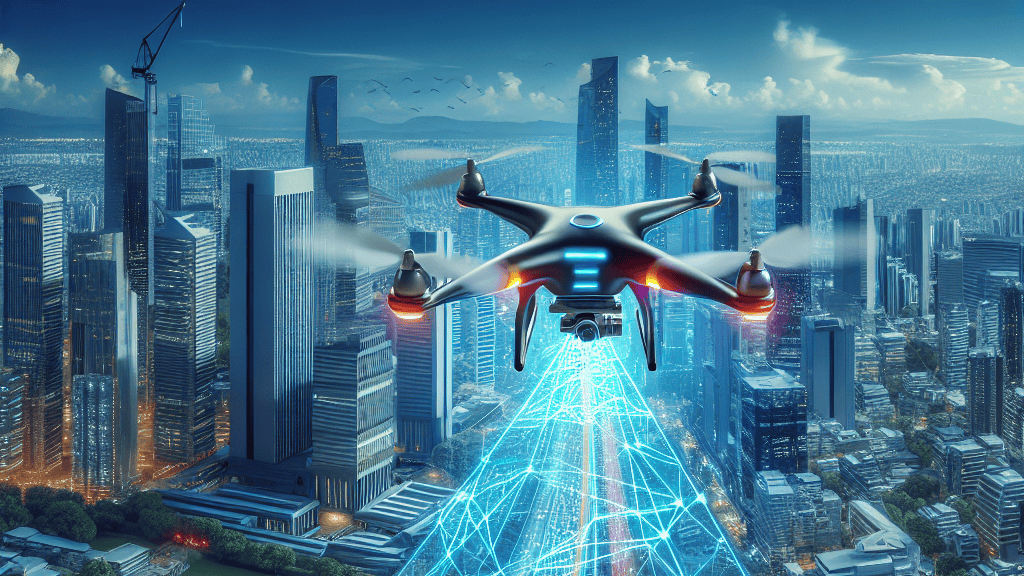
Imagine a world where delivery drones zip around the sky, each one skillfully navigating obstacles, delivering packages safely and swiftly to your doorstep. This isn’t just a scene from a sci-fi movie but a potential future reality thanks to a groundbreaking new algorithm developed for unmanned aerial vehicles (UAVs). This smart navigation system is designed to plot out the best possible flight path, ensuring drones can complete their tasks as efficiently and safely as possible.
The heart of the research lies in a new method called navigation variable-based multi-objective particle swarm optimization (NMOPSO). Simply put, it’s a clever way to help drones decide the best route to take. By transforming the path planning chore into an optimization problem, this method takes various aspects into account, like maneuverability and safety. It uses a blend of sophisticated problem-solving techniques and kinematic constraints specific to drones to make this process smooth and efficient. The algorithm even adapts as it goes, improving its decisions by considering a wide array of possible solutions, ultimately choosing the best ones.
What does this mean in the real world? Picture a future where drone delivery isn’t a gamble but a streamlined, reliable service. With this new technology, drones could potentially deliver your online shopping orders faster and more reliably, making aerial delivery as dependable as standard courier services today. By ensuring that drones can fly more smoothly and safely, this innovation promises to reduce operational risks and improve efficiency, making drones an even more integral part of our everyday lives.
Drones could navigate complex skies using a new path-planning algorithm that mimics swarming bees!
FAQs
What unexpected discovery did scientists make?
Scientists developed a new algorithm that allows drones to find the safest and most efficient flight paths, outperforming current methods.
How does this algorithm impact drone safety?
The algorithm improves drone safety by choosing paths that avoid obstacles and optimize flight patterns, reducing the risk of accidents.
Why is this advancement in drone technology significant?
This advancement ensures drones can deliver packages and perform tasks more reliably and efficiently, making them more practical for everyday use.
What makes this new algorithm unique?
It uniquely combines various optimization techniques to consider numerous factors like maneuverability and safety, ensuring drones take optimal flight paths.
How was this algorithm tested?
The algorithm was tested with real drones in practical flight scenarios to confirm its effectiveness and reliability.
Background
Path planning for drones involves determining the best possible route for them to fly from one point to another, avoiding obstacles while maximizing efficiency. This process uses mathematical techniques called optimization, which involves solving complex equations to find the best solution. A swarm optimization method mimics natural processes like bird flocking or fish schooling, where individual entities work together to achieve a common goal.
History
Path planning has evolved significantly over the years, beginning with simple rule-based systems and advancing to complex optimization algorithms capable of handling numerous inputs and constraints. The introduction of particle swarm optimization brought a new way to solve problems inspired by nature, significantly influencing various fields, including robotics and unmanned vehicle navigation.
Based on “Navigation Variable-based Multi-objective Particle Swarm Optimization for UAV Path Planning with Kinematic Constraints” by Thi Thuy Ngan Duong, Duy-Nam Bui, Manh Duong Phung, available on arXiv (arxiv.org/abs/2501.03261), used under CC BY 4.0 (creativecommons.org/licenses/by/4.0/).