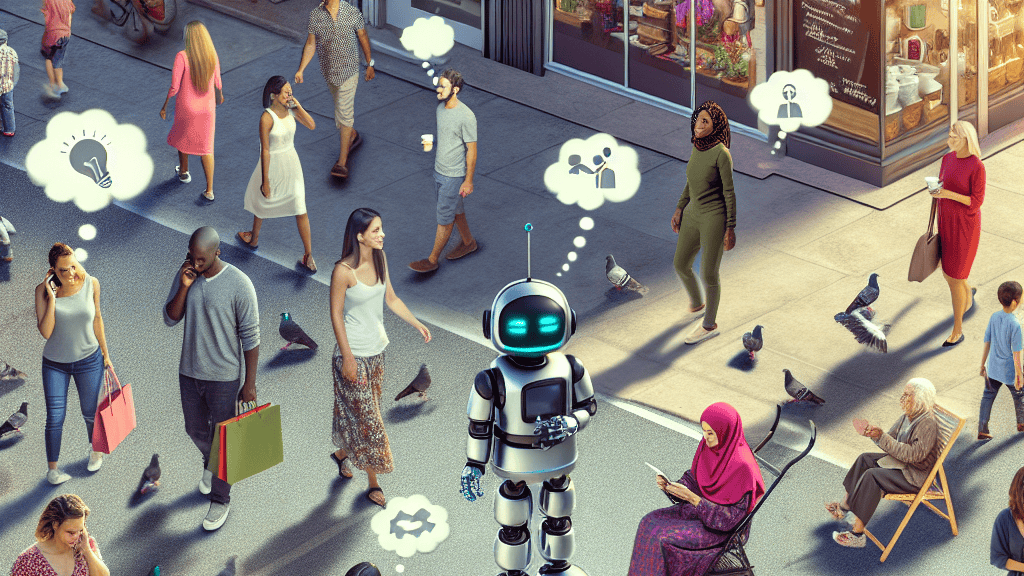
Picture yourself in a buzzing public space. Now, throw a robot into the mix. Can it interact and move as smoothly as the people around it? Current robot navigation systems often fall short, relying heavily on rigid rules or pre-programmed human strategies that aren’t flexible enough for our dynamic environments. But what if a robot could think just like us, using a blend of what it sees and hears to make real-time decisions? That’s the exciting idea driving a new wave of research into robot navigation.
Researchers are pushing boundaries by using something called Vision-Language Models, a cutting-edge approach that lets robots use language to understand what they see better. This research introduced a vast dataset called SNEI that teaches robots how to process visual cues and respond, almost as a human would, across thousands of interactions. The team even created a fine-tuned AI model named Social-LLaVA that surpasses advanced systems like GPT-4V in performing tasks requiring human-like reasoning.
Imagine going to a crowded museum, and the robot guide skillfully navigates through the crowd, all while interacting and making decisions just like you would. This research could transform how robots assist in public spaces, making them invaluable companions in airports, malls, and even providing support to those needing assistance. By combining vision and language, robots could soon blend seamlessly into the daily hustle and bustle of human life.
Did you know? The Vision-Language Model allows robots to ‘think’ like humans by using both what they see and hear to make decisions!
FAQs
What unexpected discovery did scientists make?
Scientists discovered that language can effectively bridge the gap between robot perception and socially compliant actions, allowing robots to reason more like humans in dynamic environments.
How does Social-LLaVA compare to other models?
Social-LLaVA outperformed state-of-the-art models like GPT-4V and Gemini in performing visual question answering tasks, showing enhanced capabilities in human-like reasoning.
Why is this research important for future technology?
This study paves the way for robots to navigate crowded public spaces with improved social understanding, potentially transforming how robots assist us in everyday life.
What practical applications might this research have?
Practical applications include enhancing robot guides in museums or shopping centers, where they need to interact seamlessly with people and their surroundings.
How does the dataset SNEI contribute to the research?
The SNEI dataset provides a rich resource of human-annotated interactions that help train robots to understand and make decisions in social contexts.
Background
Social robot navigation has long relied on pre-set rules or human-taught demonstrations, which aren’t always effective in rapidly changing environments. Vision-Language Models are a new tech that integrates visual understanding with language to simulate human thought processes, aiming for robots to better understand and react within complex social settings.
History
Previously, robot navigation mainly focused on technical maneuvers in less dynamic settings. However, the emergence of AI models capable of visual and language understanding has shifted focus towards making robots more socially aware and effective in densely populated areas. This work builds on this shift by fine-tuning new models that can outperform traditional methods.
Based on “Social-LLaVA: Enhancing Robot Navigation through Human-Language Reasoning in Social Spaces” by Amirreza Payandeh, Daeun Song, Mohammad Nazeri, Jing Liang, Praneel Mukherjee, Amir Hossain Raj, Yangzhe Kong, Dinesh Manocha, Xuesu Xiao, available on arXiv (arxiv.org/abs/2501.09024), used under CC BY 4.0 (creativecommons.org/licenses/by/4.0/).