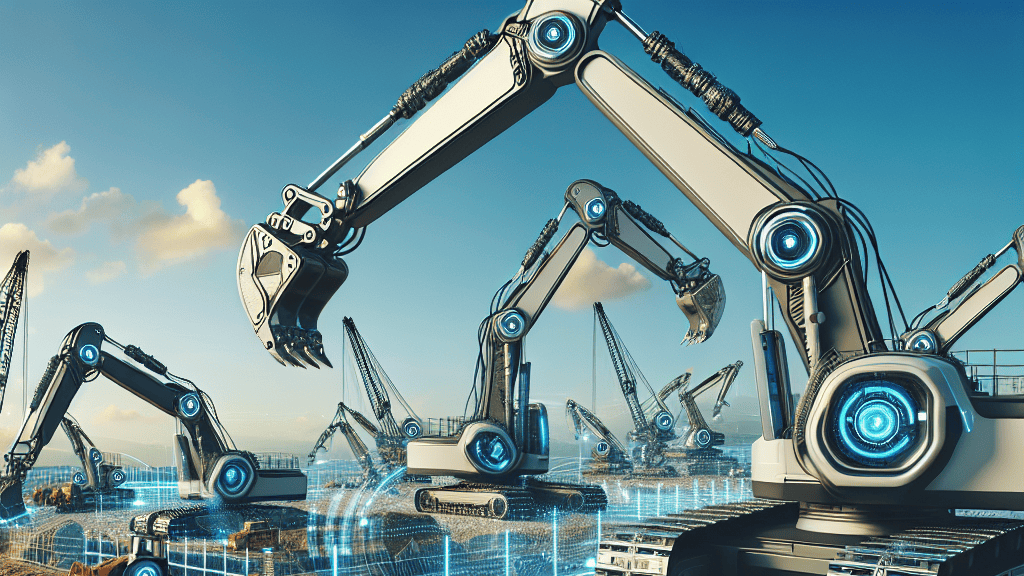
Envision a world where construction sites are bustling with intelligent machines, much like how driverless cars are redefining travel. This is where autonomous excavators come into play, and they’re being taught using advanced simulation tools. Think of it as a video game, but instead of entertainment, it’s training these massive machines to think and operate independently. Such autonomy could lead to safer and faster construction, saving time and money while reducing human risk.
This research introduces TERA, a cutting-edge simulator specifically designed for autonomous excavators. Using Unity3D and AGX, TERA offers a high-quality simulated environment where excavators can learn complex tasks. It’s like a classroom for these machines where they tackle real-world challenges, such as adjusting their movements based on changing terrains. This is a significant leap forward because while traditional simulators focus on parts, TERA comprehensively addresses the entire system, including how excavators perceive and interact with their environment.
One of the potential real-world applications of this technology is seen in construction sites prone to hazardous conditions. With autonomous excavators trained through TERA, these sites can be managed more efficiently and safely. Imagine excavators smart enough to deal with uneven grounds or variable soil types without human intervention. This advancement not only promises to enhance safety but also to boost productivity, making construction projects more predictable and less reliant on perfect weather conditions.
Did you know? The technology to autonomously control excavators is being developed using simulators as advanced as those used for training pilots!
FAQs
What unexpected discovery did scientists make?
Scientists developed a simulator called TERA that effectively trains excavators for autonomy by simulating complex terrains and operational interactions.
How does this research impact construction safety?
By simulating real-world conditions, TERA trains excavators to operate autonomously, minimizing human error and increasing safety on construction sites.
What makes TERA different from other simulators?
TERA not only simulates physical interactions but also integrates perception challenges, offering a more complete and realistic learning environment for excavators.
Can this technology be applied beyond construction?
Yes, the autonomy training concepts could extend to other physically interactive machinery across industries like mining or agriculture.
Background
In the field of automation, particularly with heavy machinery like excavators, simulators recreate real-world environments to train machines to operate independently. The core idea is to reduce risk and improve efficiency, allowing machines to learn in a virtual setting before applying that knowledge in the physical world. Traditional simulations often struggle with complexity, only replicating basic movements, but TERA advances this by refining how machines understand and interact with their surroundings.
History
Simulation in automation began with basic machine training using simple task repetition. Over time, simulations have become more sophisticated, incorporating physics and sensory elements. Past advancements helped in automotive and aeronautics, and now TERA builds on these foundations by offering an all-encompassing training environment for excavators. This step is crucial, as it moves beyond isolated interactions to promote full autonomy.
Based on “TERA: A Simulation Environment for Terrain Excavation Robot Autonomy” by Christo Aluckal, Roopesh Vinodh Kumar Lal, Sean Courtney, Yash Turkar, Yashom Dighe, Young-Jin Kim, Jake Gemerek, Karthik Dantu, available on arXiv (arxiv.org/abs/2501.01430), used under CC BY 4.0 (creativecommons.org/licenses/by/4.0/).