Did you know that certain shapes might be hiding secret properties, just like a treasure map? Imagine a donut-shaped object, known in maths as a torus, combined with a sphere. Mathematicians have long wondered if this unique combo holds a special type of curvature that usually doesn’t show up in familiar objects like basketballs or hula hoops.
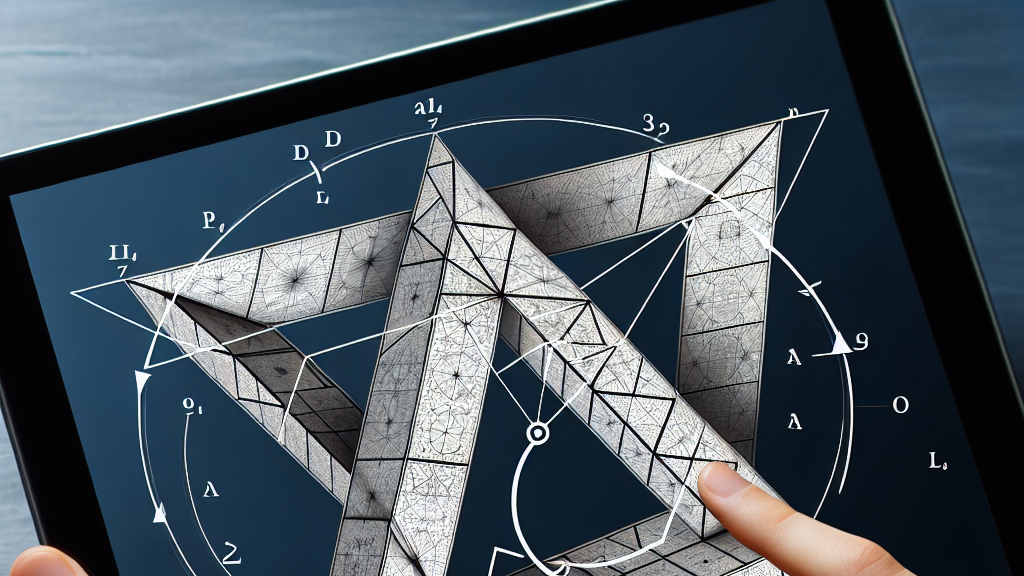
This curiosity led researchers to delve into the concept of biorthogonal curvature. It’s like if you could take two planes that cross, average their curves, and see if they’re always positive. While positively curved shapes are common knowledge—think of a well-inflated balloon—the idea that a seemingly complex shape can maintain consistent positive curvatures on all cross-sections was a mystery until now. By peeling back layers of mathematical complexity and working through the intricate dance of shapes, they proved such curvatures do exist on this sphere-torus combo.
Imagine using this knowledge of hidden curvatures to influence fields like architecture or even virtual reality worlds. Future tech could harness these principles, creating more stable and aesthetically pleasing structures, or even helping to map out more realistic virtual landscapes. Who knows, with a little imagination, the hidden curvatures in complex shapes might be the next big leap in scientific discovery!
A torus combined with a sphere can have a special type of curvature known as positive biorthogonal curvature, which was a mystery until recently!
FAQs
What is biorthogonal curvature and why does it matter?
Biorthogonal curvature refers to the average curvature of a plane and its perpendicular companion, representing a middle stage between the concepts of positive sectional and scalar curvature. It matters because it shapes our understanding of how complex forms can exist and bend in our universe.
How was the mystery of hidden curvatures on S^2 × T^2 shapes solved?
Using advanced geometric and topological analyses, researchers discovered that a Riemannian metric, a way of measuring angles and distances, could keep the biorthogonal curvature positive across these nuanced shapes.
Why should I care about positive curvature?
Understanding positive curvature can lead to breakthroughs in fields like architecture, where stability and aesthetics are key, or even in creating more realistic virtual worlds in technology and gaming.
Where else can these curvature principles be applied?
Beyond theoretical work, these principles might be applied in engineering, computer graphics, or any field that models complex shapes and needs reliable methods for ensuring structural integrity or realistic representations.
Do real-world objects have positive biorthogonal curvature?
While certain manufactured items may showcase aspects of positive curvature, an object’s biorthogonal curvature is often more complex, making this recent discovery particularly exciting for further exploration.
Background
In geometry, a Riemannian metric is like a toolkit for measuring distances and angles on surfaces or shapes. When we talk about curvatures, there are different types to consider, like sectional and scalar. Sectional curvature looks at how a surface curves in a specific section or plane, while scalar curvature is more of an average measurement over an entire shape. Biorthogonal curvature is a middle ground, focusing on how two intersecting planes curve together. Understanding these concepts helps explain complex shapes and surfaces.
History
Mathematicians have explored the concept of curvature for centuries, with foundational work by figures like Carl Friedrich Gauss. Over time, the study of how shapes bend and interact in space has led to significant discoveries in theoretical math and physics. The particular problem of positive biorthogonal curvature for a combination of sphere and torus has been a longstanding question, finally answered with modern geometric methods.
Based on “Positive Biorthogonal Curvature on S² × T²: An open problem no more?” by Alexander Pigazzini, available on arXiv (arxiv.org/abs/2502.11914), used under CC BY 4.0 (creativecommons.org/licenses/by/4.0/).