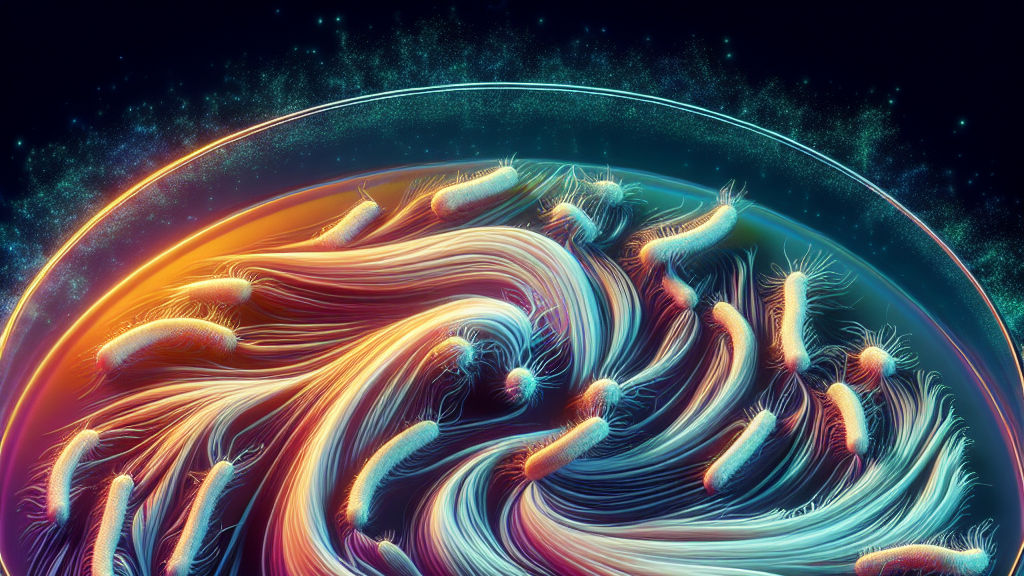
Imagine a world where chaos and disorder slowly give way to order and predictability. That’s exactly what scientists are seeing in a system of Brownian particles. These particles start off in what seems like an unpredictable state, much like marbles in a chaotic game, influenced by random movements and a long-range potential, which might remind us of how celestial bodies interact across space. It’s a bit like watching a wild dance that over time develops into a synchronized ballet.
In this research, scientists dive deep into what’s known as the ‘creation-of-chaos,’ revealing how even in chaotic systems, patterns emerge as particles interact. They looked at Brownian particles, tiny entities in constant motion, and found that despite starting in chaos, their interactions could be predicted with surprising accuracy. This happens because the chaos fades as time progresses due to something called the mean-field approximation, which simplifies the behavior of a large number of particles. This means if we know how pairs of particles relate initially, we can predict their future interactions quite accurately without knowing every tiny detail.
This isn’t just a fascinating insight into physics—it’s a key to the future. Such understanding might lead us to predict the movements of gases or liquids, control chemical reactions better, or even develop new technology materials with precision. Imagine creating new, more efficient energy materials or safer pharmaceuticals just by understanding these chaotic beginnings!
Did you know? Brownian motion, the seemingly random movement of particles, was first explained by Albert Einstein in 1905. Yet, we’re still uncovering its secrets today!
FAQs
What is the ‘creation-of-chaos’ phenomenon in particle dynamics?
The ‘creation-of-chaos’ phenomenon describes how seemingly unpredictable systems, like a group of Brownian particles, can reveal predictable patterns over time as individual particle interactions average out in a large group.
How do mean-field approximations help in understanding Brownian particle systems?
Mean-field approximations simplify the behavior of particles in large systems by focusing on the average effect of all particles instead of each individual one. This makes it easier to predict the system’s behavior as a whole, especially over time.
What role do pair correlations play in predicting particle behavior?
Pair correlations describe how pairs of particles relate to each other. In this research, these correlations help in predicting future interactions of particles by showing how their initial setup influences their later behavior.
Can understanding chaotic systems practically benefit everyday life?
Absolutely! By understanding chaotic systems, scientists can improve how we control and predict the behavior of materials, potentially leading to better technologies, safer pharmaceuticals, and more efficient energy solutions.
Background
The key concepts here involve Brownian motion, which is the random movement of particles in a fluid, mean-field approximation, a method of simplifying the dynamics of many particles by considering their average effect, and pair correlations, which measure the dependency between pairs of particles. These principles help scientists understand the seemingly unpredictable behaviors of particles over time, showing how initial chaos can morph into predictability.
History
The study of Brownian motion dates back to the early 19th century, but it gained scientific traction when Albert Einstein provided a theoretical explanation in 1905. Over time, researchers have built on this foundation, using advanced mathematical models and simulations to explore how individual particles interact and how these interactions can lead to emergent behaviors, such as the creation-of-chaos phenomenon described in this research.
Based on “Creation of chaos for interacting Brownian particles” by Armand Bernou, Mitia Duerinckx, Matthieu Ménard, available on arXiv (arxiv.org/abs/2504.09917), used under CC BY 4.0 (creativecommons.org/licenses/by/4.0/).