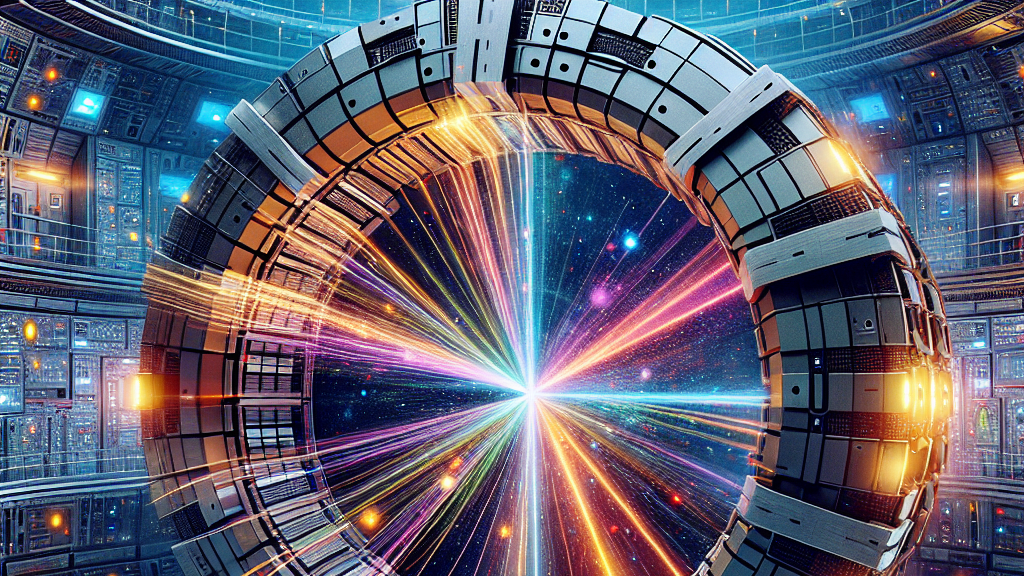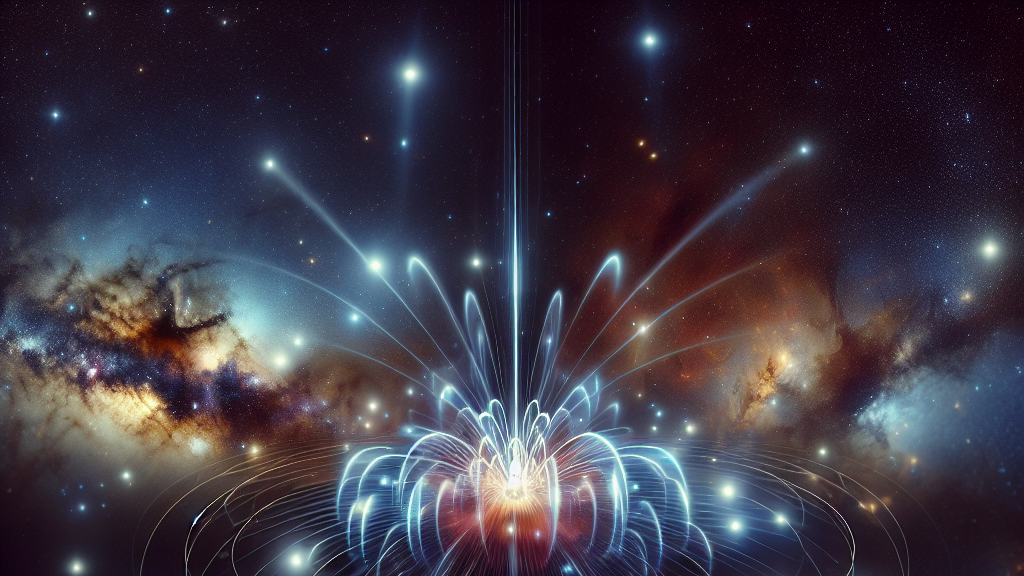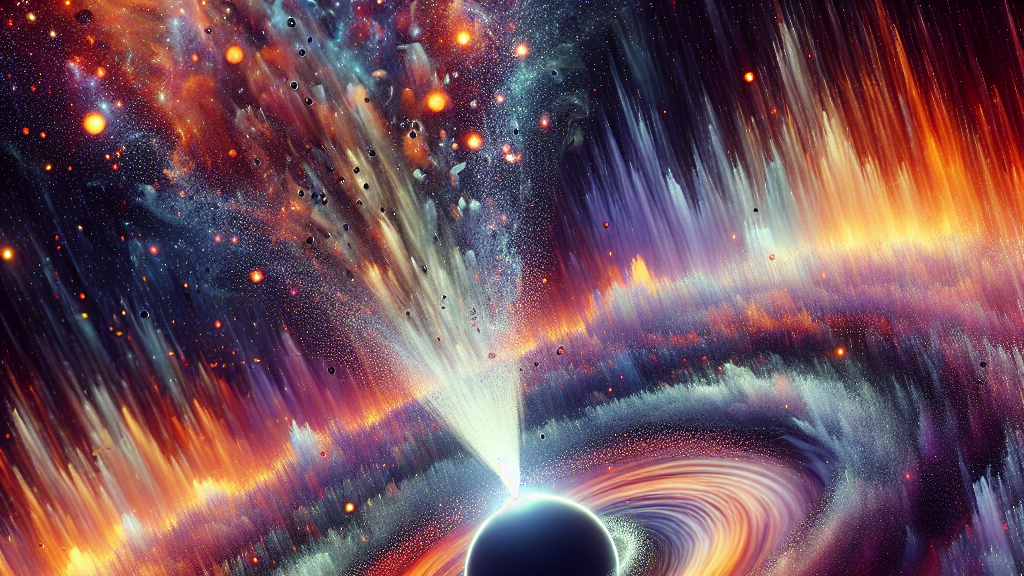
Ever wondered if the universe has its own version of a supercollider? Recent research suggests that certain black holes might just be the ultimate cosmic arena for such high-energy events. Picture this: at the edge of a black hole, particles hurtling from the depths of space could collide with those falling into the black hole, releasing immense energy, much like a supercollider, but on an astronomical scale.
Scientists have found that the powerful gravity of a near-extreme Kerr black hole creates conditions where the energy of colliding particles can skyrocket into the tens or hundreds of teraelectronvolts. These energies are so high that they rival the most advanced particle supercolliders we build here on Earth. It’s a mind-boggling idea that the universe naturally orchestrates such high-energy collisions without any human intervention, using the gravitational pull of these spinning black holes.
This discovery could revolutionize our understanding of the cosmos and particle physics. Imagine harnessing this knowledge to better comprehend the fundamental forces of nature. It could even inspire new technologies or deepen our understanding of the universe’s building blocks. The idea that black holes, once thought of only as cosmic vacuum cleaners, could also be nature’s own massive supercolliders is a thrilling revelation that might change how we view space forever.
Did you know that scientists believe certain black holes can accelerate particles to energies higher than any man-made machine?
FAQs
How do black holes act like natural supercolliders?
Black holes can accelerate particles to immense energies through their extreme gravity, creating collisions at energies rivaling our most advanced particle supercolliders.
What is a Kerr black hole?
A Kerr black hole is a spinning black hole, named after mathematician Roy Kerr, which creates unique conditions for high-energy particle collisions.
Why is this research on black holes important?
This research helps us understand high-energy physics and cosmic phenomena, potentially leading to breakthroughs in our grasp of the universe’s fundamental forces.
Can these natural supercolliders be used for scientific purposes?
While we cannot directly use them, analyzing these cosmic events expands our knowledge of particle interactions and the forces at play in the universe.
What impact could this research have on future technology?
Understanding these natural high-energy environments might inspire new technologies or methodologies in energy harnessing and particle physics.
Background
A Kerr black hole is a type of black hole that spins rapidly, creating unique and dynamic gravitational fields. The immense gravity of these black holes can accelerate particles to unbelievably high speeds. When particles collide near a Kerr black hole, they can achieve energy levels far beyond what our current technology allows, making these collisions a fascinating focus for astrophysics and particle physics.
History
The idea that black holes might act as natural supercolliders builds on decades of research in astrophysics and particle physics. The study of Kerr black holes, named after Roy Kerr, has been a pivotal part in understanding how rotation affects black holes’ properties and the surrounding space. Previous theories have suggested that high-energy interactions occur near black holes, but this research adds a new dimension by highlighting the potential for these interactions to reach energies similar to human-made supercolliders.
Based on “Black hole supercolliders” by Andrew Mummery, Joseph Silk, available on arXiv (arxiv.org/abs/2506.01437), used under CC BY 4.0 (creativecommons.org/licenses/by/4.0/).