Connect with us

Search by keyword

Physics

Can New Particles Transform Our Understanding of Physics?

Scientists might be on the brink of discovering new particles that challenge our understanding of the universe. These findings, centered around the Large Hadron Collider, could open up exciting new paths in physics and affect future technology.

Can New Particles Transform Our Understanding of Physics
✨Researched by humans. Explained by robots. Learn more.

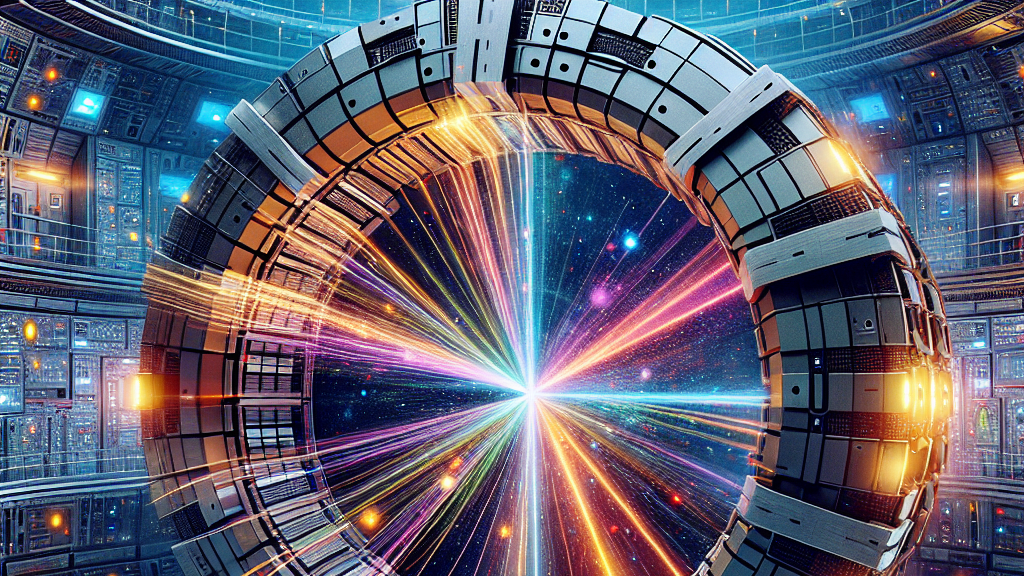
Have you ever wondered what the universe is truly made of? Scientists at the Large Hadron Collider in Switzerland are exploring the mysteries of tiny particles that make up everything around us. They are searching for new particles that could shake up our current understanding of physics, much like how discovering a new city could change our view of the world map.

In their latest research, scientists have observed something intriguing—a potential new type of particle they call a Kaluza Klein graviton, alongside various other candidates indicating phenomena beyond our current theories. These particles could reveal new forces or dimensions of space previously unknown. The Large Hadron Collider creates conditions similar to the birth of the universe, allowing researchers to glimpse these hidden parts of reality.

Imagine a future where these discoveries lead to new technologies, akin to how understanding electricity led to the modern world. For instance, these new particles could eventually help create advanced communication systems or new energy sources. Just like how mobile phones transformed our lives, these scientific advances could open doors to possibilities we can’t even imagine yet.

Did you know the Large Hadron Collider creates conditions similar to the moments after the Big Bang? It allows scientists to see and understand particles that existed at the start of the universe.

FAQs

What is a Kaluza Klein graviton and why is it exciting?

A Kaluza Klein graviton is a theoretical particle that could hint at extra dimensions beyond the familiar three-dimensional world. Discovering it would open new possibilities in understanding the laws of physics.

How do these findings impact our daily lives?

While it may take time, discovering new particles could lead to groundbreaking technologies similar to how early electricity experiments eventually led to everyday gadgets we rely on now.

Why are scientists looking for new particles at the LHC?

Scientists seek to understand the fundamental building blocks of the universe and identify forces that govern how everything interacts. This knowledge could unlock new realms of science and technology.

What is the Large Hadron Collider and how does it work?

The Large Hadron Collider is a massive underground experiment in Switzerland that smashes particles together at high speeds to study their components and discover new particles.

Could new particle discoveries change our understanding of the universe?

Yes, finding new particles can challenge existing theories and lead to a deeper, more comprehensive understanding of the universe’s workings.

Background

The Large Hadron Collider is the world’s largest particle accelerator, designed to explore the fundamental particles by crashing them together at high speeds. Researchers analyze the resulting particle sprays to discover new particles and phenomena. The Kaluza Klein graviton is a theoretical particle that suggests extra dimensions and could revolutionize physics if proven to exist.

History

Particle physics has evolved from the discovery of the electron to the development of the Standard Model, which currently explains known particles and forces. However, the model isn’t complete, as it doesn’t account for gravity or explain dark matter. The search for new particles, such as the possible Kaluza Klein graviton, builds upon past discoveries like the Higgs boson, aiming to fill gaps in our physical understanding.

Based on “New resonances at LHC” by Alain Le Yaouanc, François Richard, available on arXiv (arxiv.org/abs/2506.09490), used under CC BY 4.0 (creativecommons.org/licenses/by/4.0/).

Trending

Latest

Can AI Save Water Discover How

Computers

AI is transforming the tech world, but it uses lots of water! A new tool, SCARF, helps us measure and reduce AI's water footprint,...

Whats a Forbush Decrease and Why Should We Care Whats a Forbush Decrease and Why Should We Care

Space

Scientists just observed the biggest solar storm event in years, revealing unexpected cosmic ray patterns. Understanding these changes could help us protect our technology...

Can Cars Spot Danger Faster Than Humans Can Cars Spot Danger Faster Than Humans

Computers

Think about how quickly you react when something unexpected happens on the road. This research brings us closer to creating self-driving cars that can...

Can Fear of the Other Stop Social Harmony Can Fear of the Other Stop Social Harmony

Physics

Fear of the unknown might make it harder for people to agree and get along. This study shows that when people have strong xenophobic...

Can AI Revolutionize Breast Cancer Diagnosis Can AI Revolutionize Breast Cancer Diagnosis

Electricity

This research introduces a groundbreaking AI model that can accurately assess HER2-positive breast cancer using widely accessible staining methods, potentially revolutionizing how we diagnose...

Can AI Transform Your Singing into a Choir Can AI Transform Your Singing into a Choir

Computers

Imagine singing solo and having AI turn you into a choir. This research unveils a groundbreaking AI tool that transforms your voice into rich...

You May Also Like

General Relativity and Quantum Cosmology

Imagine a place in space where particles smash into each other with immense energy, like nature's own supercollider. Black holes might just be the...

Math

Ever wondered how a jumbled mess of particles might actually find order? This study shows that even chaotic systems like Brownian motion can create...

Nuclear Experiments

Ever wonder how particles collide and stick together? Scientists at the Large Hadron Collider found something unexpected when they smashed protons together: particles are...

Nuclear Theory

Imagine particles disappearing and reappearing elsewhere—sounds like sci-fi, right? This research uncovers a new teleportation-like phenomenon, potentially changing how we see atomic collisions and...

Physics

Imagine particles popping up in places they shouldn't be able to reach! This research explores how observing particles like electrons affects their behavior, potentially...

Nuclear Theory

Ever thought teleportation was just science fiction? Turns out, scientists have discovered a groundbreaking phenomenon that looks a lot like teleportation. This could completely...

General Relativity and Quantum Cosmology

Ever wondered if tiny particles zooming through space could unravel the mysteries of the universe? Scientists believe neutrinos might hold the key to understanding...

Materials

Discover the secret stories hidden in sand with The Sand Atlas! This innovative project transforms tiny grains into mesmerizing 3D models, unlocking a world...

Physics

This groundbreaking research unveils a fresh way to interpret the behavior of particles, possibly leading to insights on complex phenomena like dark matter and...

Copyright © 2024 8ig8rain.

Disclaimer: The content on 8ig8rain.com consists of AI-generated summaries of scientific abstracts from arXiv. Please note that most arXiv abstracts are preprints and may not have undergone formal peer review. While these summaries aim to convey key ideas and potential applications, they are provided for informational purposes only and should not be interpreted as validated scientific findings or professional advice. The summaries are intended to educate, spark curiosity, and inspire further exploration of science.