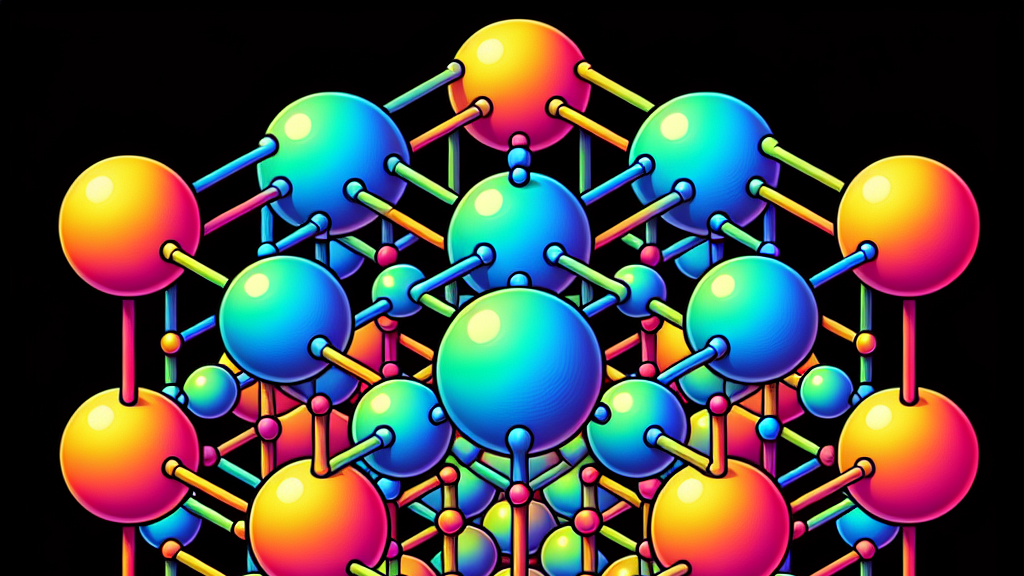
Imagine a world where packing your grocery bags perfectly was not just a way of life, but a breakthrough in mathematics. That’s the magic of sphere packing! It’s all about figuring out how to arrange spheres (like those oranges in your bag) as tightly as possible without squishing them, and mathematicians have been cracking their heads over it for ages.
Our latest breakthrough focuses on packing spheres in 48-dimensional space, which is like thinking way beyond your usual 3D world! Researchers have found that by applying specific rules about how far apart spheres’ centers need to be, they can achieve the perfect balance, like a perfectly arranged puzzle. Amazingly, this new arrangement maximizes space efficiency, proving certain geometric formations (called lattices) are the best way to pack spheres in this mind-bending space.
Why should you care? Well, this isn’t just about neatness; it’s a game-changer for technology. These ideas could lead to more efficient data storage and transmission. Imagine Netflix being able to stream even more movies with less data! Or your phone storing double the photos without extra space. It’s magic, really, and it’s all thanks to some seriously clever geometry.
Did you know that sphere packing solutions can help improve data storage? The same principles can be used to maximize how data is packed digitally!
FAQs
What is sphere packing and how does it relate to everyday items like oranges?
Sphere packing involves arranging spheres in an efficient way to occupy maximum space without overlapping. It’s like stacking oranges as densely as possible in a box!
How does this sphere packing research impact technology?
It can lead to advancements in data storage and transmission by making digital information more compact and efficient, allowing for better performance and less space usage on devices.
Why study sphere packing in 48 dimensions?
Studying higher dimensions helps mathematicians understand complex problems and find optimal solutions, which can then be translated into real-world settings, like improving storage and communication technologies.
What is a lattice and why is it important in this research?
A lattice is a specific, regular arrangement of points (or centers of spheres) in space. In the context of sphere packing, finding the best lattice helps achieve the most efficient packing arrangement.
How do these discoveries relate to games or puzzles?
Understanding optimal arrangements can be likened to solving puzzles where each piece must fit perfectly, similar to how spheres need to be packed just right to maximize space.
Background
Sphere packing involves arranging non-overlapping identical spheres within a given space. The most efficient way to do this often results in extremely regular patterns called lattices. Lattices are ways to evenly distribute points over a space, and finding the optimal lattice in various dimensions is crucial because it informs us about maximal packing density. This mathematical puzzle has implications in packing, coding theory, and information transmission.
History
The sphere packing problem has intrigued mathematicians for centuries, beginning with Johannes Kepler’s conjecture in 1611 about how cannonballs stack. Later, more dimensions came into play in the 19th and 20th centuries, involving mathematical figures like Carl Friedrich Gauss and John Leech. Recent advances have explored high-dimensional spaces, going beyond what’s physically observable, to understand the math’s underlying principles that could have technological applications.
Based on “Sphere Packings in Euclidean Space with Forbidden Distances” by Felipe Gonçalves, Guilherme Vedana, available on arXiv (arxiv.org/abs/2308.03925), used under CC BY 4.0 (creativecommons.org/licenses/by/4.0/).