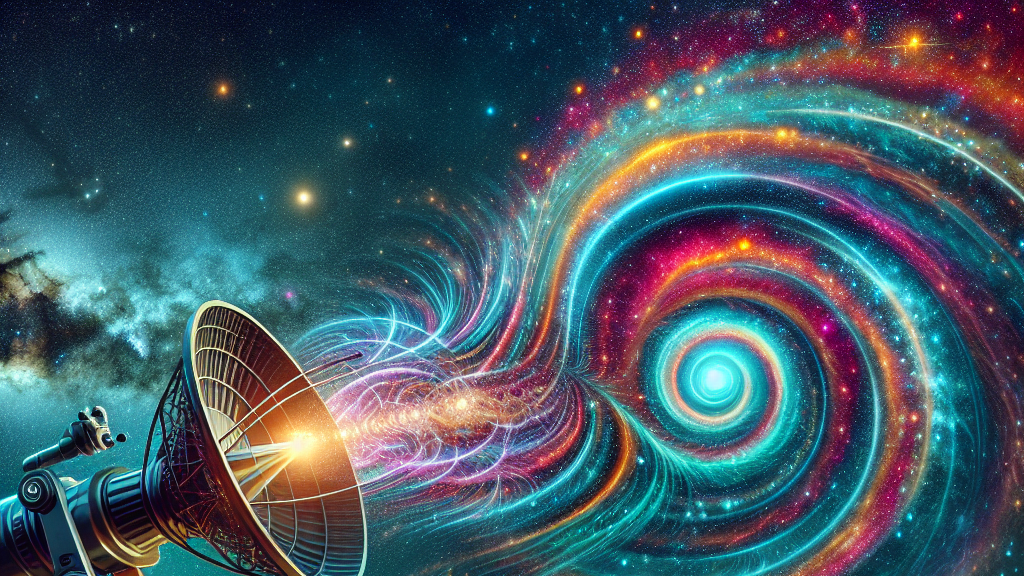
Imagine peering into the cosmic abyss and finding signs of volcanic eruptions on planets light-years away. It sounds like science fiction, but scientists have figured out how to spot distant worlds bubbling with volcanic activity by studying the glowing rings of plasma they leave behind. These rings, known as plasma tori, are essentially massive belts of charged particles that dance around stars, hinting at the fiery happenings on the planets themselves.
At the heart of this research is the idea of a cosmic recycling system, just like we see with Jupiter’s moon, Io. On distant planets, volcanic eruptions eject particles into space, creating a torus around their stars that acts like a fingerprint, revealing the presence and intensity of the volcanism. By examining these ethereal rings, scientists can calculate just how much volcanic material is being spewed into space and even make educated guesses about what’s hiding beneath a planet’s surface.
This isn’t just about satisfying our curiosity—this method could revolutionize how we search for life on other planets. If we find a planet with frequent, fierce volcanic activity, it might provide clues about its potential habitability. After all, Earth’s volcanoes have played a crucial role in creating the environment that supports life. This new approach suggests that future explorers may use ultraviolet telescopes to peer into the skies and uncover the hidden dynamics of alien worlds, bringing us a step closer to understanding our place in the grand cosmic tapestry.
Did you know Earth’s moon used to have active volcanoes over a billion years ago? Understanding exoplanet volcanoes shines a light on our own cosmic past!
FAQs
What is a plasma torus and why is it important for detecting exoplanet volcanism?
A plasma torus is a ring of charged particles that orbit a star, created by volcanic activity from a nearby planet. Studying these tori helps scientists identify volcanic processes on planets outside our solar system, offering insights into their geologic activity and potential habitability.
How does this research help us understand distant exoplanets?
This research allows scientists to estimate volcanic activity on exoplanets by analyzing the plasma torus it creates. This gives clues about a planet’s interior composition and geologic state without the need for direct observation, widening our understanding of distant worlds.
Why is ultraviolet instrumentation crucial for this method?
Ultraviolet instruments have the necessary resolution to detect atomic lines in a plasma torus and are sensitive enough to capture the ultraviolet continuum of stars. This detailed information is crucial for accurately monitoring and characterizing volcanic activity on exoplanets.
How could this research impact space exploration?
By revealing volcanic activity on exoplanets, this research could inform future exploration targets for the search for life and habitability. It provides a new tool for identifying planets with active geologic processes that might support life.
Background
The concept of plasma tori involves a band of ionized particles encircling a central body, in this case, a star, caused by volcanic eruptions from a nearby planet. When volcanic gases are emitted into space, they become ionized by the star’s magnetic field, forming a plasma torus. Researchers then analyze these tori to gather data on the planetary volcanic activity that created them.
History
Initially inspired by observations of Jupiter’s moon Io and its plasma torus, this research broadens the concept to exoplanets that may have similar volcanic and magnetic interactions with their stars. Previous studies primarily focused on the inner workings of our solar system, but this approach applies those principles to distant stellar systems, paving new paths in exoplanetary science.
Based on “Constraining Ongoing Volcanic Outgassing Rates and Interior Compositions of Extrasolar Planets with Mass Measurements of Plasma Tori” by V. Abby Boehm, Darryl Z. Seligman, Nikole K. Lewis, available on arXiv (arxiv.org/abs/2506.08177), used under CC BY 4.0 (creativecommons.org/licenses/by/4.0/).