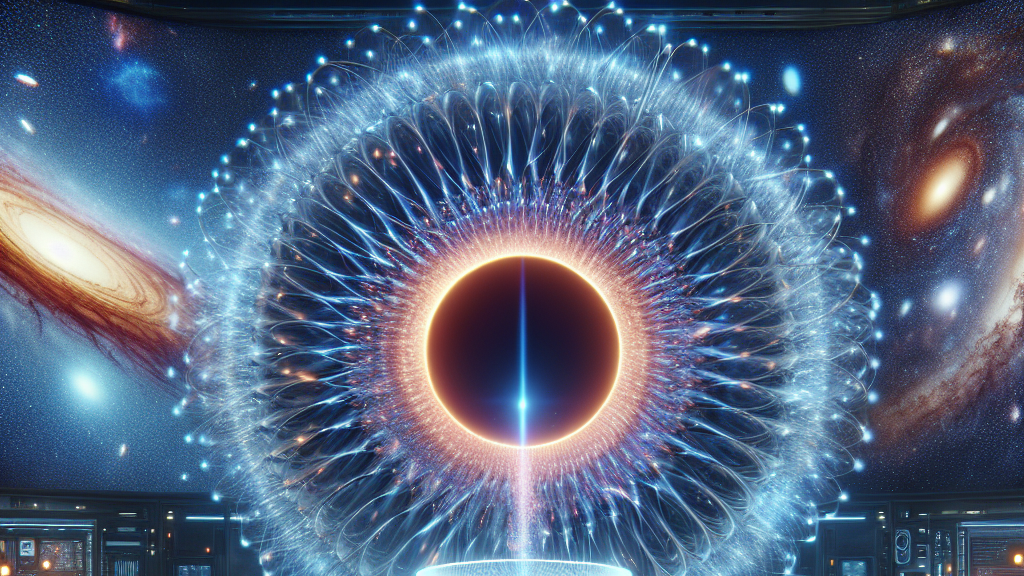
Are there tunnels hidden in the universe that act like cosmic highways, but are invisible to us? That’s what this groundbreaking research is suggesting. You might think these wormholes only exist in science fiction, but scientists are exploring the idea that they are real and might even be disguised as something else entirely. In the vastness of the cosmos, they could be right under our cosmic noses, cleverly presenting themselves as black holes, those mysterious space objects we already know.
The study delves into the exciting possibility that these wormholes can imitate black holes so convincingly that they could fool our telescopes and other detection methods. By using a mathematical model, researchers looked at how these theoretical wormholes might replicate certain features of black holes, like how they vibrate or resonate under specific conditions. Known as quasi-normal modes, these vibrations are like the sounds a bell makes. The researchers wanted to find out if wormholes could produce similar “sounds” in the universe. What they found is that, for certain parameters, wormholes can indeed mimic black holes, making it a fascinating puzzle for scientists.
So, why does this matter? Think about the future of space travel. If cosmic wormholes exist and we can learn how to identify and navigate them, it might one day allow us to travel vast distances across space almost instantaneously. No more worrying about the enormous distances between stars and galaxies! Uncovering these cosmic bridges might just revolutionize our understanding of the universe and open up exciting new possibilities for exploring it.
Wormholes were first theorized by Einstein and Rosen in 1935 as tunnels in spacetime.
FAQs
What are wormholes and why are they significant?
Wormholes are theoretical tunnels in spacetime that could connect different regions of the universe. They are significant because, if proven to exist, they could allow for instant travel between distant points in space, revolutionizing our understanding of the cosmos.
How do wormholes mimic black holes?
Wormholes can mimic black holes through certain properties, like their quasi-normal modes—akin to sound frequencies created by objects when disturbed. By matching these modes, wormholes can appear similar to black holes, making them hard to detect using current astronomical methods.
Could wormholes be used for space travel?
If wormholes exist and can be stabilized for traversal, they could potentially allow for rapid travel across vast cosmic distances, significantly impacting future space exploration and our understanding of the universe.
Why haven’t we detected wormholes yet?
Wormholes might closely mimic black holes in observable properties, making them challenging to distinguish with current technology. Future advancements and new detection methods could help identify these cosmic structures.
What are quasi-normal modes in the context of this research?
Quasi-normal modes are the characteristic ‘tones’ that objects, like black holes or potentially wormholes, exhibit when they vibrate under perturbations. Studying these can help researchers understand the nature of the objects in question.
Background
In the realm of theoretical physics, wormholes are hypothesized as bridges in spacetime that provide shortcuts between two distant points in the universe. They are solutions to the equations of General Relativity, initially brought to light by Albert Einstein and Nathan Rosen. Unlike black holes, which have a singularity at their center, wormholes are exotic compact objects without such singularities, offering a theoretic passage through spacetime.
History
The concept of wormholes dates back to 1935, when Albert Einstein and Nathan Rosen proposed the idea while exploring solutions to General Relativity, leading to what’s known as the ‘Einstein-Rosen bridge.’ Over the years, the theoretical framework has been expanded, with many seeking to understand their properties, stability, and potential existence. This study is another step in understanding how wormholes might mimic black holes, a theory that builds upon decades of research in gravitational physics.
Based on “Can wormholes mirror the quasi-normal mode spectrum of Schwarzschild black holes?” by Ciro De Simone, Vittorio De Falco, Salvatore Capozziello, available on arXiv (arxiv.org/abs/2502.12646), used under CC BY 4.0 (creativecommons.org/licenses/by/4.0/).