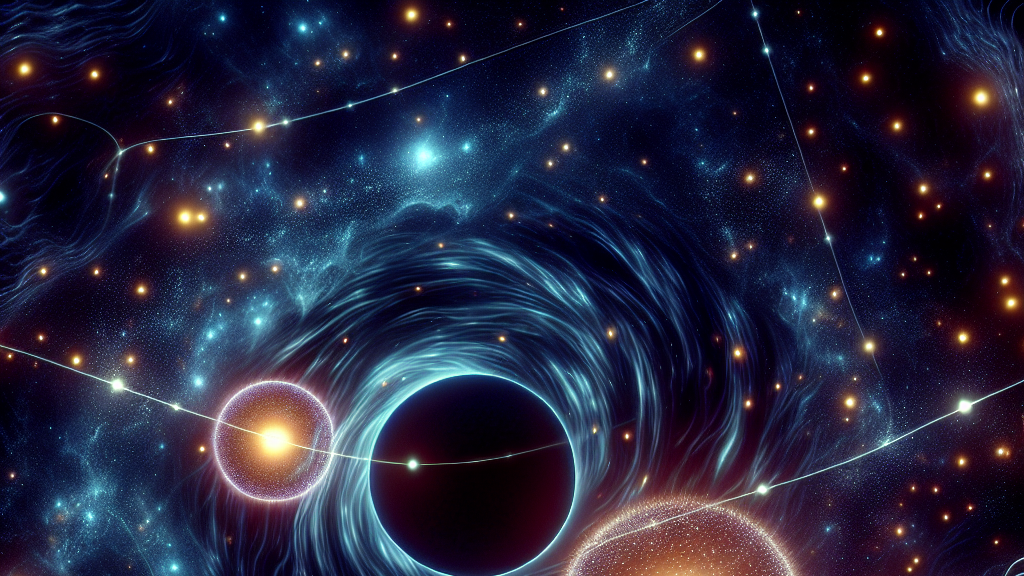
Imagine two tiny detectors falling into a black hole, not knowing if they’ll survive or what they’ll discover. But here’s the kicker: as they approach the black hole, they start to pick up something strange—entanglement! This mysterious connection, which even the event horizon can’t block, hints at the universe’s deepest secrets. What do these detectors do? They reveal how black holes influence quantum particles by somehow connecting them via entanglement, even if they’re separated by the immense force of the black hole’s pull. That means black holes aren’t just cosmic vacuum cleaners; they actually play a role in the tangled web of quantum physics.
In this fascinating study, scientists used Unruh-DeWitt detectors to explore these quantum connections. These detectors, named after physicists, are like cosmic ears tuning into the vibrations of the universe. The researchers found that black holes affect these quantum connections—sometimes enhancing them and sometimes shadowing them, depending on where they are around the black hole. This means that even the simplest black holes have the power to change the way quantum fields interact, opening up new possibilities for understanding how the universe works on the smallest scales.
Now, picture this: someday, we might use this knowledge to create technology that harnesses these quantum effects, much like how we currently use electricity. Imagine devices that can tap into the quantum realm, powered by the universe’s most mysterious objects—black holes. This could lead to advancements we haven’t even dreamed of yet, all thanks to the entangled dance of particles around these cosmic giants.
Did you know? The idea of ‘entanglement shadows’ suggests that black holes don’t just suck in matter; they can also obscure quantum connections in mysterious ways!
FAQs
How do black holes affect quantum entanglement?
Black holes can both enhance and obscure quantum entanglement, leading to phenomena like ‘entanglement shadows’ where connections between particles are altered by the intense gravitational forces.
What are Unruh-DeWitt detectors used for in this study?
Unruh-DeWitt detectors are theoretical tools used to detect entanglement in quantum fields, helping researchers understand how particles become entangled around black holes.
What is ‘entanglement harvesting’ and why is it important?
Entanglement harvesting is the process of extracting quantum connections between particles, which could pave the way for new technologies and enhance our understanding of the universe.
Background
Quantum entanglement is a phenomenon where particles become linked so that the state of one instantly influences the state of another, no matter the distance. This study examines how black holes affect such connections using Unruh-DeWitt detectors, which ‘listen’ for changes in the quantum field—a key concept in quantum field theory dealing with how fields fluctuate and interact.
History
The study of black holes and quantum entanglement has roots in early 20th-century physics, with breakthroughs like the theory of general relativity from Albert Einstein and the development of quantum mechanics. The concept of entanglement was famously termed ‘spooky action at a distance’ by Einstein. Recent research has focused on examining these ideas in extreme environments, like near black holes, to understand their combined effects.
Based on “Harvesting Information Across the Horizon” by S. Wang, M. R. Preciado Rivas, R. B. Mann, available on arXiv (arxiv.org/abs/2504.00083), used under CC BY 4.0 (creativecommons.org/licenses/by/4.0/).