We often think of protons and neutrons as the tiny building blocks of matter, but did you know there’s a lot more to them than meets the eye? Recent studies are shedding light on the intricate internal structure of these particles, changing how we understand the universe at its most fundamental level. The size of a proton isn’t just about its physical dimensions but about how its charge, magnetic fields, and even internal stress are distributed.
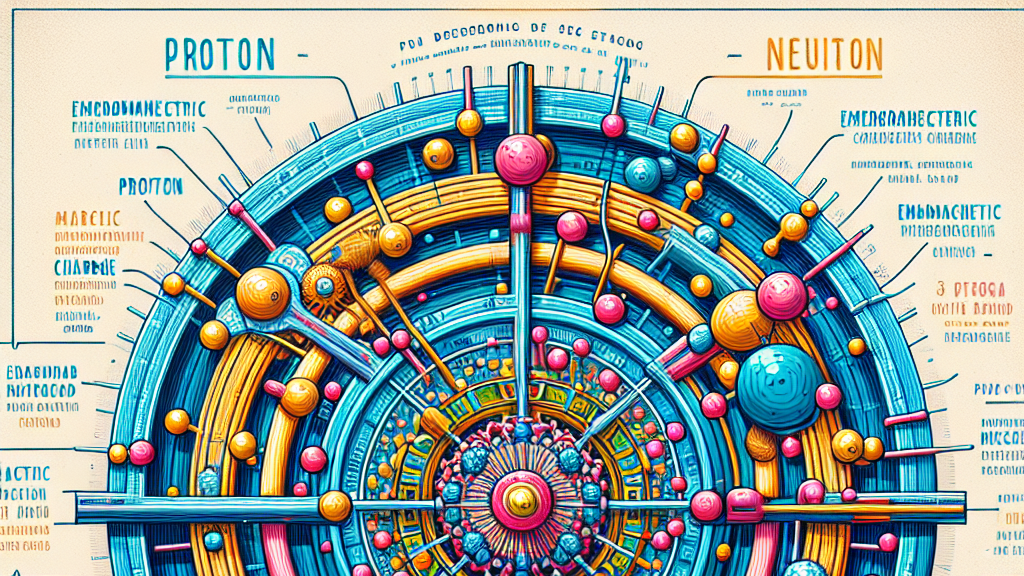
This research dives deep into the various ‘radii’ of nucleons, which are like different ways to measure and understand their complexities. These include charge, magnetic, axial, and even mechanical and mass radii. Each offers a unique perspective on how these particles behave and interact. For example, the charge radius informs us of the charge distribution within a proton, while the magnetic radius helps us understand its magnetic properties. This research not only reviews the latest experimental and theoretical advancements but also questions our previous interpretations, like the simplistic view of proton size.
In the future, comprehending nucleon structure more thoroughly could impact technologies that rely on understanding particle interactions, such as nuclear energy and medical imaging. Imagine a world where we can manipulate particle properties for new types of energy sources or advanced medical treatments. Understanding the nuanced complexities of protons and neutrons today leads us one step closer to those innovations tomorrow.
A proton isn’t just one solid sphere; its ‘size’ depends on several factors, like how its electric charge and internal pressures are distributed.
FAQs
What is the nucleon charge radius?
The nucleon charge radius describes the distribution of electric charge within a proton or neutron, helping to understand their electromagnetic properties.
Why does the proton radius matter in quantum chromodynamics?
The proton radius is crucial to quantum chromodynamics because it offers insights into the strong force that binds quarks together, revealing the internal structure of protons.
How do mechanical and mass radii of nucleons differ?
Mechanical radii relate to internal forces within nucleons, like pressure distributions, while mass radii consider how mass is spread within protons and neutrons.
Can understanding nucleon radii improve technology?
Yes, advancements in understanding nucleon radii can lead to better technologies in nuclear energy production and improve techniques in fields like medical imaging.
Why is it misleading to see the proton radius as its size?
It’s misleading because the proton radius encompasses complex characteristics beyond simple size, including charge distribution, magnetic properties, and even weak forces.
Background
Nucleons, which are protons and neutrons, are the components of atomic nuclei. Quantum chromodynamics is the framework that describes how the strong force binds quarks together within these nucleons. The concept of nucleon radii refers to various ways of measuring how different physical attributes like charge and magnetic properties are distributed inside these particles.
History
Understanding nucleon structure has evolved significantly over decades. Prior studies mainly focused on simple measurements of charge radii. However, recent advancements have introduced new types of radii, like magnetic and mechanical, offering a more comprehensive view of nucleon properties. These insights stem from both experimental advancements and theoretical developments in quantum chromodynamics.
Based on “Can we determine the exact size of the nucleon?: A comprehensive study of different radii” by The MMGPDs Collaboration, Muhammad Goharipour, Fatemeh Irani, M. H. Amiri, H. Fatehi, Behnam Falahi, A. Moradi, K. Azizi, available on arXiv (arxiv.org/abs/2503.08847), used under CC BY 4.0 (creativecommons.org/licenses/by/4.0/).