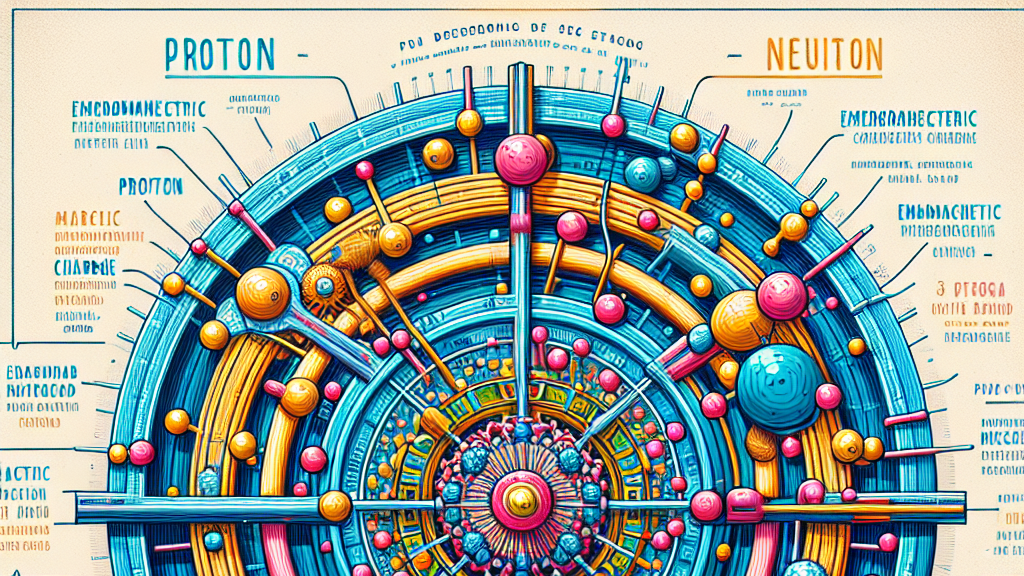
Ever thought about the size of a proton or neutron and what makes them tick? You might assume it’s as simple as measuring a ball, but it’s way more fascinating than that! Scientists have discovered that understanding the ‘size’ of these tiny particles is not just about their physical boundaries—it’s a tale of electric charges, magnetism, forces, and more.
Recent findings emphasize that each ‘radius’ or measurement of protons and neutrons tells a different story about what goes on inside them. The charge radius, for example, gives clues about the electric charge distribution, while the magnetic radius uncovers their magnetic secrets. Then there’s the axial radius, and newer concepts like mechanical and mass radii, which reveal internal stresses and how these particles hold together. This multidimensional approach is helping physicists piece together the complex puzzle of quantum chromodynamics, the theory that explains the strong force binding atomic nuclei.
Imagine if these insights could lead to groundbreaking advancements in nuclear energy or even new medical technologies. By refining our understanding of fundamental particles, we’re paving the way for real-world applications that could revolutionize industries. This isn’t just about dusty physics textbooks—it’s about unlocking potential that could change how we live and interact with the universe.
Did you know? The idea of a proton’s ‘size’ isn’t just about how big it is—it’s also about how its parts hold together and interact!
FAQs
What makes nucleon radii important in physics?
Nucleon radii are essential for understanding the internal structure of protons and neutrons. They reveal information about electric charges, magnetic properties, and internal stresses, offering insights into the fundamental forces and interactions within atomic nuclei.
How does the proton radius affect everyday technology?
Understanding proton radii can lead to advancements in technology, like more efficient nuclear energy and improved medical imaging, by providing a clearer picture of atomic interactions that underlie these technologies.
Why is the proton size not just a physical measurement?
The proton size involves more than just physical dimensions; it encompasses multiple radii that represent different aspects of its structure, like charge distribution and magnetic properties, making it a multifaceted concept.
Background
Nucleons, which are protons and neutrons, are governed by quantum chromodynamics, a doctrine that explains the strong interaction—the force that holds atomic nuclei together. The concept of nucleon radii is crucial because it helps physicists decipher the enigmatic forces at play inside these particles. Each type of radius—charge, magnetic, axial, and others—highlights different aspects of the nucleon structure, shedding light on the interactions that keep them stable.
History
The exploration of nucleon radii began with the quest to measure the proton’s charge, leading to discussions about its size. As methods advanced, scientists discovered that measuring size wasn’t so straightforward—it involved understanding a variety of radii. Breakthroughs in this field have refined the understanding of quantum chromodynamics and opened doors to deeper insights into nuclear physics, building upon decades of investigating particle behavior.
Based on “Can we determine the exact size of the nucleon?: A comprehensive study of different radii” by The MMGPDs Collaboration, Muhammad Goharipour, Fatemeh Irani, M. H. Amiri, H. Fatehi, Behnam Falahi, A. Moradi, K. Azizi, available on arXiv (arxiv.org/abs/2503.08847), used under CC BY 4.0 (creativecommons.org/licenses/by/4.0/).