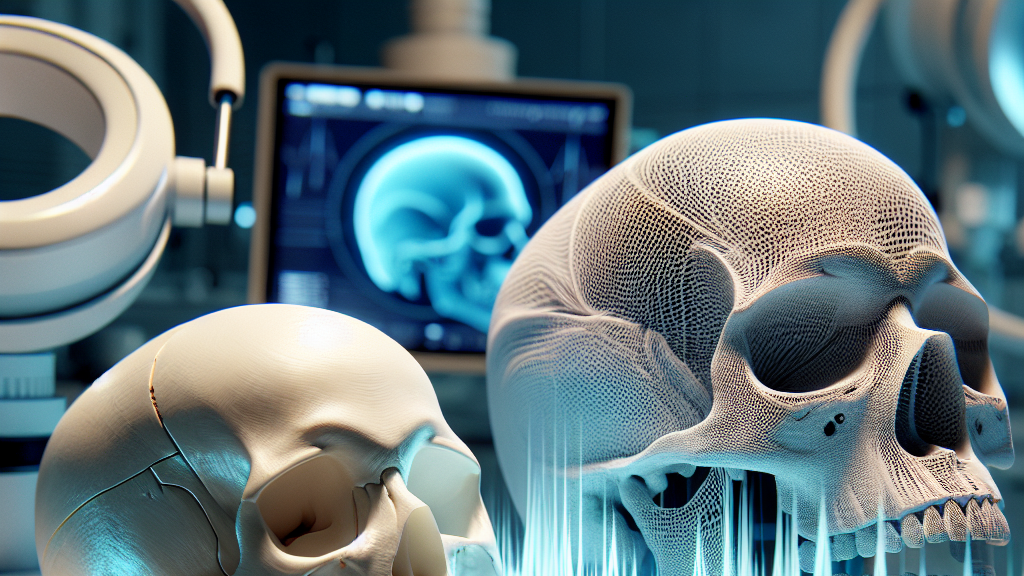
Ever wondered how scientists can peek inside our heads without cracking them open? Researchers are using 3D printing to make models of skulls that mimic human bone. This groundbreaking approach could transform medical imaging for our brains.
The challenge has always been that sound waves used in photoacoustic imaging get distorted and weakened when they pass through the skull’s dense bone. To tackle this, scientists have started 3D-printing skull replicas that mimic human bone structure. This allows them to experiment and understand how these sound waves behave, improving the accuracy of brain imaging techniques.
Imagine a future where diagnosing and treating brain conditions like tumors or strokes could be done with the precision of a laser pointer. Thanks to this innovative research, doctors might soon have clearer ‘maps’ of our brains to work with, making surgeries safer and treatments more effective.
Did you know that 3D-printed skulls can mimic human bone so accurately that scientists are using them to improve brain imaging?
FAQs
What are photoacoustic waves in skull imaging?
Photoacoustic waves are sound waves created by using light (like a laser) that are used in imaging to see inside our bodies. In skull imaging, they often get distorted, making it hard to get clear pictures.
How does 3D printing help with brain imaging?
3D printing allows scientists to create accurate models of the human skull, helping them study how sound waves travel through skull bone. This can help improve the quality and accuracy of brain imaging techniques.
Why is improving brain imaging important?
Better brain imaging can lead to more accurate diagnoses and effective treatments for brain conditions like tumors, strokes, and injuries, potentially saving lives and improving outcomes for many patients.
Are 3D-printed skulls used in real medical scenarios?
Currently, they are primarily used for research, but as the technology improves, they could be used for planning surgeries or other medical procedures in the future.
What makes 3D-printed skulls special?
They can mimic the density and structure of real human bone, providing a realistic model for studying how different imaging techniques work, especially when bones cause distortions.
Background
Photoacoustic imaging combines light and sound to create images of the inside of our bodies. When light hits tissue, it generates sound waves that can be detected and turned into images. However, dense structures like the skull can distort these waves, complicating imaging accuracy. By creating skull models with 3D printing that closely resemble human skulls, researchers can better understand and mitigate these challenges.
History
For years, scientists have been striving to improve medical imaging techniques to provide clearer pictures of the brain. Traditional imaging methods like X-rays or MRIs sometimes fall short when it comes to visualizing intricate details without distortion. Recent advancements in photoacoustic technology have shown promise, especially if researchers can address the challenges posed by the skull’s complex structure. This study marries new 3D printing tactics with long-standing imaging challenges, aiming to refine and enhance the field.
Based on “3D printed human skull phantoms for transcranial photoacoustic imaging” by Hannah Linde, Saskia Menzer, Jan Laufer, Thomas Kirchner, available on arXiv (arxiv.org/abs/2502.10910), used under CC BY 4.0 (creativecommons.org/licenses/by/4.0/).