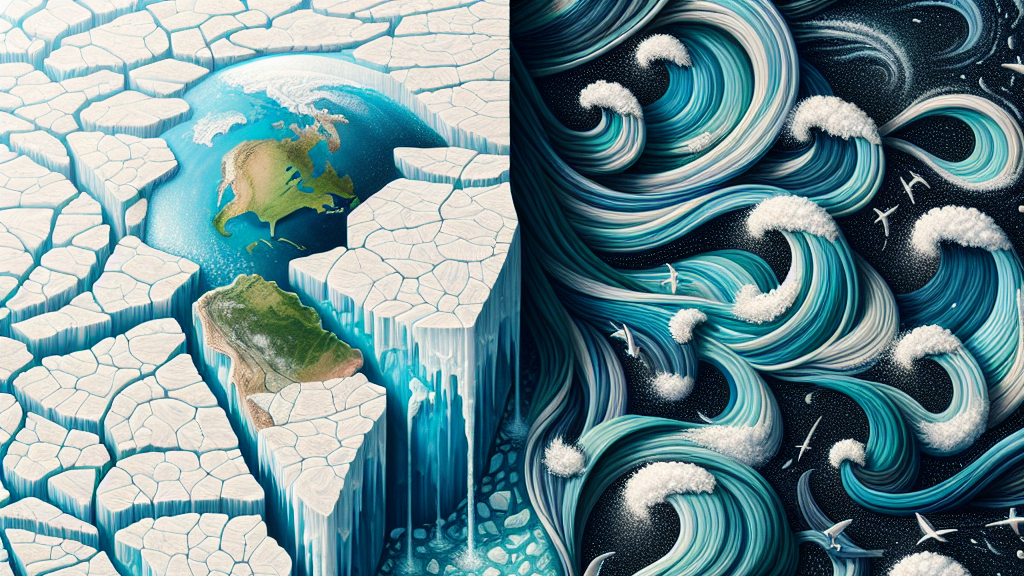
Picture this: massive ice sheets in Greenland and Antarctica melting rapidly due to global warming. The common fear is that this could spell disaster for our climate, leading to drastic changes in ocean currents that could disrupt weather patterns we rely on for our daily lives. But what if there was a surprising twist to this story?
Scientists have been using a nifty tool called the Earth System Model to simulate different scenarios of ice melting. They’ve discovered that, while Greenland’s melting ice can threaten to destabilize important ocean currents, the meltwater from Antarctica might actually help protect these currents. Imagine it as a balancing act—while one side loses ground, the other side steps up to stabilize the situation.
This finding opens up a new way of thinking about climate solutions. If Antarctic meltwater can prevent the collapse of crucial ocean currents, it could offer a lifeline as we tackle climate change. Imagine a future where understanding these dynamic relationships helps us avoid a climate catastrophe, ensuring stable weather patterns and healthy oceans for generations to come.
Did you know Antarctic ice melt might actually stabilize ocean currents that are crucial for our climate?
FAQs
How does Antarctic ice melting potentially stabilize ocean currents?
The meltwater from Antarctic ice can mix with the ocean and influence the movement and strength of ocean currents. This effect can counter the destabilizing impact of Greenland’s melting ice, aiding in the recovery of key ocean currents.
Why are ocean currents important for the climate?
Ocean currents play a key role in regulating the global climate by distributing heat across the planet. Disruptions to these currents can lead to extreme weather patterns and affect ecosystems worldwide.
Is it possible to prevent catastrophic climate tipping points?
Research suggests that strategic actions, such as understanding and leveraging natural processes like Antarctic ice melt, may help prevent some catastrophic tipping points, but comprehensive global efforts to reduce greenhouse gas emissions are still crucial.
What are ‘tipping points’ in climate science?
Tipping points refer to thresholds in the climate system that, once crossed, can lead to significant and potentially irreversible changes. They are critical junctures where minor changes can have large impacts.
How does this research affect our understanding of climate change?
It highlights the complex interactions within our climate system and suggests that some natural processes might contribute to climate stability, offering new insights into how we can address climate change more effectively.
Background
The Atlantic Meridional Overturning Circulation (AMOC) is a key ocean current that helps regulate climate by distributing heat between the equator and the poles. It’s like a giant conveyor belt moving warm water from south to north and cool water back down. Ice sheets, particularly in Greenland and Antarctica, can release meltwater into the ocean, impacting this circulation. When ice melts, it adds fresh water to the ocean surface, which can affect the density-driven flows that power the AMOC. If the AMOC weakens too much, it could alter global weather patterns and affect ecosystems.
History
For years, scientists have studied how ice sheets and ocean currents interact, fearing that Greenland’s melting ice could weaken the AMOC and lead to widespread climate disruptions. However, this research explores a new angle by considering how Antarctic meltwater might stabilize the AMOC. Historically, studies mostly focused on the catastrophic potential of an AMOC collapse, but this research suggests a possible stabilizing role of Antarctic meltwater, offering a fresh perspective on how interconnected systems can sometimes buffer against extreme changes.
Based on “West Antarctic Meltwater can Prevent an AMOC Collapse” by Sacha Sinet, Anna S. von der Heydt, Henk A. Dijkstra, available on arXiv (arxiv.org/abs/2502.17104), used under CC BY 4.0 (creativecommons.org/licenses/by/4.0/).