Connect with us

Search by keyword

Physics

Can Wavefunctions Explain Everything?

Imagine if every tiny blip in your phone or computer was due to a predictable ‘wave’ rather than a random ‘dot.’ By understanding wavefunctions, we might finally unlock the mysteries of the atomic world, paving the way for groundbreaking tech and more reliable gadgets.

Can Wavefunctions Explain Everything
✨Researched by humans. Explained by robots. Learn more.

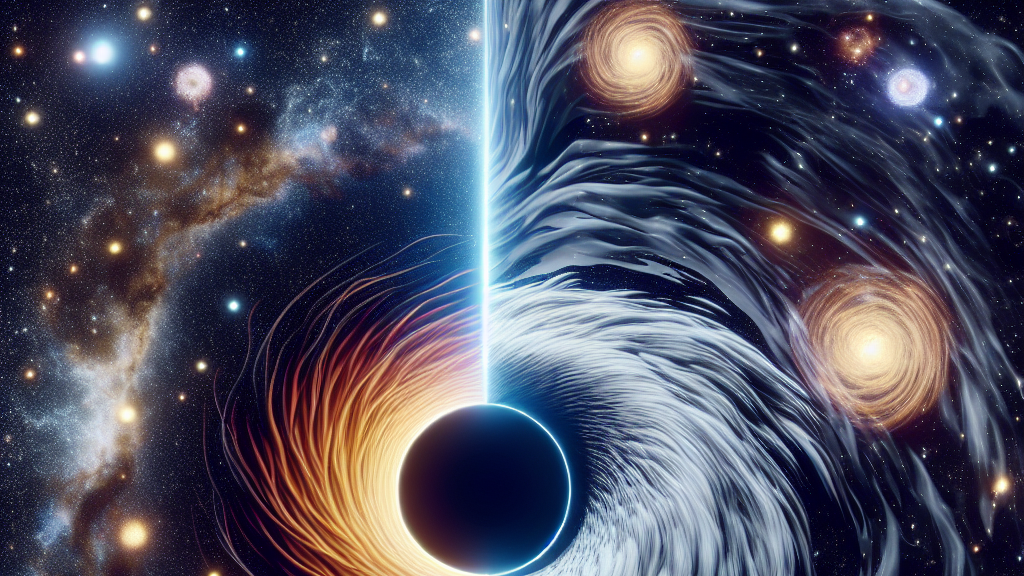
What if the universe is more like a gentle ripple on a pond rather than a chaotic storm of tiny particles? This new wave-based perspective could change everything we thought we knew about the atomic world. Instead of random particles appearing and disappearing, imagine them as graceful waves tracing elegant paths—suddenly, the universe feels a bit more predictable and harmonious.

The big idea is that the bustle of atomic life—tiny blips in detectors and random particle appearances—could be entirely explained by wavefunction models. These models draw on Schrodinger’s original idea, suggesting that the quantum world operates more like a continuous wave. Even when things seem random, like where a detector ‘clicks,’ it could just be chaos—a sensitive dependence on initial conditions—rather than true randomness.

Picture a future where, by understanding these wave functions better, our technology becomes smarter and more dependable. Take your smartphone, for example—what if signal drops or glitches were minimized because we grasped how quantum waves work? This kind of leap could redefine the reliability and efficiency of devices in profound ways.

The famous ‘dots on a screen’ in quantum experiments might actually be explained by wave chaos, not randomness.

FAQs

What does the wavefunction really explain about atomic phenomena?

The wavefunction provides a framework for understanding atomic phenomena by treating them as waves instead of particles, potentially offering a complete and coherent description of how atomic events occur.

How does chaos theory play a role in quantum mechanics?

Chaos theory suggests that what seems random, like where a detector clicks, may actually arise from small differences in initial conditions, meaning there is an underlying order we may be able to understand.

Is it possible that quantum events aren’t truly random?

Yes, with wavefunction models, it’s proposed that quantum events are the result of predictable wave patterns, with apparent randomness stemming from chaos, not true unpredictability.

How could understanding wavefunctions affect technology?

If technology can harness these wave patterns, we could see more reliable electronic devices with fewer glitches and improved efficiency by accurately predicting atomic behavior.

Why revisit Schrodinger’s ideas now?

Advancements in modeling and simulations offer us a fresh perspective to explore his ideas, potentially leading to a deeper understanding of the quantum realm and practical applications.

Background

A wavefunction is a mathematical description of the quantum state of a system, often used in quantum mechanics to describe the behavior of particles at the atomic and subatomic levels. Schrodinger’s famous wave equation describes how these wavefunctions evolve over time. In quantum mechanics, the challenge has always been explaining how these waves translate into particle-like behavior, like clicks on detectors or dots on screens.

History

The journey of quantum mechanics started in the early 20th century when scientists began exploring the strange behaviors of particles on an atomic scale. Erwin Schrodinger, one of the pioneers, initially proposed that particles could be explained as waveforms. Although this idea was ground-breaking, it faced skepticism due to the unpredictable nature of quantum events, often interpreted as inherently random. Schrodinger’s wave theory was overshadowed by the probabilistic approach introduced by Max Born, but recent efforts to revisit wavefunctions suggest they may still have a vital role in explaining quantum phenomena more holistically.

Based on “That Dot on the Screen: also, what about Born? and other objections to wavefunction physics” by W. David Wick, available on arXiv (arxiv.org/abs/2504.17808), used under CC BY 4.0 (creativecommons.org/licenses/by/4.0/).


Trending

Latest

Can AI Save Water Discover How

Computers

AI is transforming the tech world, but it uses lots of water! A new tool, SCARF, helps us measure and reduce AI's water footprint,...

Whats a Forbush Decrease and Why Should We Care Whats a Forbush Decrease and Why Should We Care

Space

Scientists just observed the biggest solar storm event in years, revealing unexpected cosmic ray patterns. Understanding these changes could help us protect our technology...

Can Cars Spot Danger Faster Than Humans Can Cars Spot Danger Faster Than Humans

Computers

Think about how quickly you react when something unexpected happens on the road. This research brings us closer to creating self-driving cars that can...

Can Fear of the Other Stop Social Harmony Can Fear of the Other Stop Social Harmony

Physics

Fear of the unknown might make it harder for people to agree and get along. This study shows that when people have strong xenophobic...

Can AI Revolutionize Breast Cancer Diagnosis Can AI Revolutionize Breast Cancer Diagnosis

Electricity

This research introduces a groundbreaking AI model that can accurately assess HER2-positive breast cancer using widely accessible staining methods, potentially revolutionizing how we diagnose...

Can AI Transform Your Singing into a Choir Can AI Transform Your Singing into a Choir

Computers

Imagine singing solo and having AI turn you into a choir. This research unveils a groundbreaking AI tool that transforms your voice into rich...

You May Also Like

Materials

New insights suggest quantum mechanics might influence macroscopic decisions, giving a fresh perspective on how reality is formed during big events.

General Relativity and Quantum Cosmology

Imagine using a tabletop setup to mimic the intense gravitational effects of a black hole! These 'gravity simulators' are pushing the boundaries of what...

General Relativity and Quantum Cosmology

Scientists are bringing the mysteries of black holes into the lab by creating small-scale experiments that simulate their incredible gravitational forces. This means we...

Physics

Ever wondered where the universe decides to play by completely different rules? This research suggests the boundary between classical and quantum physics might not...

Physics

Scientists have found a way to use light to make a material, that normally behaves one way, act like it’s breaking the laws of...

General Relativity and Quantum Cosmology

Ever wondered what happens to information once it falls into a black hole? This thrilling research delves into the discrepancies of quantum theories and...

General Relativity and Quantum Cosmology

Did you know black holes might actually be cosmic time machines? This research reveals two new ways of looking at black holes, hinting they...

Physics

Scientists are diving into the world of particles, using quantum entanglement to possibly unlock secrets of the universe! Imagine if understanding tiny particles can...

Math

This research shows that if a certain simple pattern exists in a quantum spin chain, it ensures the entire system behaves predictably. This could...

Copyright © 2024 8ig8rain.

Disclaimer: The content on 8ig8rain.com consists of AI-generated summaries of scientific abstracts from arXiv. Please note that most arXiv abstracts are preprints and may not have undergone formal peer review. While these summaries aim to convey key ideas and potential applications, they are provided for informational purposes only and should not be interpreted as validated scientific findings or professional advice. The summaries are intended to educate, spark curiosity, and inspire further exploration of science.