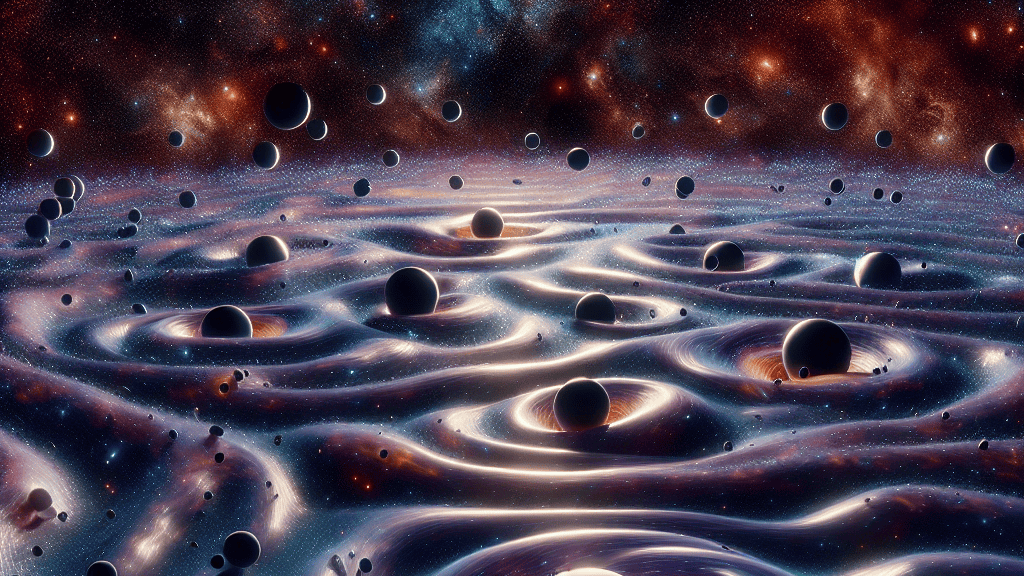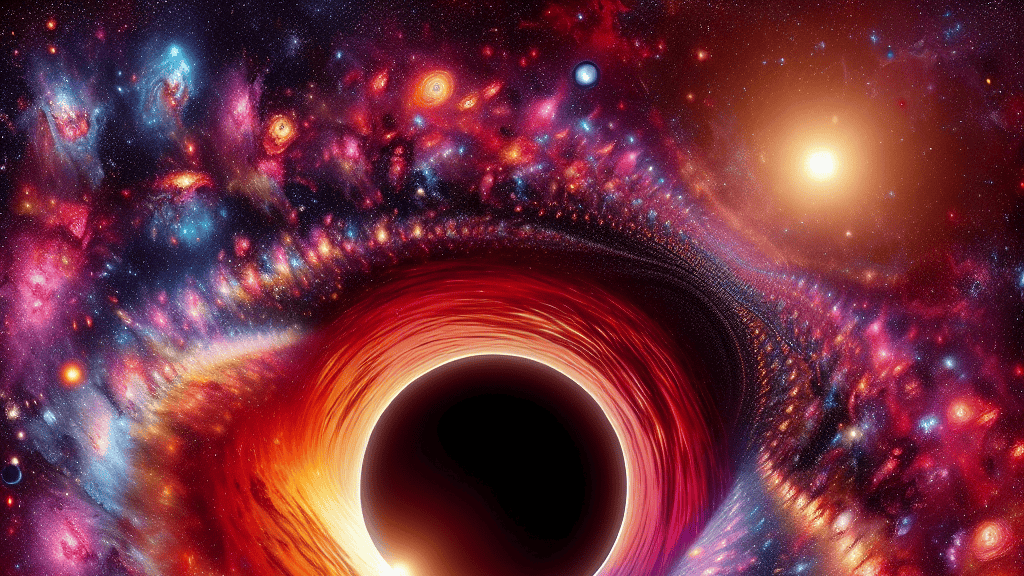
Ever wondered if there could be tiny, hidden universes sprinkled throughout our own cosmos? Recent research dives into this tantalizing idea, suggesting that baby universes might be forming inside black holes! These aren’t just sci-fi fantasies but could be real outcomes of cosmic processes that happened eons ago, right after the universe was born.
This study explores what happens when certain cosmic events, known as first-order electroweak phase transitions, get delayed. This delay could lead to the creation of ‘false vacuum’ areas with lots of energy. Picture these areas as the starting point for forming black holes—specifically, a type known as primordial black holes. Using complex math and simulations, scientists showed that these formations are not just theorized, but could indeed be lurking in the universe we see today.
Imagine someday being able to explore these baby universes, each with its unique physical laws! While this might sound like science fiction, the research updates the parameters for future experiments and observations, so we’re getting closer to understanding whether these cosmic phenomena are possible and how they might alter our comprehension of space and time.
Did you know that some black holes might actually be gateways to new universes? These cosmic giants could harbor what scientists call ‘baby universes’—a fascinating twist in our understanding of the cosmos.
FAQs
What unexpected discovery did scientists make?
Scientists found that delayed cosmic events might lead to the formation of baby universes inside black holes.
How do these ‘baby universes’ form?
They could emerge from areas of high energy left over from cosmic transitions, which then form primordial black holes.
Why are these baby universes important?
They could expand our understanding of cosmic structures and even offer insights into new physics beyond our current comprehension.
What does this mean for future space exploration?
This discovery could change how we search for evidence of other universes and challenge our views of the cosmos.
What are primordial black holes?
Primordial black holes are a type of black hole thought to form soon after the universe’s birth, potentially as sites for new universe creation.
Background
In the universe’s infancy, particles and forces underwent massive changes called electroweak phase transitions. If this process delays, sections of space might not fully transition, leaving behind high-energy ‘false vacuum’ zones. These areas could theoretically collapse into primordial black holes. The thin-wall approximation helps simplify the view of these vacuum zones as thin bubbles that might encase these baby universes.
History
The concept of primordial black holes originated in the 1970s as theoretical objects formed from density fluctuations in the early universe. Over time, the idea evolved, leading to today’s exploration of their role in cosmic structure formation and as sites where new universes might flourish. This study represents a sophisticated numerical approach to understanding how these cosmic structures might form and fit into broader theories of the universe.
Based on “Super-critical primordial black hole formation via delayed first-order electroweak phase transition” by Katsuya Hashino, Shinya Kanemura, Tomo Takahashi, Masanori Tanaka, Chul-Moon Yoo, available on arXiv (arxiv.org/abs/2501.11040), used under CC BY 4.0 (creativecommons.org/licenses/by/4.0/).