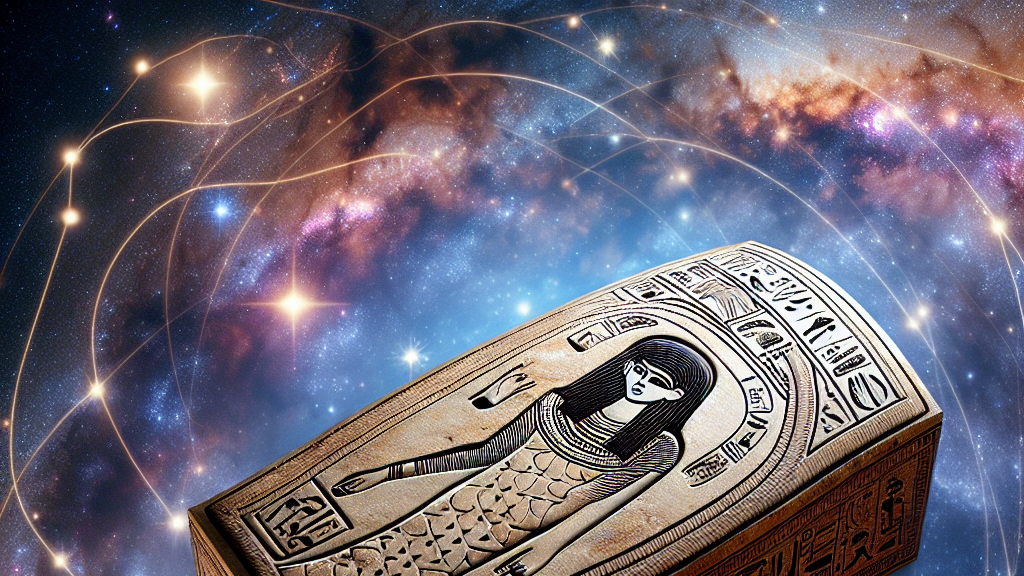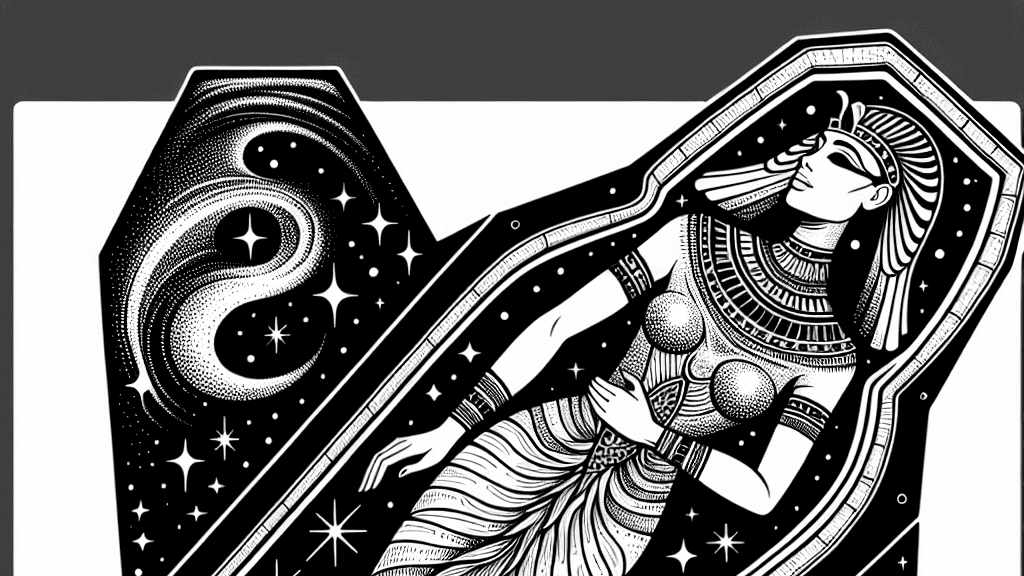
Have you ever wondered how ancient civilizations viewed the night sky? The ancient Egyptians, known for their intricate mythology and art, might have associated their sky goddess Nut with the Milky Way. This celestial connection isn’t just a fascinating peek into their cosmological beliefs, but also into how they visually represented the universe around them on their stunning artifacts, like coffins and tombs.
In a recent study, researchers analyzed over 500 coffin elements and discovered that some depicted Nut with an undulating black curve across her body, reminiscent of a cosmic rift in the Milky Way. This unique feature is rare but meaningful. It suggests a visual representation of the Milky Way, indicating that while Nut and this galaxy were linked in the Egyptians’ eyes, they were not one and the same. It’s like seeing the galaxy as one of her many celestial accessories, alongside stars and the sun.
Imagine finding this cosmic connection inside a beautifully adorned coffin. While not every depiction of Nut included stars, those that did highlight the Egyptians’ preference for showcasing the goddess’ link to the daytime sky. This finding is not just about stars and galaxies; it’s also about understanding the eschatological role of Nut as a protector and embodiment of the coffin itself. Future discoveries might further illuminate how these symbols and beliefs evolved over centuries, from the New Kingdom to the Roman Period, leaving us even more in awe of this ancient culture.
Did you know that some Native American cultures also saw the Milky Way as a symbolic, winding celestial feature?
FAQs
How did ancient Egyptians represent the Milky Way on coffins?
Ancient Egyptians sometimes depicted the Milky Way on coffins using an undulating black curve across the body of the sky goddess Nut, which resembles the Great Rift in the Milky Way.
What did the sky goddess Nut symbolize in ancient Egyptian culture?
Nut was the embodiment of the sky in ancient Egyptian culture, associated with celestial phenomena like the Sun, stars, and possibly the Milky Way, symbolizing protection and eschatological beliefs.
Was Nut always depicted with stars in the ancient Egyptian cosmological vignettes?
No, Nut was depicted with stars in only a quarter of the analyzed cosmological vignettes, suggesting a preference by Egyptians for representing her connection to the daytime sky over the night sky.
Why is the depiction of Nut with the Milky Way considered rare in ancient Egypt?
The depiction of Nut with the Milky Way is rare because it was only identified in a small number of cases, like tombs of certain Pharaohs, highlighting a unique yet uncommon artistic choice.
What are the implications of linking Nut to the Milky Way for our understanding of ancient Egyptian beliefs?
Linking Nut to the Milky Way reveals insights into the Egyptian understanding of the cosmos, showing how they might have woven celestial phenomena into their mythology, art, and burial practices.
Background
In ancient Egyptian mythology, Nut was a key goddess representing the sky, symbolizing protection and cosmic order. The Egyptians believed that she swallowed the Sun every night, only to birth it again each morning. The Milky Way, our galaxy, was seen as an impressive celestial river or path across the night sky. The study’s focus on the visual depictions of Nut in coffin art explores whether this galaxy was metaphorically connected to her.
History
The association between the goddess Nut and cosmic phenomena has been a topic of interest for Egyptologists. Prior studies have examined Nut’s depictions in various forms of art and architecture, but recent findings highlight the possibility of connecting her role to the Milky Way. This study builds on previous work by adding new dimensions to our understanding of ancient Egyptian cosmology and its expression through art, drawing parallels with other cultures that also personified celestial features.
Based on “The Ancient Egyptian Cosmological Vignette: First Visual Evidence of the Milky Way and Trends in Coffin Depictions of the Sky Goddess Nut” by Or Graur, available on arXiv (arxiv.org/abs/2409.10265), used under CC BY 4.0 (creativecommons.org/licenses/by/4.0/).